
PASCACK VALLEY—“The inhabitants of Park Ridge and Woodcliff are becoming alarmed at the numerous burglaries that have been perpetuated in the two villages within the last two weeks,” the New York Tribune began on Jan. 18, 1896.
Last week you learned about Mrs. Buerk of Etna, who in January of 1896 vigorously wielded her hickory club in defense of her property. Staying in the same time period, now we head a few miles north. It’s too bad Mrs. Buerk wasn’t loaning out her services, because the people of Hillsdale, Woodcliff, and Park Ridge could have used them.
We go back 130 years, when our area was in the midst of a disturbing crime wave. Had a police blotter run in the Pascack Valley 130 years ago, it would have looked something like this at the beginning of 1896:
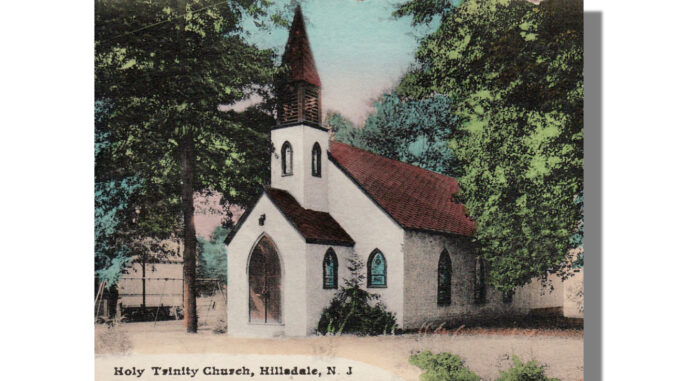
- Jan. 4, 1896 – Thieves broke into the Episcopal Church in Hillsdale and carried away some candles and several packages belonging to the Sunday School. They also broke the front windows and took the key of the rear door.
- Jan. 11, 1896 – The summer home of Dr. Petrie was entered by thieves. A quantity of half-burned matches were found scattered all over the floor of his house.
- Jan. 12, 1896 – The railroad stations in Woodcliff and Hillsdale Manor were entered by burglars. Some express packages were broken open and their contents stolen.
- Jan. 14, 1896 – The beautiful summer cottage belonging to J.H. Malloy, at Woodcliff, was destroyed by a fire in an apparent act of arson. Charles Schoppa, a neighbor, who was watching over the place while its owner was in New York for the season, was awakened about 1 a.m. by a crackling noise. When he ran outside, he found the Malloy place engulfed in flames and beyond the point of saving. The loss is estimated at $4,000. (This house was several doors down from Dr. Petrie’s place, where the burnt matches were found on the floor three days earlier.)
- Jan. 15, 1896 – Burglars have struck in Park Ridge. They broke into the home of the O’Brien family on Local Street (a small street off Morningside Avenue near Rivervale Road) and stole numerous items. They also visited the unoccupied typewriter ribbon factory of Mittag & Volger on Lawn Street and they took tools and packages.
- Jan. 16, 1896 – Thieves broke into the henhouse of John Lockwood in Park Ridge and stole 17 hens. They decapitated the fowls, leaving the heads behind in the coop. After discovering this grisly scene in the henhouse the following morning, Mr. Lockwood attempted to track the thieves by the blood trail left in the snow, but the path was lost in the area of the Park Ridge station.
- Jan. 21, 1896 – Thieves visited the houses of ex-Freeholder Garret T. Haring on Rivervale Road in River Vale and Col. J.R. Eckerson, of Old Tappan. At these two places they were not successful, having been met with a ball from Haring’s revolver, and an attack in the rear from a faithful watchdog of Col. Eckerson’s.
- Jan. 22, 1896 – The Park Ridge home of Jacob Beerman, a cigar manufacturer, was visited by burglars while he was away attending the funeral of his brother. The thieves entered his house and stole 1,500 cigars.
Things calmed down in the Pascack Valley after this. Perhaps all of the media attention caused the burglars to move on to another area. It never was discovered who had committed all of these crimes.