
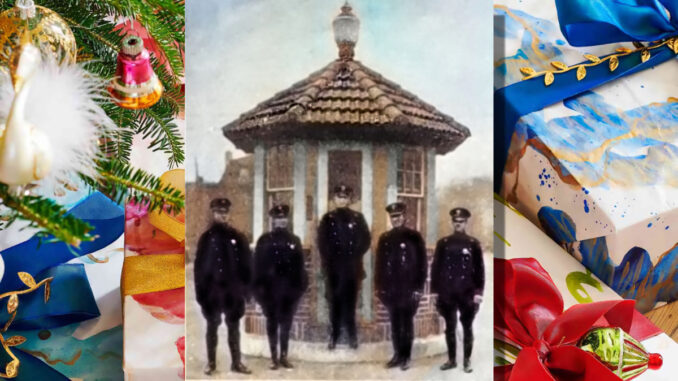
Hillsdale’s iconic police booth — the first police headquarters in the borough — was a Christmas gift from the Board of Trade, an organization of local businessmen, in 1925.
A century-old news report describes a beautiful scene in downtown Hillsdale on that Christmas Eve: “The Hillsdale center glowed with electric illumination. A huge Christmas tree in the park was bedecked from bottom branch to top-most peak with colored lights and on the very tip-top a huge circle of lights gave a final brilliant touch.”
A large crowd gathered that evening to see the dedication of the booth and sing Christmas carols in the park.
“The new police booth beamed with a most becoming and suitable light on its peak,” the report continued. “It is a beautiful ornament to the town, artistically made of tapestry bricks and glass, with tiled roof, and is a splendid testimonial of the public-spiritedness of the Board of Trade.”
The small structure marked a huge step forward for Hillsdale’s early police force.
Before the booth existed, police officers used an open-air telephone mounted on a pole at the corner of Park Avenue and Broadway.
One Hillsdale resident, a Mr. Beck, donated a beach umbrella that was placed next to the telephone so that officers could use it without being exposed to the weather.
Commissioned by the Board of Trade, Hillsdale building contractor and bricklayer John H. Olley constructed the booth. For the next 65 years, it stood in the center of Hillsdale Avenue near Broadway — a relic of an era with drastically fewer cars on the road.
The first traffic light in Hillsdale was installed at this same intersection in 1926. An officer sitting inside the booth operated the signal manually. This was an improvement over the former system, which involved an officer standing in the intersection with a stop-and-go sign.
When the sole policeman on duty was needed for an emergency, he would switch the traffic light to automatic. Nearby shopkeepers would help answer the police telephone during those times when the officer was away.
The 1920s brought major milestones in Hillsdale police work, even beyond the addition of the first police telephone in 1924, the building of the police booth in 1925, and the first traffic light coming to town in 1926. For example, in 1926 the police department bought its first patrol car, a Chevrolet Roadster.
Then, in 1928, a borough ordinance established the police department as an official municipal entity and named the first chief.
The booth served as headquarters for the Hillsdale Police Department until 1931, when a new station was created inside the Hillsdale Borough Hall. Still, the booth remained in place for decades after that. Some people reading this might remember when it was damaged severely in 1985 after a car crashed into it.
John J. Olley — the son of the man who built the police booth in 1925 — repaired the damage.
Around 1990, the police booth was moved out of the road and placed on the sidewalk area next to Veterans Park. The local landmark stands as a testament to a simpler time and the public spirit that helped shape the Borough of Hillsdale.