
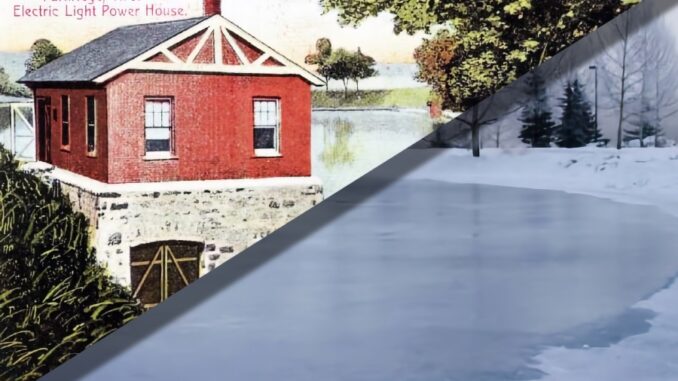
PARK RIDGE—Generations of people who grew up in Park Ridge spent winter days skating on Mill Pond. A future Olympian once skated there, too.
This week we go back a century, to the first week of February 1926, when Park Ridge’s ice carnival brought thousands of spectators to Mill Pond—then referred to as Electric Light Pond.
On Sunday, Feb. 7, 1926, more than 2,500 people gathered around the pond for an ice show that included races and spectacular exhibitions by well-known skaters famous for their speed or tricks. It was a large crowd for the time, nearly matching Park Ridge’s population. Organizers called it the biggest event of its kind ever held in Bergen County.
“Automobiles lined one side of Mill Road the entire length of the lake,” wrote the Park Ridge Local newspaper.
Can you picture the pond surrounded by all those Model T Fords and Chrysler Sixes?
The ice carnival was organized by American Legion Post 153, formed seven years earlier by veterans of World War I.
A similar event was attempted in 1925, but a last-minute thaw melted the ice. The veterans rolled the dice again in 1926—and ran into the opposite problem. Just before the big day, a deep snow fell on the Pascack Valley and covered the pond. The men cleared a one-eighth-mile circuit, banking the snow toward the interior, and found the ice underneath in good skating condition. The show could go on.
This was no small-town social. The meet was sanctioned by the Middle Atlantic Skating Association and drew top competitors from the Tri-State Area.
Prominent skating clubs from New Jersey and New York sent delegations. Highly trained skaters came from sports clubs in Paterson and Englewood, the Van Cortlandt Park Skating Club, the Women’s Skating Club of Brooklyn, the 181st Street Ice Palace in Washington Heights, and the New York Skating Club, among others.
“When they appeared on the ice in their close-fitting sport outfits of blue, red, yellow, green, purple, black, and combinations of them, they represented a prospect such as many of the onlookers had never seen before,” wrote the Park Ridge Local, adding, “There were girls among the skaters, and they attracted unusual attention.”
The races drew a field of 163 skaters competing for bronze, silver and gold medals in 11 categories. Events for men, women, high school athletes and children—and for both experienced skaters and beginners—made it possible for almost anyone to participate.
Spectators were amazed by 8-year-old Hazel Gants of Hastings-on-Hudson, who took gold in the 440-yard ladies’ novice. Skating against a group of girls twice her age, Hazel led from the start and finished first with many yards to spare. She was lifted onto a table when her medal was awarded so the crowd could get a look at the petite phenom. Hazel later became the New York State, Metropolitan and Westchester champion in girls’ amateur speed skating—titles she held for years.
Our local girls could hold their heads high after losing to such an opponent, though they probably didn’t realize it at the time. Second place went to 15-year-old Freda Claus of Park Ridge, and third to 14-year-old Louise Strokirk of Hillsdale.
Another star of the day was 19-year-old speed skater Irving Jaffee of the Van Cortlandt club, who won three gold medals: the 880-yard men’s handicap, the 1-mile men’s handicap and the 5-mile championship. Newspapers reported that Jaffee would conserve his energy until the final stretch—then fly across the finish line with a burst of speed.
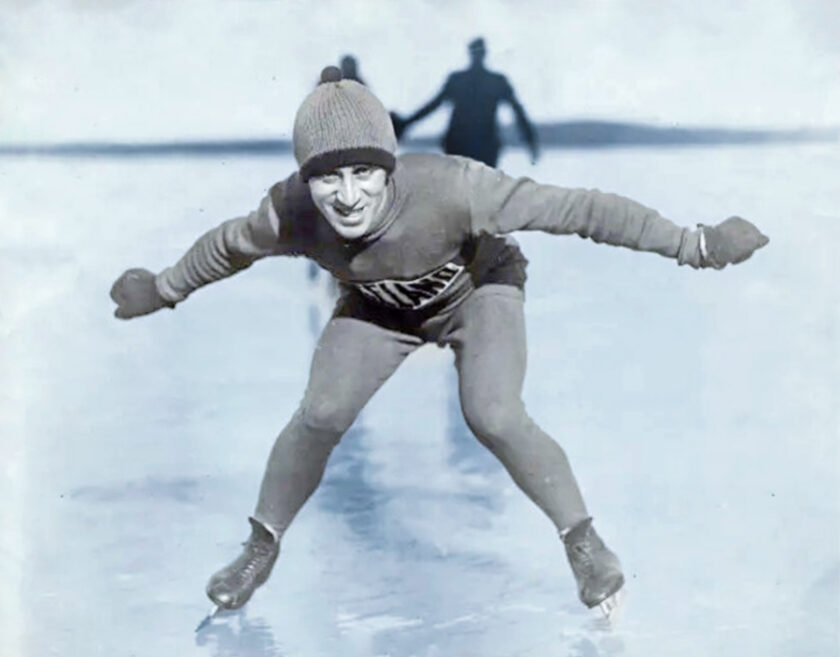
That strategy helped propel him to national stardom. Jaffee went on to win two gold medals at the 1932 Winter Olympics in Lake Placid—one in the 5,000-meter and the other in the 10,000-meter. Media outlets described the latter as one of the most sensational finishes ever seen in an Olympic meet.
As the New York Daily News put it on Feb. 9, 1932: “Neither the natural limitations of the human frame, nor the might of the heavens themselves could check the speed of this human hurricane from the Bronx in this afternoon’s fiercely fought battle on blades.
Back in the ruck, with 500 yards to go and six of the world’s fleetest skaters ahead of him, [Jaffee] plunged his way from behind up the snow-whipped track, slowly forged past his rivals from Canada and Norway, and lunged across the finish line.”
One of America’s early Winter Olympics champions, Jaffee was inducted into the U.S. Skating Hall of Fame in 1940. And the people of the Pascack Valley could boast they saw him when he was just some kid from New York.