
CLOSTER—For nearly three decades, the Village School stood quiet — a landmark with a venerable past and an uncertain future, its windows looking out over a town that had grown up around it.
On Jan. 21, Closter decided the building’s story was far from over.
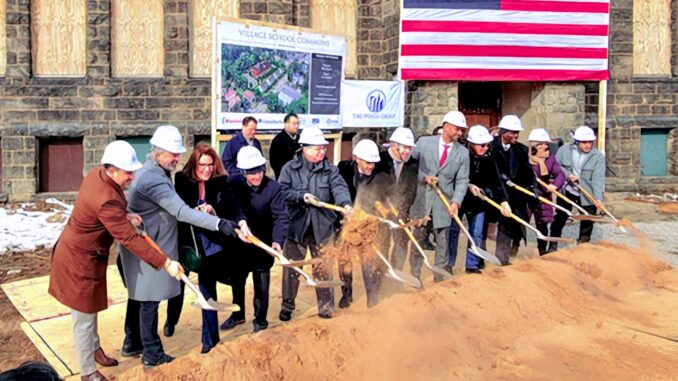
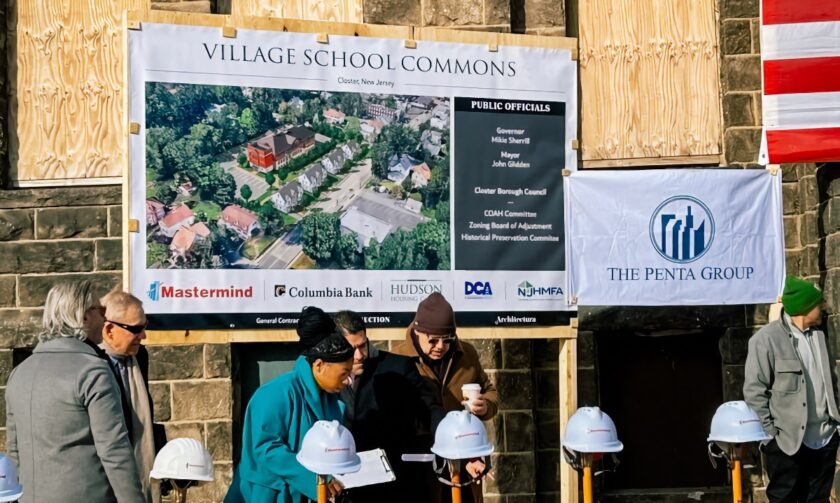
With a groundbreaking ceremony led by Mayor John Glidden, borough officials and development partners launched Village School Commons, a 35-unit, income-restricted housing community at 511 Durie Ave. that will transform the long-vacant former public school into homes for working families — while preserving one of Closter’s most recognizable historic buildings.
It is a milestone in the borough’s court-approved housing plan. But it is also something more personal: a decision to carry forward a structure that has helped define Closter for more than a century.
“Village School Commons allows us to meet our affordable housing obligations while protecting a site that holds deep significance for our residents,” Glidden said. “This partnership ensures that the Village School remains a part of Closter’s future.”
A building that grew with the town
As local historian Kristin Beuscher notes in her “Back in Time” column in this issue, the story of the Village School mirrors the story of Closter itself.
At the turn of the 20th century, the arrival of the railroad had begun transforming the area from a rural settlement into a commuter suburb. The population surged, and by the late 1890s the small four-room school at Durie and Demarest avenues could no longer meet demand.
Voters approved the purchase of the Bloomer property at Durie Avenue and High Street, and a new public school opened there in 1900 — before Closter was even incorporated as a borough in 1904.
Architect William J. Martin, a member of the Closter Historic Preservation Commission and the Bergen County Historic Preservation Advisory Board — and a former student at the school (1975–1977) — told is this was “a great day for Closter” and that the building made a statement from the start.
The original structure was a “proud two-story” school in Beaux Arts design with Renaissance and Colonial Revival influences, featuring a rusticated stone base, brick upper stories, a hip roof, and a copper-topped belvedere, Martin told Northern Valley Press on Jan. 27. Even the bell from the earlier school was brought forward, symbolizing continuity.
As the town grew, the school grew with it. Additions in 1907, 1912, and 1921–22 expanded classrooms, administrative space and a gymnasium, Martin said, reflecting both population growth and evolving educational standards.
By 1929, with the opening of Tenakill Grammar School, the building transitioned into Closter’s Junior–Senior High School, serving grades 7–12 until 1955. After the creation of Northern Valley Regional High School in Demarest, the building returned to middle school use under the name Village School, serving students until it closed in 1996.
What happened next, Martin said, was “nearly three decades of uncertainty.”
A long search for the right future
Since the closure, the building has seen multiple redevelopment concepts come before the Zoning Board — age-restricted housing, inclusionary housing, affordable housing and mixed-use proposals among them.
Each idea reflected a familiar local tension: how to meet housing needs while preserving a building woven into the town’s identity.
For Martin, the Jan. 21 groundbreaking marked the moment “that balance had finally been achieved. … It felt like standing at the intersection of history, community identity and forward-looking sustainability.”
He added, “Historic buildings are vessels of memory. Preserving this one ensures Closter keeps a tangible link to its past while meeting present needs.”
Village School Commons will include 35 income-restricted rental homes, with a mix of one-, two-, and three-bedroom apartment and townhouse-style residences, affordable to households earning up to applicable Area Median Income thresholds.
The project is intended to serve working families and residents who might otherwise struggle to remain in Bergen County’s housing market. Plans call for modern building systems, accessible design, and durable materials.
“This represents more than a financing milestone; it represents a promise kept to the Closter community,” said Radame Perez, president of Mastermind Development, in a statement shared with us. “Village School Commons shows that affordable housing can be thoughtfully designed, financially responsible and deeply respectful of neighborhood character.”
Construction is projected to be completed by 2027.
Martin said the redevelopment also highlights a key environmental principle. “The most sustainable building is the one that already exists,” he said.
Reusing the Village School conserves embodied energy, reduces demolition waste and allows for energy-efficient upgrades. In Martin’s view, the project shows that historic preservation and environmental responsibility are not competing goals, but complementary ones.
By retaining the building’s architectural presence, he added, the redevelopment strengthens the character of the surrounding neighborhood and sets a precedent for future projects that respect Closter’s heritage.
A layered partnership
Financing for the project combines 4% Low-Income Housing Tax Credits, tax-exempt bond financing, construction lending and public subsidy, with support from the Borough of Closter and the New Jersey Housing and Mortgage Finance Agency. Tax credit equity is being syndicated through Hudson Housing Capital, with Columbia Bank participating.
The project is expected to create construction jobs along with several permanent and on-site positions.
For Closter, the symbolism runs deep. As Beuscher notes, the earlier 1871 schoolhouse was eventually converted into apartments — and still stands today at 483 Durie Ave.
More than a century later, the Village School is following a similar path.
“This redevelopment is more than a ceremonial moment,” Martin told us. “It is a commitment to honoring the past, serving present needs, and shaping a sustainable future. The Village School is being re-imagined, not erased — and Closter is stronger for it.”