
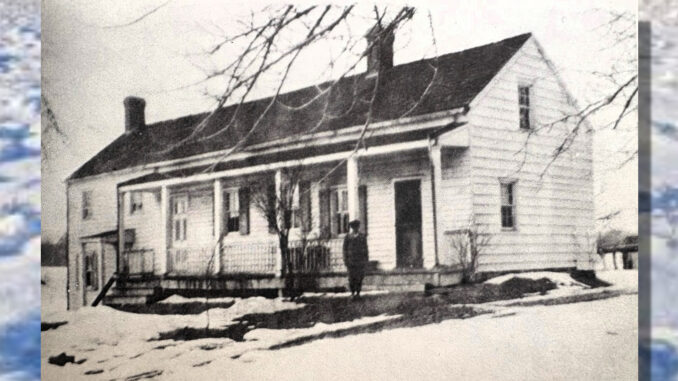
It was a snowy day on Piermont Avenue in Hillsdale, 1914, when this photograph was taken outside the Forshee-Blauvelt-Peterson House.
This farmhouse, which stood at Piermont Avenue and Meadow Road, was one of the oldest homes in the Pascack Valley. Having decayed over time and become structurally compromised, it was demolished in 2021. A modern home was constructed in its place.
The frame house went all the way back to the 1740s, which is when John Forshee (1706–1783) brought his family from Tarrytown, N.Y., and bought the land from the Blauvelts. When Forshee built his homestead, the surrounding fields and woodland included 146 acres. He was one of the original settlers in what is now Hillsdale.
Of course, Hillsdale did not exist in Forshee’s time. From 1710 through 1775, all of the towns now comprising the Pascack Valley were part of a massive township called New Barbadoes. This township took in a vast swath of Bergen County west of the Hackensack River. The man who named it had formerly lived in the English colony Barbados.
Forshee was already well into adulthood when he built the house on Piermont Avenue. He had married Catherine Waldron (born 1698 in Harlem) on May 18, 1728. The couple had five children: Petrus born in 1728, Barent born in 1730, Johannis born in 1733, William born in 1736, and a daughter, Jannetje, born in 1738.
The original farmhouse was smaller than the structure shown in the 1914 photograph. Sometime after its initial construction, the eastern end of the house was enlarged by one room. In the photograph, this is the section on the right, behind where the man stands.
The western end of the farmhouse, which is on the left side in our picture, was added during the 1850s. This addition contained a kitchen wing at the back. Even though this section was taller than the rest of the homestead, the contour of the land enabled the entire structure to have one continuous roofline.
Area historian Howard I. Durie wrote about the house in 1970, “The middle and earliest section of the house, with its sandstone foundation, hand hewn beams and wide floorboards, is probably the oldest extant frame building in Hillsdale.”
When Piermont Avenue was surveyed in 1775, Forshee had a total frontage of over 2,900 feet. The road itself was so named because it was the early route for farmers of the valley taking their produce to Piermont on the Hudson River, and then on to the New York City markets.
After John Forshee’s death, the house passed to his son, Petrus (Peter). He held on to the property for only a handful of years. On May 13, 1789, Cornelius Blauvelt bought the homestead and resided there for the remainder of his life.
Blauvelt, who died in 1807, bequeathed the family homestead to his daughter, Jannetje, wife of Andrew Peterson. Andrew, born in 1777, served as a private in the War of 1812. He survived his wife and was still living in the house in 1850. He left no recorded estate, and the farm passed to his two sons.
The homestead stayed in the Peterson family for generations until it was sold to James C. Haring, brother-in-law of Abraham W. Peterson, in 1891.
Some might recall that in the mid-20th century, the Schrier family lived in this house and operated a chicken and vegetable farm.
Leonard Schrier, a veteran of World War I, and his wife and two daughters moved to the farmhouse in 1940. The family operated a farmstand on the east side of the house, in the area now known as Meadow Drive. There they sold fresh eggs from their chickens and a variety of home-grown vegetables.
One daughter, Grace Schrier Wohn, volunteered for the Pascack Historical Society for many years. This author fondly recalls hearing her stories about growing up on the Hillsdale farm. She painted a beautiful picture of a bygone age, and we are fortunate that she wrote some of it down.
In a 2003 article for the Pascack Historical Society, Grace wrote, “Ours was just a little farm, located on Piermont Avenue beyond the present-day high school. As we looked out the back door, we could see chicken coops, wire chicken runs, the big old barn, pear and apple trees, vegetable and flower gardens, and cows grazing on the many acres of green pastureland, both ours and the land of our neighbors.””