
LOWER MANHATTAN—A haircut on Pell Street could earn five points. So could a foot massage. Other assignments called for finding Chinese characters, photographing incense or recording a video of friends trying a new food and speaking Chinese.
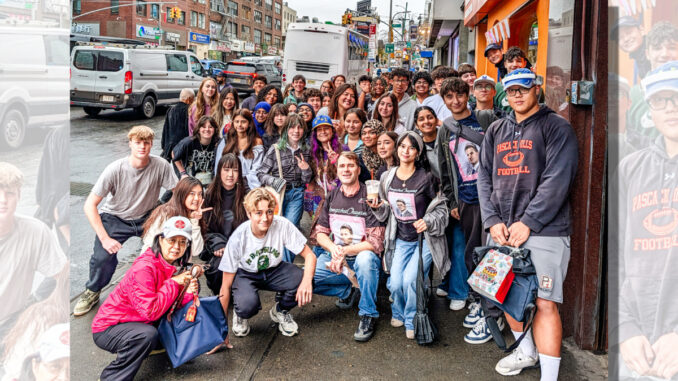
For 52 students from Pascack Hills and Pascack Valley high schools, a day in Manhattan’s Chinatown offered a different kind of language lesson: one that sent them into the neighborhood to explore.
The students, spanning grades 9–12 and representing the district’s six Chinese classes and the Asian Culture Club, filled a coach bus for the Oct. 16 trip, teacher Liam O’Neill said. Once there, younger students had a scavenger hunt to guide them, while upperclassmen had a culinary assignment: try three or four different cuisines and explore the variety available within Chinatown.
The idea, O’Neill said, was “to show the richness, the diversity of China” through slices of life savored close to home.
“It’s a lot to ask a teenager to engage a stranger on the street with a foreign language. But in a group and with a little guidance many of our students are able to do so. An important area in the city that is known to them but probably foreign suddenly becomes more familiar and accessible. This does wonders for their language acquisition,” he said.
Freshmen and sophomores worked in small groups with a list of roughly 20 to 25 challenges. Some asked them to recognize language or find cultural landmarks, such as a house of worship. Others encouraged them to try something unfamiliar.
Asked which restaurants or regional cuisines the older students tried, and whether a particular dish got a memorable reaction, O’Neill said, “In class, we’ll read about different regions and cuisines in China. Some are represented in Chinatown restaurants, such as spicy noodles, meat buns, or Beijing Duck. Of course, most students like Taiwanese bubble tea, too.”
The haircut and foot massage were among the more adventurous options. The larger purpose, O’Neill said, was to get students acquainted with the neighborhood.
The trip also fell on his birthday — an occasion spent with students in a program that aims to make a challenging language approachable.
Asked how he and teaching colleague Debbie Yao prepare students for these trips and build on the experience afterward, he said, “We’ll go to Chinatown at least once a year. Students master practical vocabulary ahead of time. Afterward, we’ll use the photos and videos collected from their assigned scavenger hunts for future classroom experiences.”
As with mastering any new language, he said, “Nothing compares to experiencing, firsthand, a different culture. Chinatown is great halfway step towards a full-immersion experience.”
Students arrive in the district’s Mandarin classes with different interests. Some see a possible connection to careers in international business. Others are drawn to East Asian culture. Still others have heard good things about the program itself, O’Neill said.
His own interest began with an unexpected turn.
As a college undergraduate preparing for medical school, O’Neill wanted to study abroad. He found a program in China focused on Chinese medicine and went for a semester in 1998.
“I went and I loved it,” he said.
What began as an opportunity connected to medicine became an interest reaching across history, politics, literature, economics, religion and the arts.
“It’s like a light bulb went off,” he said.
By the time he returned to China in 1999, he had changed his major. A grant supported research that included living in Buddhist monasteries and examining questions about religion and the state. He later became involved in human rights work, helping people who had fled persecution seek asylum and begin new lives, he said.
That experience helped set him on the path to teaching Chinese.
For his students, opportunities to connect language with people and places have extended beyond Manhattan. O’Neill — his students call him by his Chinese surname, Ōuyáng — said the program has made several trips to Taiwan, where students stay in a hotel and visit a sister school, Taipei Municipal Yangming High School.
On those trips, which last about eight or nine days, students spend at least one day at the school. Students from Yangming also join them on outings, he said.
(The school takes its name from philosopher Wang Yangming. Its motto—“Sincerity, Respect, Knowledge and Action”—reflects an emphasis on character, learning and putting knowledge into practice.)
Pascack Valley Regional High School District’s Chinese program has changed in size over the years. O’Neil said it had 11 classes about six years ago, compared with six now. Enrollment has had its ups and downs, he said, though he sees signs of renewed growth.