
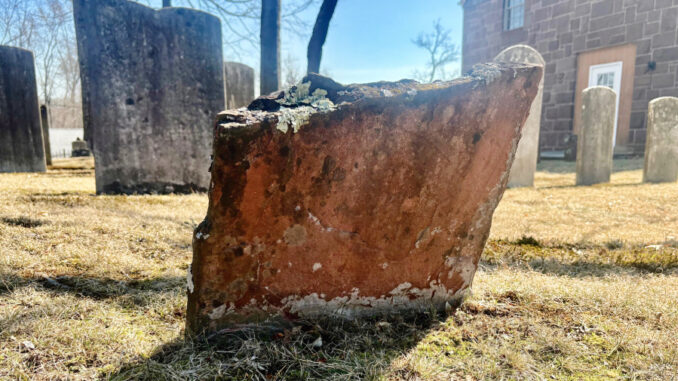
A modest grave marker stands nestled in the Pascack Cemetery as traffic zips by on Pascack Road. The top has broken off, the stone is a bit askew, and the inscription has long ago been destroyed by weathering. All of this is to be expected of a piece of sandstone that has endured Bergen County’s changing seasons for over 200 years.
This grave is among the oldest in the cemetery that lies just north of the Pascack Reformed Church in Park Ridge. It belongs to Peter G. Haring, who, along with his wife Elizabeth, was a founding member of this church in 1813. He was also a veteran of the American Revolution.
Born in 1760, Peter was the fourth child of eight of Old Tappan’s Garret Haring and Cornelia Lent. During the American Revolution, he served as a private in Capt. Abraham Haring’s company of the Bergen County militia that was raised at Harrington. That township then included all the land between the Hudson River on the east and the Saddle River on the west, and north to the New York border.
After the war, in 1784, he married Elizabeth. He was 24 and she was 21. They went on to have 11 children, with the youngest arriving in 1807. Unlike many women of her era, Elizabeth survived all of these births and lived to be 58, which was enviable for the time.
The Haring homestead was off what is now Grand Avenue in Park Ridge. Their farm was quite large. Records show that Peter was taxed for 140 acres in 1790.
During Peter’s lifetime, present-day Park Ridge and the surrounding area was known generally as “Pascack.” This was an isolated rural settlement, home to a handful of Jersey Dutch families. Pascack Road was a narrow wagon track that cut through the hundreds of acres of farmland and wilderness. The people spoke Jersey Dutch in their homes, attended Dutch Reformed Churches, and everyone, regardless of whichever specialized trade they practiced, also farmed the land.
Peter’s service in the militia would have put him at odds with many of his neighbors. The majority of the Jersey Dutch who lived at Pascack were Loyalists.
Peter died on Oct. 25, 1818, and Elizabeth followed three years later. Husband and wife were laid to rest at the Pascack Cemetery, next to the church they helped establish.Left: The grave of Revolutionary War soldier Peter G. Haring in the Pascack Reformed Church cemetery. He and his wife were charter members of the church, and he was buried there in 1818. The elements in their centuries have taken their toll on the sandstone marker.