
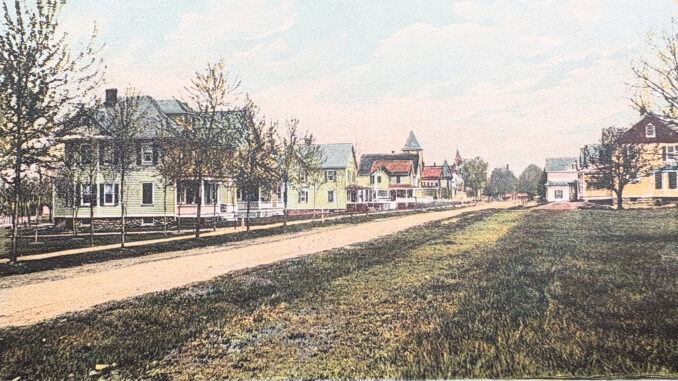
In those years when warm weather brought scores of summer boarders to our countryside, thousands of scenes from the Pascack Valley appeared on postcards, like this one from Westwood.
Views of local streets, railroads, churches, houses, farms, waterways, parks, schools and more were immortalized on the little paper cards, and seasonal visitors mailed them to friends and family.
Featuring a view that looks up Third Avenue from Mill Street in Westwood, this postcard was mailed by a vacationer on Aug. 20, 1910.
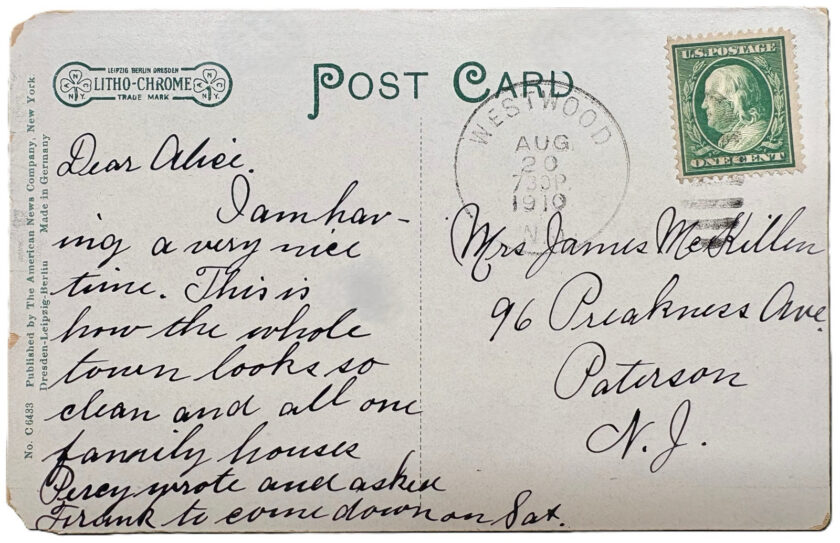
The sender tells a friend in Paterson, “I am having a very nice time. This is how the whole town looksв so clean and all one-family houses.”
The grammar school (later the high school, now The Enclave townhouse complex) is out of frame to the left. Two church steeples are visible up the street. The closer one was the Calvary Baptist Church at Third Avenue and Elm Street (still standing, now Carousel Early Learning Center). Farther down was the Westwood Reformed Church at Third and Park avenues (rebuilt in the 1960s, now Parkside Community Church). Almost all of the residences shown on both sides of Third Avenue are still standing.
In the late 19th and early 20th centuries, summertime in the Pascack Valley meant that our local population would swell as folks embarked on country vacations. Traveling by railroad, and later by automobile, people from nearby cities would flee the sweltering streets of New York, Paterson, and Newark in favor of the breezy air, pristine water, and pastoral landscapes our region provided.
In August 1899, the Bergen Democrat reported that there were more summer boarders in the Pascack area than ever before.
“The country is beautiful hereabouts, and this attracts people who have no liking for the seashore or mountains,” the paper wrote.
Of course, there was no Mariott in those days, but there were dozens of small hotels and boarding houses. In our local communities it was common to find a hotel and livery stable (for renting horses) both just steps from the railroad station.
Some of those old hotels are still standing. The Park Hotel in Westwood and Block’s Hall in Emerson became restaurants called the Iron Horse and Emerson Hotel. The Hillsdale House still stands on Broadway across from that borough’s train station, and for many years it has been a salon. The Park Avenue Hotel, still at the corner of Park and Maple avenues in Park Ridge (now partially hidden behind a modern storefront on the ground floor), was one of three hotels in that neighborhood in the late 19th century.
Some families ran boarding houses or even opened their private homes to summer visitors, welcoming the influx of vacationers as an opportunity to make some extra cash.
At a Pascack Valley boarding house in 1910, one could expect to pay from $7 to $10 per week, depending on the room’s size and the property’s amenities. That is equivalent to about $235 to $330 in today’s money.
An advertisement printed in the Brooklyn Daily Eagle on May 12, 1912 lists a property in Westwood: “Exceptional opportunity to board with a private family and enjoy the conveniences of a beautiful home. All improvements: gas, electricity, water, over an acre of lawn, boating, shade trees, fruit trees and own garden. 10 minutes from station, 45 minutes from New York.”
Proximity to the railroad station was important: Some families would board in the countryside for weeks during the summer, and during that time the man of the house would commute back and forth into the city for work every day. It was common to see the wives and children seeing them off at the train station in the morning, and there would be a crowd again in the evening as they awaited father’s return.