
Let’s continue our stagecoach journey through the 1860s Pascack Valley. We are following the real path that the stagecoach made through this area 165 years ago. The route began at the old Trading Post at Pascack and Mill roads in Park Ridge, with the horse-drawn carriage collecting passengers as it meandered through villages that we now call Woodcliff Lake, Hillsdale, Westwood, and Emerson.
Its destination was the Northern Railroad depot in Closter. This was how people traveled to New York City during that decade before the Pascack Valley got its own railroad line. If you missed that first two parts of the story, you can visit Pascack Press’ website and find them under the “Back in Time” tab.
As we continue down Pascack Road in Woodliff Lake, making our way toward Hillsdale, we pass a blacksmith shop, a saddle maker, and the inns run by Peter Wortendyke and J. Hopper. In this time, this section is called “West Pascack.”
We have no need of overnight accommodation on this trip, but if we did, a hearty dinner and a place to sleep at one of these inns would cost us about 50 cents. We could add a quart of cider for 8 cents or warm up with a small glass of brandy for 12 cents. Unfortunately, there is no free parking at these hotels. The price is 16 cents for a spot in the stable and a quart of oats.
We continue through expansive farmland and woods owned by the Banta family. When we reach the intersection of Hillsdale Avenue, we see on our right side the Lower Pascack School House, also called the Hillsdale School. William W. Banta is the principal here, overseeing the few dozen students from kindergarten through eighth grade. For the majority of them, this one-room schoolhouse will be the extent of their education. It will serve them well as they follow in the footsteps of their parents, becoming farmers.
Here we turn toward the east, making a left from Pascack Road onto Hillsdale Avenue. Just a handful of homes dot the length of this country lane that will one day be fully lined with houses. One of these belongs to Henry Smith, the local undertaker. He lives in a pre-Revolutionary home that Hillsdale residents of the future will associate with the name Clendenny, one of his descendants.
Mr. Smith is in his office writing out a bill to James Demarest, whose mother, Bridget, recently passed away. Bridget was born in 1779, and her life was considered a very long and fruitful one. Her total funeral expenses, including a casket, gravesite in Pascack Cemetery, the labor of the diggers, tolling of the church bell, and services of the minister come to $22.50.
Bridget’s funeral had tested the skills of the bell toller at the Pascack Reformed Church. The sexton always takes his place in the belfry long before the time of the service. This gives him an advantageous position—he can see the funeral procession approaching from either direction on Pascack Road for approximately a half-mile from the church. As the wagons come into sight, he begins to toll. The number of strokes indicates the years of the deceased’s age. For octogenarian Bridget, it required considerable skill to give the proper number of strokes before the procession reached the church. Undertaker Smith, seated on his high perch at the front of the hearse, had to use his skill, too—he had to check his horses so that he arrived in front of the church just as the final stroke sounded.
Shortly after Mr. Smith’s place we make another turn, this time to the right, and we are on Yesler Way—at least that’s what people in the future will call it. The narrow, crooked, and rough path has us jostled about. On our right, we pass the Westervelt farm, which includes over 74 acres and a Dutch sandstone homestead dating to before 1750. Casper Westervelt lives here now. He is one of the farmers in this section that specializes in strawberries.
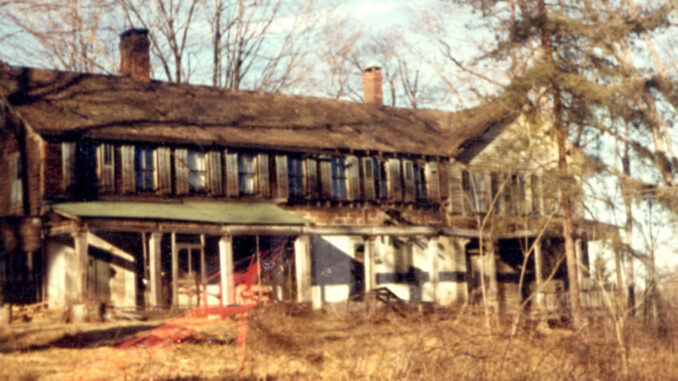
Yesler Way turns into Hillside Avenue, and at its end we make a left onto Washington Avenue. As we make the turn, the home on the left is one of the oldest in the area. This was once part of a large tract owned by Daniel Haring of Haworth, and he had the house built for his son, John D. Haring, after he waxs married in 1763. The house and its 50 acres stayed with the Harings until 1847. As our stagecoach passes by, through the window we spot its current owner, John C. Westervelt.
We are in Pleasantville—a sparsely populated rural area that future people will call Westwood. There is no “downtown” to speak of. The stores have not yet come; the first ones will arrive a few years from now, along with the railroad. For now, the few commercial enterprises belong to millers and tradesmen. About two dozen houses stand in the vicinity, and we pass three of them on our right—the Ottignons, Hoppers, and Westervelt farms—as we make our way down Washington Avenue.
Ahead we come to William Bortick’s place—he is the postmaster here in Pleasantville. This location will one day be the entrance to busy Westwood Avenue, lined with shops and restaurants. The coming of the railroad at the end of this decade will mark the beginning of a new era for this section. For now, the modern world has not yet reached this place.
Our journey concludes in next week’s Pascack Press…