
PARK RIDGE, N.J.—Laptops? Air-conditioned schools? Artificial intelligence?! This group would have settled for indoor plumbing.
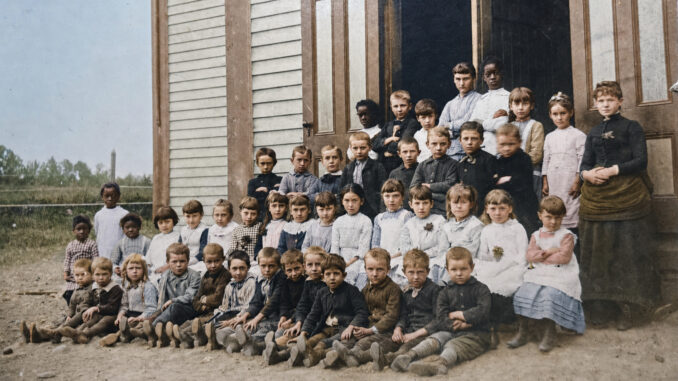
As we send the kids back to school, let’s take a look at one of this author’s favorite photographs from the Pascack Historical Society’s archive. Dated to between 1887 and 1890, this was the entire student body of the Park Ridge schoolhouse. The snapshot captures so many little faces, so many different personalities.
The woman standing on the far right, who looks like she should be in high school, was the teacher. The school budget for 1889, as reported in the Bergen Index newspaper, included $120 for her salary. There was also $70 set aside for repairs, $45 for coal to heat the building, and $40 for cleaning.
The schoolhouse these children attended was set back from Pascack Road (Main Street to them) and Park Avenue. The land is now part of the Park Ridge High School campus. Built in 1856 with just one room, an 1876 addition had added more space on the north side.
Still, the population of rural Park Ridge was very small, and not everyone saw the value of staying the course when it came to education. One can tell by this photograph that there were many more young children than older ones. Most had already left school by the time they reached their teen years, taking up work on the farm or learning a trade. The number of graduates each year could usually be counted on one hand, and we know that in 1887 the graduating class (completing what might be comparable to eighth grade today) was just two students, one boy and one girl.
The school year generally began on the first Monday of September. During summer vacation, which started on the last Friday in June, the school was locked up and deserted. At the end of August, the doors and windows would be thrown open to air out the building, the floor was scrubbed, blackboards given a fresh coat of paint, and the walls whitewashed.
The grass and weeds had grown out of control since school ended in June. A laborer would be sent in with his scythe to cut it all down. It was not thought necessary to remove the clippings; these would soon be flattened by all the little feet.
The world this group knew was so different from the one children know today. People traveled in horse-drawn wagons, not automobiles. Nights were illuminated by the flicker of kerosene lamps, not electric light. People got their water from wells, and they used outhouses, at home and at school. They wrote letters and waited days or weeks for a reply, as houses did not have telephones.
They couldn’t have in their wildest dreams imagined a PlayStation or an iPad. Even the ability to listen to recorded music at home was still a few years away, and movies and television would have been science fiction. In their adult years, they saw all of these breakthroughs realized.
Soon after this photograph was captured, another building addition in 1890 would add a second story to the school, and this allowed more separation between different age groups. The addition would house grades five through eight, the original 1856 school room housed grades three and four, and grades one and two had lessons in the portion from 1876. It was also a step forward in that while the building still did not have indoor plumbing, there were now two outhouses, one on each side behind the school.
The building also had its own hand pump for well water, which was a marked improvement over having to run to nearby farms with a bucket.