
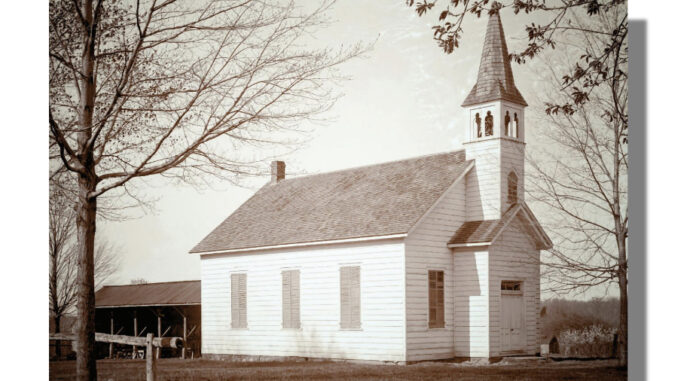
“The congregation of the Upper Montvale Church was driven out by a swarm of bees last night when the regular weekly prayer meeting was being held, and the services had to be concluded in a grove nearby,” The New York Times reported on June 9, 1899.
The congregation’s quaint country church, built in 1886, stood on Summit Avenue just east of Spring Valley Road in Montvale. The Methodist Episcopal congregation traced its origins to 1872, when it began as an informal Sunday school serving residents on both sides of the New Jersey-New York border. A parsonage was built across the road in 1889.
At the time of the incident, the church was led by Rev. Dr. Joseph H. Ware, 40. His wife, Tema, served as principal of the Montvale schoolhouse on Grand Avenue.
One evening in early June 1899, Rev. Ware had just opened the regular weekly prayer meeting. It had been a hot day, and long before the era of air conditioning, the church windows were open.
Congregants soon noticed a buzzing sound that seemed to grow louder by the minute. Distracted worshippers looked around in confusion. Then a swarm of bees began pouring through one of the open windows.
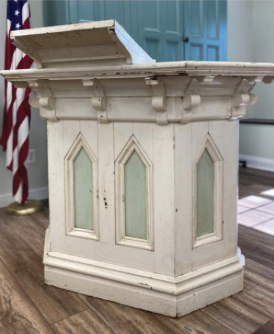
“The brightest light was near the platform and thither the swarm winged its way,” reported the Passaic Daily News. “The Rev. Dr. Ware tried to go on with the services, but his voice appeared to annoy the bees and some of them began to fly close to him. Others flew about the church looking for a good place to settle.”
The congregation retreated from the church to a nearby grove, where the prayer service continued in the open air.
“Seats were placed in the shade of trees, while the humming bees had possession of the interior part of the house of worship,” the Hackensack Democrat reported.
The bees eventually found a new home thanks to farmer James Van Riper, a church deacon. Van Riper owned a large property at the corner of Spring Valley Road and Summit Avenue, diagonally across from the church. The site is now occupied by the Olde Woods townhomes.
“Deacon Van Riper, who knows a lot about bees, hurried home and returned with a hive and nets. About the time the prayer meeting was over he had the queen bee and most of her followers imprisoned,” reported the Passaic Daily Herald.
The bees lived out their days making honey on the Van Riper farm.
As for the church, it survives — in a sense. Local families continued to worship there for many years, but attendance eventually declined and the congregation closed in the 1960s. In 1968 the remaining members merged with Saddle River Methodists to form Bergen Highlands United Methodist Church in Upper Saddle River.
The building itself, now about 140 years old, still stands. In the 1970s, the former church was restored and converted into a private residence, preserving a distinctive piece of Montvale’s early history.