
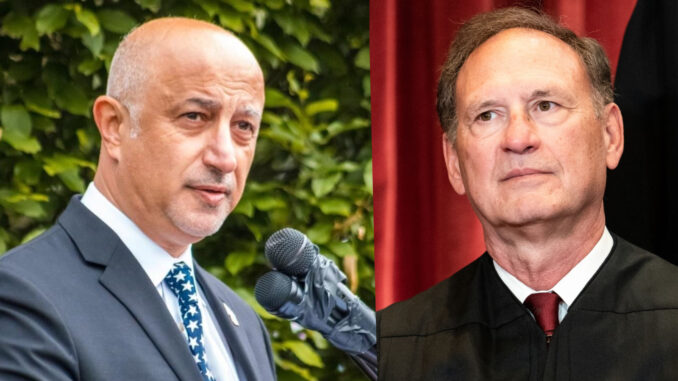
MONTVALE—The New Jersey Attorney General’s Office on Feb. 17 urged U.S. Supreme Court Justice Samuel Alito to reject an emergency appeal seeking to pause a March 15 affordable housing deadline, arguing that the coalition’s claims have already been rejected by multiple state and federal courts.
The appeal was filed by a coalition of 29 municipalities known as Local Leaders for Responsible Planning, which is seeking to halt implementation of the state’s fourth round of affordable housing obligations. Only nine of the 29 coalition towns joined the emergency application submitted to the Supreme Court.
The coalition turned to the Supreme Court after lower courts repeatedly denied efforts to block the deadlines tied to New Jersey’s amended affordable housing law. The Attorney General’s Office noted in its response that the coalition’s arguments had been rejected by five separate courts.
“It could be any time now,” Montvale Mayor Mike Ghassali said Feb. 18, referring to the anticipated Supreme Court decision. Ghassali said it was unclear what legal options would remain if Alito rejects the request for a stay.
Ghassali said that if Alito were to pause the March 15 deadline, the case could be sent back to U.S. District Court for further proceedings, though he acknowledged that outcome is uncertain.
Ghassali spearheaded the legal challenge to the amended affordable housing law approved in March 2024 by the Legislature and Gov. Phil Murphy. The original lawsuit was filed in September 2024 by a nine-town coalition led by Montvale, which later expanded to 29 municipalities.
Adam Gordon, executive director of Fair Share Housing Center, said the coalition’s claims have been consistently rejected.
“The Attorney General’s response is exactly right,” Gordon said. “Montvale’s emergency application simply repackages arguments that have already been rejected by state courts, the federal district court, and the Third Circuit. New Jersey law gives municipalities broad flexibility to create affordable homes in ways that work best for their communities. The vast majority of towns are moving forward in good faith, and there is no basis for extraordinary intervention.”
Most of New Jersey’s 564 municipalities — including those participating in the coalition — have complied with fourth-round affordable housing deadlines. Towns that fail to meet the requirements risk losing legal immunity from so-called builder’s remedy lawsuits, which allow developers to pursue higher-density projects that include affordable housing.
The fourth round of obligations covers the period from July 1, 2025, through June 30, 2035.
In its 38-page brief, the Attorney General’s Office asked the court to deny the requested stay, calling the coalition’s constitutional claims unfounded.
“Applicants’ novel equal-protection theories are groundless,” the brief states. “Applicants complain that this state law’s affordable-housing formula improperly relieves certain cities of an obligation to provide for construction of affordable housing for future residents. But Applicants admit their challenge to the statute is subject only to rational-basis review, and there is no basis to argue that a Legislature acts irrationally in distinguishing poorer urban subdivisions from other municipal subdivisions for affordable-housing purposes.”
The brief added that the statute implements New Jersey’s Mount Laurel doctrine, which requires access to affordable housing throughout the state and “could never be satisfied by a surfeit of affordable housing in urban centers alone.”