
Editor’s note: The views expressed in this reader commentary are the author’s alone; publication does not constitute endorsement by Pascack Press. In seeking to illuminate our vibrant Pascack Valley from within, we give priority to local voices and people with a direct connection to the issues discussed, and we particularly welcome perspectives that are underrepresented in public debate. Civil, substantive responses—including disagreement with this commentary—are welcome. We ask contributors to engage the facts and ideas rather than attack individuals or the newspaper. Submission guidelines are available on our website.
By BARBARA C. DUNN
SPECIAL TO PASCACK PRESS
MONTVALE, N.J.—As a longtime Bergen County resident and retired executive director of Paterson Habitat for Humanity, I have seen the devastating consequences when working families cannot find safe, affordable places to live. I have also seen what happens when communities make room for those families: Lives become more stable, children’s futures are transformed, and entire communities become stronger.
That is why, as a 50-year resident of neighboring Hillsdale, I am concerned about what Montvale is proposing for the former KPMG campus—and why residents deserve a clear explanation of what is being planned.
The 34-acre KPMG property is Montvale’s largest redevelopment opportunity and one of the largest in Bergen County. Montvale also is required under New Jersey’s affordable housing law to create a 10-year plan allowing for its fair share of homes. The site could meet the borough’s entire affordable housing obligation.
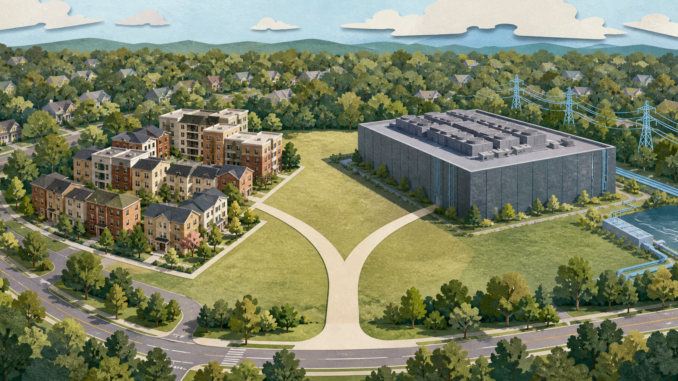
Instead, the settlement preserves two alternative paths for the KPMG site. One would permit 250 homes, including 50 affordable units. The other would allow continued or expanded commercial use—including the 322,822-square-foot data center shown in an attached concept plan—while still requiring 50 affordable homes on another portion of the property.
No formal site-plan application for the data center has yet been filed, according to Montvale officials, but the developer’s option is embedded in a fully executed settlement filed with the court May 6. In an April 17 court filing, Montvale said, “The PILOT on the data center becomes the economic engine driving the creation of affordable housing.” (The settlement’s oral arguments are scheduled for Nov. 10 but that date could change.)
That raises a basic question: Why should one of Bergen County’s largest redevelopment opportunities be devoted principally to a massive industrial facility? How many permanent jobs would it create, and would those benefits justify its other effects?
Data centers are attracting concern across New Jersey. They can consume enormous amounts of electricity and water, while backup generators can bring noise and air pollution to surrounding communities.
That concern is reflected in two recent statewide polls:
A Fairleigh Dickinson University Poll conducted March 20–28 among 805 registered New Jersey voters found that 65% supported halting construction of new data centers until more power plants can be built. The poll was conducted in partnership with the International Union of Operating Engineers.
A Stockton University poll conducted April 21–27 among 642 registered New Jersey voters found that 56% would support banning data centers in the communities where they live.
The question is not whether data centers have a role in our economy. It is whether this is the right place for one—and whether Montvale residents have enough information to answer that.
If the borough believes this facility is appropriate, residents deserve to know how much electricity and water it would consume, what cooling systems and backup generators it would use, and what noise and air pollution would result. They also deserve an accounting of its possible effects on the watershed.
More than 400 municipalities are moving forward with affordable housing plans under the state’s new law. Much of that housing will come through the redevelopment of underused properties—exactly the kind of opportunity the KPMG site represents.
Repurposing an already-developed property for housing means communities can add homes without paving over forests, farms and other limited open space. It can make better use of existing roads and utilities while putting people closer to jobs, businesses and services. Done well, redevelopment can address both the shortage of affordable homes and the environmental costs of sprawl.
Once a 322,822-square-foot data center is built there, Montvale will have sharply limited its ability to use one of its most valuable existing sites to create the homes our region needs.
Montvale has the same flexibility as other communities to decide how to meet its affordable housing needs. It does not need to choose between local control and affordable housing. It needs to use its local control responsibly.
I know what affordable housing can do for families and communities because I have spent years working alongside people who need it. Teachers, nurses, first responders and others who keep our communities running need homes they can afford, too.
Montvale should not make a data center the “economic engine” of its housing plan. The KPMG property is too important—and the need for affordable homes is too great.
Montvale residents deserve a plan that treats affordable housing as a central opportunity, not an obligation to be minimized alongside a much larger industrial development.
Editor’s note: Paterson Habitat for Humanity was not involved in preparing or submitting the piece, and Ms. Dunn’s former affiliation is included for biographical context only. We have invited Montvale officials to respond.