
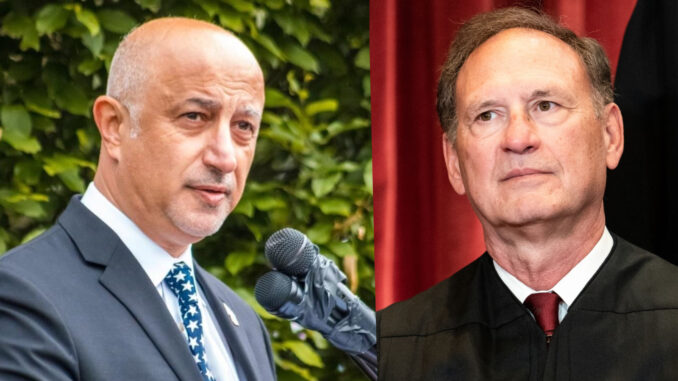
WASHINGTON, D.C.—U.S. Supreme Court Associate Justice Samuel Alito has ordered the New Jersey Attorney General’s Office to respond by Feb. 17 to an emergency application from Local Leaders for Responsible Planning seeking to stay a March 15 state deadline requiring towns to adopt zoning and ordinances implementing their fourth-round affordable-housing plans.
Officials in Acting Attorney General Jennifer Davenport’s office said they anticipate replying by Feb. 17 and offered no further comment. Montvale Mayor Michael Ghassali, who leads the Local Leaders coalition, said the order is encouraging.
The Fourth Round is New Jersey’s current 10-year cycle requiring towns to plan and zone for affordable housing in exchange for protection from developer lawsuits.
“It’s a very good sign that he’s looking at this seriously. That’s the first hurdle we’ve passed,” Ghassali told Pascack Press Feb. 10. Ghassali has said his group’s issue is not with affordable housing but rather with mandates toward high density development.
So far, most legal efforts by Local Leaders for Responsible Planning have been denied in state and federal courts. The U.S. Court of Appeals for the Third Circuit rejected the coalition’s bid on Jan. 30, and U.S. District Judge Zahid Quraishi denied related requests twice earlier. In early 2025, Mercer County Superior Court Judge Robert Lougy twice rejected the towns’ bid to halt fourth-round deadlines; in June 2025, Lougy rejected another request to block certain requirements but granted a limited extension tied to a June 30 deadline.
Ghassali, who spearheads the 29-town coalition opposing New Jersey’s fourth round of affordable-housing obligations, said he hopes Alito issues a decision soon after reviewing briefs from the coalition and the attorney general’s office.
Ghassali said he hopes Alito stays, or pauses, the March 15 deadline. He said Alito will likely consider the filings and make a decision quickly given the emergency nature of the request.
The filing is an emergency application seeking immediate relief, not a full Supreme Court appeal. Alito, the justice assigned to emergency matters from the circuit that includes New Jersey, ordered the state to respond as he considers whether to pause the deadline. If he halts the deadline, Ghassali said the stay would immediately apply to the nine towns identified in the coalition’s filing. He said the coalition would seek to add as many as 20 additional member towns that want to be included. He said it would not appear to apply to other towns statewide.
Alito, who grew up in Hamilton Township in Mercer County, is the Supreme Court justice assigned to handle emergency matters from the federal circuit that includes New Jersey. Hamilton Township is not listed among Local Leaders for Responsible Planning’s member municipalities.
Jag Davies, communications director for the Fair Share Housing Center, said the court’s order is “a routine request for a response from the other side, not anything that suggests any particular outcome … Docketing just means they assign a number to a filing, as happens at any level of courts.”
Joshua Bauers, the Fair Share Housing Center’s director of exclusionary zoning, said New Jersey law gives towns flexibility in how they meet obligations.
“New Jersey’s affordable-housing law gives towns a lot of latitude to create new homes in a wide variety of ways to meet their local needs — that helps explain why the vast majority of towns are complying with the law,” Bauers said. “Local officials who choose endless litigation over inclusive communities are ultimately harming the very towns they serve.”
The coalition filed its request on Feb. 4 seeking an injunction against the March 15 deadline. In an email update, Ghassali wrote, “We ask Justice Samuel Alito to grant a pause of the state’s arbitrary March 15 deadline so we can first have our claims decided in court.”
Ghassali said the coalition’s filing argues New Jersey’s fourth-round affordable-housing law violates equal protection by relying on a 40-year-old “urban aid” classification formula that, he said, requires communities like Montvale to zone for far more than their fair share of affordable housing.
“I am beyond proud of our coalition sticking together against developers and special interests and taking this fight to save our communities to the highest court in our land,” Ghassali said.
The filing argues that, without a pause, plaintiffs will suffer “irreparable harm,” including immediate reputational and electoral harm. It says that if the deadline is not stopped, towns will be forced to adopt high-density housing, and that public officials who support such ordinances could face political consequences.
One section summarizes concerns cited by public officials who oppose high-density affordable housing.
“If Applicants vote in favor of the implementing ordinances, they will be voting against the will of their constituents,” the brief states. It says Ghassali frequently attends community events and engages with residents, and that in those interactions, “not one person said we want high-density housing.” It says that if and when Ghassali votes on new zoning, his reputation would suffer and his re-election prospects would dim — and that he “would not be voted back in.”
The brief also argues that if officials vote against implementing ordinances, their municipalities could still face builder’s remedy litigation that may result in high-density development.
“If Applicants instead vote as their own consciences and constituents demand, they will be held politically accountable for the ensuing builder’s remedy litigation that will still result in high-density development,” the brief states. It adds that developers have shown municipalities such as Montvale plans for high-density housing and said applications would be submitted once a municipality lost immunity.
The filing argues the state’s “urban aid” classification is based on a 40-year-old law that is outdated and no longer applies, and says “urban aid” towns should also be assigned prospective-need affordable-housing obligations.
“The robust population growth in the urban aid municipalities reflects that, unlike in 1984, they can now absorb their fair share of prospective need,” the brief states. It adds that urban aid municipalities “presently create half of New Jersey’s population growth and, therefore, under the 2024 FHA’s formula, generate half of the state’s prospective need.”