
WESTWOOD—When I attended college in the mid-1970s, Environmental Studies 101 was known as a “gut” course — soft on science and an easy “A.” It was condescendingly called “Trees Are Our Friends.” We chuckled at that snarky witticism, displaying the uncertainty of our inexperienced youth. But we’re not laughing now.
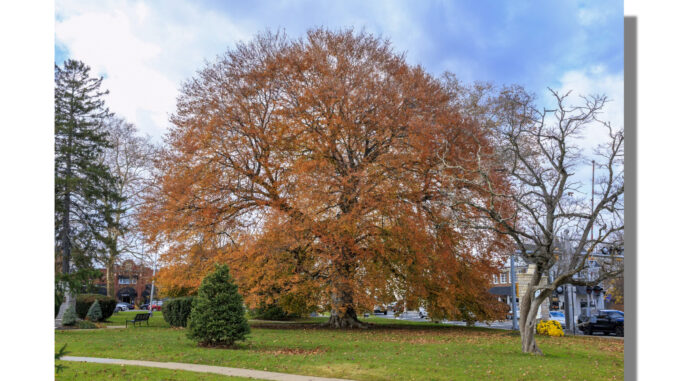
The majestic European copper beech in Veterans Park — Westwood’s storied “Kissing Tree” — is dying. It has contracted a terminal fungus that spreads quickly, hollows out the trunk and destabilizes the giant tree’s tether to the earth. As the disease progresses, the risk of our 63-foot legacy tree toppling increases.
Our tree, the second-tallest copper beech in Bergen County, was recently recognized as an important Heritage Tree. Estimated to be somewhere between 168 years old (a sapling during the Civil War) and 252 years old (two years older than our budding nation), it has withstood every local triumph and tragedy since — a silent witness, absorbing our fears, hopes and dreams.
As the legendary Kissing Tree, it presided over the timeless poetry of young love in Westwood. Today it generates nostalgia for simpler, more innocent times, when casual intimate dalliances were not counted like rings on a trunk. Its romantic roots are captured in these contemporary song lyrics:
“True that I saw her hair like the branch of a tree, willow dancin’ on air before covering me, under garden and calicos, over canopy dappled long ago.”
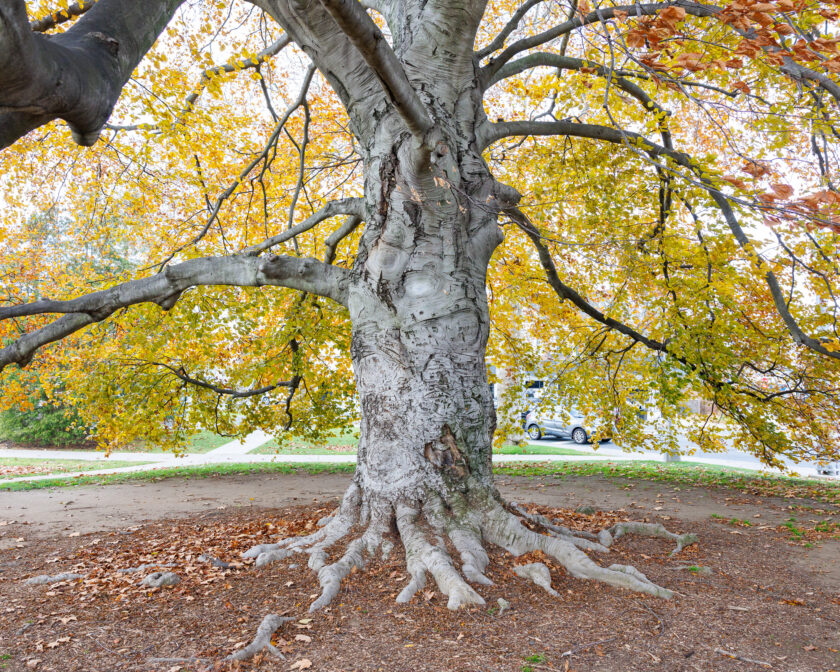
The Kissing Tree is our living monument to a legacy of stolen kisses and whispered promises — the fluttering hearts of Westwood’s youth discovering the dewy newness of a crushing first love.
Love’s first cuts are the deepest. Its final ones are the cruelest. And so, here we are, coming full circle, nearing the end of our love affair with the Kissing Tree. As the lyric continues: “True that love in withdrawal was the weeping of me. That the sound of the saw must be known by the tree.”
Old age has planted its Judas kiss on our landmark tree. Sentenced by the fast-spreading brittle cinder fungus, the Kissing Tree cannot be saved. Experts advise it must eventually be removed to prevent harm should it fall in a storm. This is the consensus of the Shade Tree Committee’s professional advisors, in consultation with their counterparts at Rutgers University.
There will be a physical void where St. Valentine’s sentinel once stood in Veterans Park — a hole in the heart of our town.
We take so much for granted in a small town. Our mature trees are often twice the size of our homes. They shade us in summer and soften the winter winds. Westwood’s Shade Tree Committee reports that “trees of this size are mega-resources and perform 600 times the environmental benefits of typical trees.”
Visually, the tree line shapes the center of our village skyline. It subconsciously draws our eyes upward, framing the sun-kissed dome of blue sky above us. In autumn, its leafless branches reach toward the night sky, backlit by a rising harvest moon.
Our oldest trees are recognized as New Jersey Champion and Heritage trees, not only for their longevity but as markers of our local history. They are signifiers of a successful model for living — a legacy worth preserving and passing down.
Fortunately, we still have some time to say goodbye. The tree has been well cared for, and the borough arborist will continue to monitor the progression of the disease and its structural stability. The governing body is also seeking cost estimates for temporary structural supports should they be needed before removal.
The Shade Tree Advisory Committee has done a wonderful job promoting awareness and statewide recognition of this special tree. They hope someone reading this may know of new or experimental treatments for brittle cinder fungus — and reach out.
Meanwhile, the committee will consider how to guide the community through this loss. Volunteers are collecting the last of its beech-nut seedlings for replanting around the borough. If safe and feasible, its bark and intact heartwood slabs may be repurposed into keepsakes. Events will be organized to celebrate the Kissing Tree while it is still with us.
And when the time comes, the DPW may collect the tree’s usable remains and make them available as firewood for Westwood residents.
In its final role, Westwood’s Kissing Tree becomes the Giving Tree. The memories of all those burning loves, witnessed across generations, held in the grain of its wood — now set aflame. Transformed into soft flickering light and glowing embers in our hearths. The Kissing Tree’s final kiss: precious burnt offerings to keep us warm.
May its fire, and its memory, blaze all night.

Editor’s Note: This week, we are publishing a reflective essay from Mayor Ray Arroyo on the condition of Westwood’s historic Kissing Tree, a landmark holding deep meaning for many. The mayor offers an emotional and personal perspective on what the tree has represented across generations.
We will follow with a full news report detailing the arborists’ findings, the borough’s monitoring plans, and the Shade Tree Advisory Committee’s ongoing work. We appreciate residents’ patience as we gather the factual information necessary to present the most accurate account of the tree’s condition and the steps ahead.