PASCACK VALLEY—Last week’s severe weather certainly put a damper on the Pascack Valley’s Fourth of July plans. A heat wave that saw temperatures soar into the triple digits was broken only by a severe storm that knocked out power to thousands of people, toppled trees, caused property damage, and canceled municipal fireworks displays. It wasn’t exactly the spectacular celebration of America’s 250th birthday that we had all hoped for.
Of course, those who follow history know there really is nothing new under the sun. For this week’s story, we go back to the summer of ’74.
1874, that is. America’s 98th birthday.
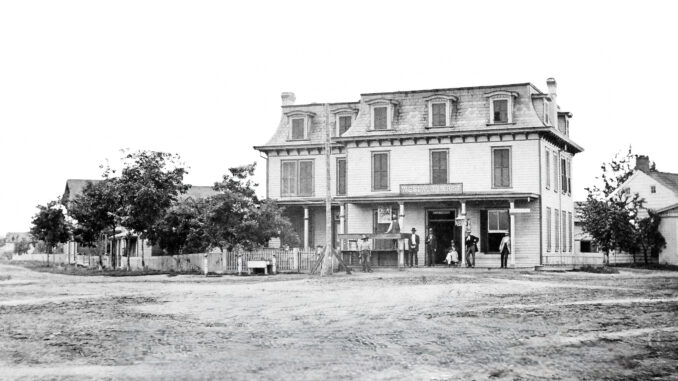
The people of Westwood were excited for what was to be the first community-wide Fourth of July celebration. The rural hamlet was home to only approximately 200 residents, but on this day its streets would be be full. People from all around the Pascack Valley would journey to the village for this important event.
Certainly in those days, the Revolutionary War was a more tangible era in history. Unlike today, when it is recorded only in artifacts and history books, the lives of older adults in 1874 had overlapped with those of our Founding Fathers. In their younger days, some would have known veterans who had fought for independence.
In 1870, the Fourth of July became a national holiday. In the 19th century, it was the most widely celebrated secular holiday on the calendar. Months of preparation had gone into Westwood’s July Fourth program. So great was the patriotism in those days that a full $400 had been raised for a celebration that was to include sack races, chasing greased pigs, climbing a greased pole, athletic contests, patriotic speeches, and fireworks.
From all over Bergen and Rockland counties, crowds made their way over dusty roads in horse-drawn wagons. Westwood was the place to be.
Then, in the midst of the festivities, ominous dark clouds began to spread over the village, turning a sunny day into something more like dusk. What followed was the most violent hailstorm that had ever been known in this section. Those who were there to witness the event could still recall it with clarity many years later.
One account from the New York Herald reads as follows: “One of the most extraordinary phenomena ever witnessed in this country took place on the Fourth of July in Bergen County. About a quarter of 6 o’clock p.m., in the village of Westwood, during the celebration of the day, a sudden darkness came over the village, and before the alarmed inhabitants could seek shelter, a violent storm of hailstones descended upon the heads of the crowd.”
The Herald continued, “Hailstones reportedly 2? inches in diameter, and as hard and heavy as cobblestones, came down in a furious shower. The people ran in every direction, seeking shelter wherever they could—in sheds, beneath trees, and under wagons. Hens and chickens that were outside their coops were killed in large numbers. Cattle in the fields were bruised, and horses bolted. Windows were smashed, roofs destroyed, and wagon tops torn to shreds.”
Incredibly, no people were killed in this storm. The injuries were plentiful, but they included lacerations and bruises that eventually healed. On the other hand, the property damage was immense.
The storm covered an area 25 miles wide, from Spring Valley to the village of Kinderkamack (Emerson).
In Park Ridge, the railroad station was “completely riddled, as though a battle had been fought in the neighborhood.”
“To give some idea of the unprecedented weight and fury of this hailstorm, we may state that there is not a slate roof in the track of the storm that was not pounded into fragments, and in some shingle roofs great breaches were made. It not only beat in the lights, but the frames of the windows. Shutters were split into kindling wood. Fences were stripped of their pickets,” wrote Passaic County’s The Item in its July 11, 1874, edition.
The Rockland County Journal reported, “Grass, grain crops, and gardens were annihilated, and fruit and forest trees are as bare of leaves today as they were last January. A branch of an apple tree brought over by Irving Stephens [a farmer from Clarkstown] was shown to us and the bark was peeled from it as clean as if done by a knife.”
Especially dire was the damage at the bobbin mill in Park Ridge. The Van Riper Manufacturing Company of Paterson had established its four-story factory off Mill Road in Park Ridge around 1870. It was a major producer of bobbins—wooden spools—for use in textile mills all over the country. On this building, 1,000 panes of glass had been broken, the shutters were stripped off, and the roof was riddled with holes.
“Through the section of the country where the storm raged a most perfect scene of desolation can be witnessed,” the New York Herald wrote on July 7, 1874. “During the continuation of the shower the thunder and lightning were incessant, and with the screaming of men, women, and children, and the shrieks of frightened cattle, the scene was one truly awful.”
It was many years before Westwood again attempted a Fourth of July celebration. The hailstorm of 1874 was never forgotten by those who had seen it.
On Independence Day in 1922, it rained so hard in the evening that some of the older residents were reminded of that unprecedented weather they had witnessed in their youth. “Remember ’74?” was heard all around the Pascack Valley that day.