

PASCACK VALLEY—We were glad to hear from George Kritzler of Hillsdale, a Korean War veteran and longtime utility professional who has written a technical resource on gas-fired infrared heating and the economic analysis that drives building decisions.
Five years in the writing and editing, Kritzler’s book, Gas Infra-red, the Green Heat: History of IR heating and Infra-red Heating Design and Economic Analysis, was published Oct. 14, 2025 by River Publishers as part of its Series in Energy Management. The book runs 216 pages and includes 11 color and 88 black-and-white illustrations. (Hardback $104; eBook $97.50; ISBN 9788770046589.)
This book is “a self-study guide for HVAC energy and non-HVAC energy engineers and plant managers who either lack formal training in the subjects of finance, accounting, and gas IR heating engineering economics, or simply need a means to refresh their knowledge in these subjects.”
In his Preface, Kritzler starts far from Bergen County and far from boilers — with an astronomer and a prism. In his book, he traces infrared back to 1800, when Sir William Herschel measured the heat of sunlight split into colors and found the temperature rising as he moved toward the red end — and rising even more just beyond it, in a band no one could see. “That invisible spectrum,” Kritzler writes, “is the infrared spectrum.” Two centuries later, he’s still promoting what that discovery made possible: designing heat you can’t see, but can feel — and enjoy.
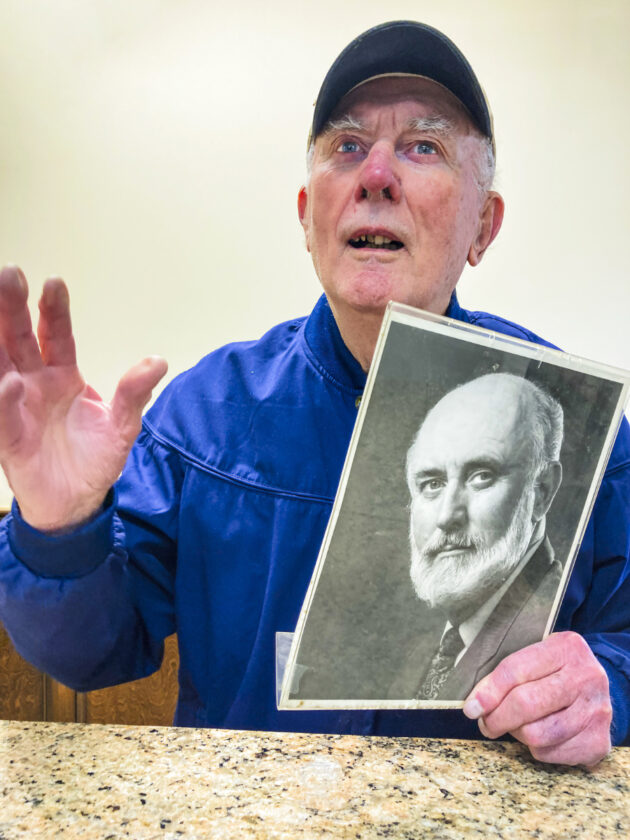
Kritzler says many energy and non-energy engineers and technical managers “feel inadequately equipped to comprehend and apply certain important finance and accounting principles. Understanding of finance and accounting principles is important in interfacing and conducting business with accountants, financial analysts, and members of upper management.”
He adds, “This book is designed to familiarize energy engineers and other engineering professionals — in a relatively simple and easy to understand fashion — with decision making skills founded on financial calculations and case study based quantitative analysis.”
Asked what prompted him to develop this resource, Kritzler points to his career. “I’ve worked for three utility companies—Public Service Electric and Gas, Elizabethtown Gas, and Con Edison,” he said. And he was president of the international Association of Energy Engineers (AEE), “So I’ve had a lot of experience with natural gas and natural-gas heating. And I have found that gas infrared heating is the most efficient type of heating that you can find, so I wrote a book on it.”
In plain terms, infrared heating is a form of radiant heat, often used in large spaces where conventional heating can be less efficient.
He emphasized that his focus is energy conservation in the real world.
Asked whether his field sees any unique challenges of opportunities heading into the new year, he says, “There’s always opportunities for energy conservation.”
Offering to visit the newsroom, he adds, “I can walk into any building in any town around here and I can find ways of reducing energy costs.”
Kritzler still lives on Pascack Road in the house he built himself, in 1961. “I hammered-the-nails built it,” he said. He grew up in Carlstadt and worked for PSE&G while he lived there.
Of his military service, he says he was in Korea “when it was not nice to be there.” He served with the combat engineers, part of the U.S. Army 25th Division.
He’s active in veterans organizations, notably Hillsdale’s General Leonard E. Wood American Legion Post 162 (home post for residents of Hillsdale, Woodcliff Lake, and Old Tappan), and the Westwood VFW, where is is commander.
The book also has a local connection that Kritzler is proud of: he pointed to an energy-efficient piece of equipment shown early in the book that is manufactured in Hillsdale. “On pages 8 and 9, there’s a piece of equipment that is made right here in Hillsdale,” he said. “And it’s an energy efficient piece of equipment,” adding it’s manufactured right off Broadway.
Kritzler’s enthusiasm now is about getting the book into the hands of the people he knows can put it right to work—especially students and future professionals, and so this calls for hitting the road in 2026.
Still a dedicated mentor in his field, he said he expects to visit colleges and universities throughout the country and that he wants copies on hand for that effort. He took our copy back.
“I’ll definitely be getting it into different college libraries,” he said.
Locally, he said he could also envision sharing the book through civic channels. He noted he gave a copy to the Hillsdale manufacturer he references, and that a Rotary presentation is a taking shape.
“I was hoping that you could do a little blurb on this and publish it in your paper,” Kritzler said. We’re honored to.
Pascack Press welcomes stories of local authors and creators.
Got a tip? Write newsdesk@thepressgroup.net.