
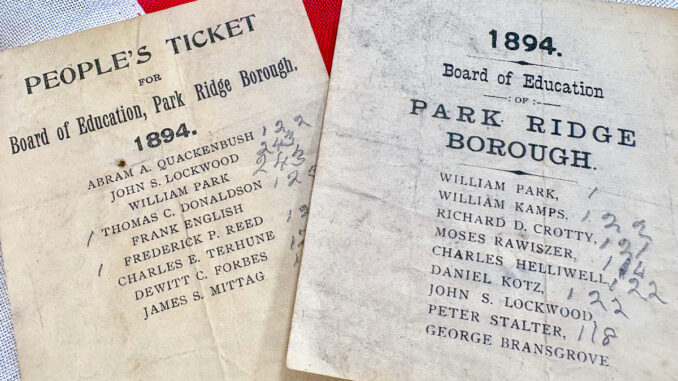
PARK RIDGE, N.J.—Park Ridge broke from Washington Township and began life as a borough in 1894. With that came its own school district, and the first election of school board members took place that July. Voting in those early years was intense, marked by mutual disdain and mistrust between two rival factions.
We go back to this week in 1894, in the newly formed Borough of Park Ridge. There was an ideological divide in town, fueled by the population shift that followed the arrival of the railroad in 1871.
One side was officially called the People’s Party, although the opposition nicknamed them the “Hayseeds” and “Punkin’ Dusters.” These were the old Jersey Dutch farmers whose families had called the Pascack Valley home for generations. They wanted to preserve the old ways and generally opposed spending tax dollars on modernization. If it was good enough for their grandfathers, it was good enough for them.
Then there was the Citizens’ Party, the newer population of New York City commuters who had settled in Park Ridge after the railroad arrived. These businessmen favored better schools, improved roads and expanded services, even if it meant paying higher taxes. They had pushed for Park Ridge to separate from Washington Township and form its own borough, giving residents greater local control, while the farmers preferred to remain a village within the larger township.
“Of late years a few New-Yorkers have taken up residence in the village and have tried to imbue the old-timers with some progressiveness,” wrote the New-York Tribune on July 22, 1894. “The farmers resented this.”
The rivalry between the two parties permeated Park Ridge life, reaching a fever pitch at election time.
That brings us to July 20, 1894—the borough’s first election for school trustees. Voting took place at the schoolhouse, a two-story wooden building near the corner of Pascack Road and Park Avenue, now the site of the Park Ridge High School campus.
For weeks before the election, the businessmen had canvassed on the trains, formulating their strategy during their daily commutes to and from New York. The farmers made the village grocery store their headquarters, talking politics around the old cracker barrel.
Both sides went to great lengths to get out the vote. Early on election day, delegates from each faction hired liverymen from Park Ridge, Hillsdale and Westwood to transport voters to the polls.
“Farmers’ truck wagons, Sunday carriages, and vehicles of all descriptions were also engaged for the struggle. These wagons were kept busy transferring voters to and from the polls until it was time for them to close,” wrote the New York Herald on July 23, 1894.
The Hayseeds and Commuters each fielded candidates for the nine-member board, hoping to secure a majority. The polls opened at 2 p.m. and voting continued well into the evening. When they closed, the wooden ballot box was unlocked, the slips counted on the spot, and the winners announced before the assembled crowd.
“It was late at night before the votes were counted,” wrote the Tribune. “Then the result of the count left things in almost as bad a condition as ever.”
When the 243 ballots were tallied, four men—two Hayseeds and two so well regarded that both parties had endorsed them—emerged as clear winners. Behind them, six candidates tied for the remaining five seats, each receiving 122 votes. That’s right: a six-way tie.
“If one of them would have withdrawn, the matter could have been settled there and then. All six decided to fight,” wrote the New-York Tribune on July 28, 1894.
The following day, the candidates redoubled their campaign efforts, canvassing Park Ridge in anticipation of another election.
“The residents were dumfounded,” wrote the Tribune, “when they learned the state superintendent of public instruction had directed County Superintendent Terhune to put a stop to the nonsense at Park Ridge, and appoint the five trustees.”
With that, the rival factions gathered their delegations and drove their wagons and carriages to Hackensack, intent on persuading Terhune to select their candidates. They must have been surprised to learn that, after all their effort and strategizing, Terhune would choose the final five by drawing slips of paper bearing the candidates’ names.
In the end, the farmers prevailed—but only narrowly. Park Ridge’s first nine-member school board included four men from the Hayseed ticket, three from the Commuter ticket and the two candidates endorsed by both parties.
Still, while the farmers won this battle, we know how history unfolded. Progress proved unstoppable. Within the next 15 years, Park Ridge gained electric lights, macadamized roads, telephones in private homes and, in 1908, its first high school classes.