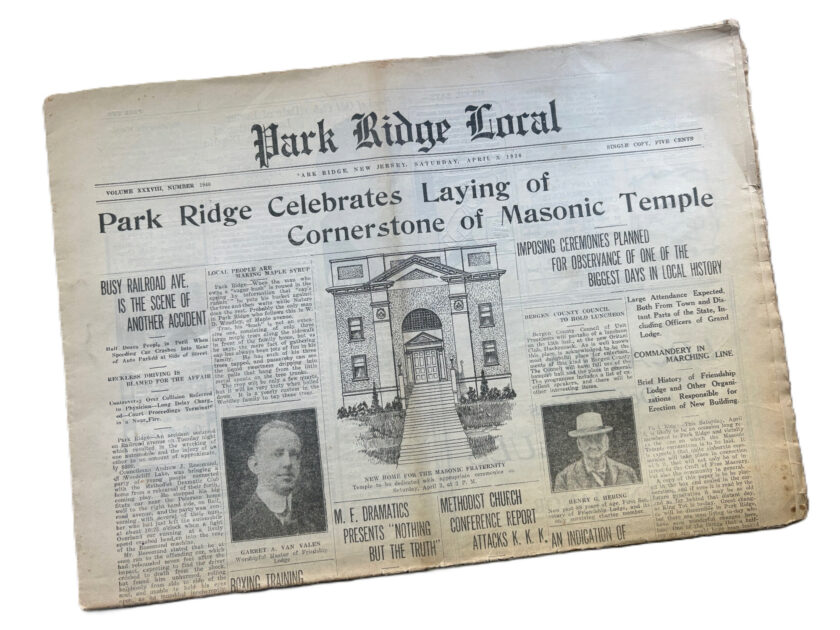
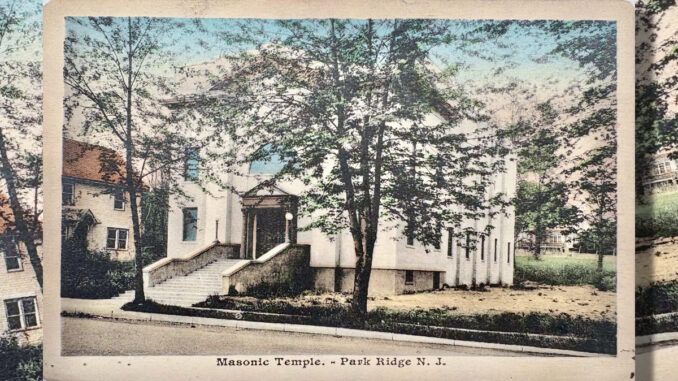
PARK RIDGE—“This Saturday, April 3, is likely to be an occasion long remembered in Park Ridge and vicinity, as the one on which the Masonic Temple cornerstone is to be laid,” reads an article in the Park Ridge Local published on that date in 1926.
“A copy of this paper is to be placed in the box and sealed in the cornerstone. If ever it is read by the future generation, it may be as old and as far behind that distant day as King Tut is today.”
This week we go back a century. The new temple of Fulton Friendship Lodge No. 102 had just risen on Magnolia Avenue — now called Kinderkamack Road. The large stucco building with its grand front entrance was then, and still is, one of the most impressive structures in the borough.
While the building was brand new in 1926, Masonry had a long history in the Pascack Valley. The original Friendship Lodge met together in 1870, a time when the entire area was still part of old Washington Township, and only a handful of farmers lived in this corner of Bergen County.
Bergen County had only two other Masonic lodges back then: one in Hackensack and the other in Closter. Getting to either of these locations from Pascack was a hardship in that era of horse-drawn conveyance over dirt roads. The winter season afforded the farmers practically the only time available to attend lodge meetings, and then the roads were frequently impassable due to snow drifts. They needed a place closer to home.
A general store owner, a doctor, and five farmers made up the charter membership. The three were Garret F. Hering and Owen J. Keenan from Montvale; Dr. Henry C. Neer from Park Ridge; Charles F. Neer from Woodcliff Lake; and James G. Hering from Hillsdale.
As Park Ridge historian John C. Storms wrote in 1926, “Let us for a moment consider how widely separated were the homes of the original members of the lodge. Nearly all of them lived in the old Pascack neighborhood, but that was a rather extensive and poorly defined geographically… Probably the combined population of the entire territory covered did not at that time exceed 500 persons.”
There were humble beginnings, to say the least.
The first meeting location was the upper floor of a carpentry shop. This building was on the west side of Pascack Road, about 100 feet back from the roadway, and nearly across the street from the Pascack Reformed Church. It was where John H. Storms had carried on his trade of manufacturing doors, windows, sashes, and blinds for local construction in the 1860s. The building was elevated on posts so that a horse could be led into its lower floor. The animal would be attached to a sweep and walked around and around to produce power for operating the saw and other machinery located on the floor above.
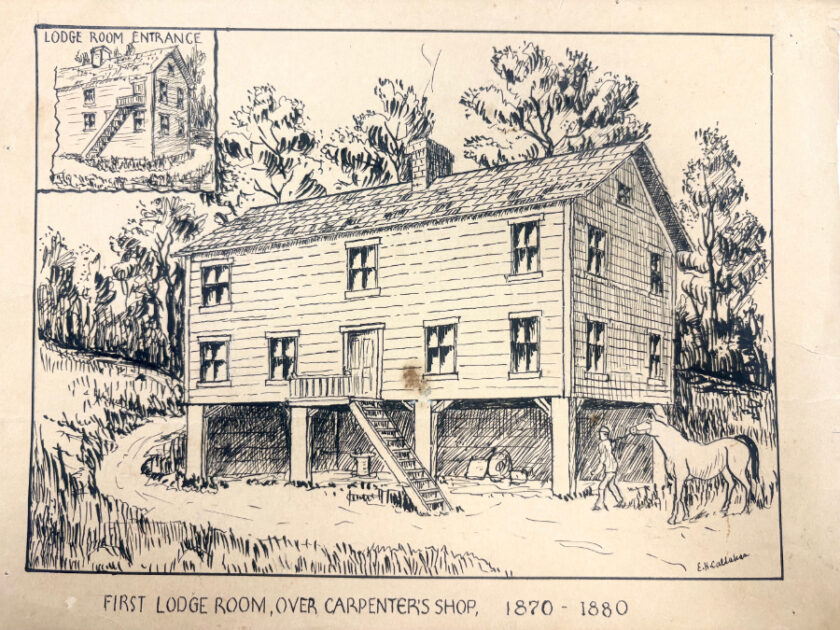
A fraternal group such as the Masons was an entirely new concept in this area. In fact, there was not a single lodge, society, or organization of any sort in the entire Pascack Valley, with the exception of the Pascack Reformed Church in Park Ridge, and those political groups who formed every spring and fall to get their bearings for elections.
Dr. Henry C. Neer became the first master of Friendship Lodge upon its constitution. He had moved to Park Ridge right after the Civil War and was the first physician in the Pascack Valley. Later on, he became the second mayor of Park Ridge.
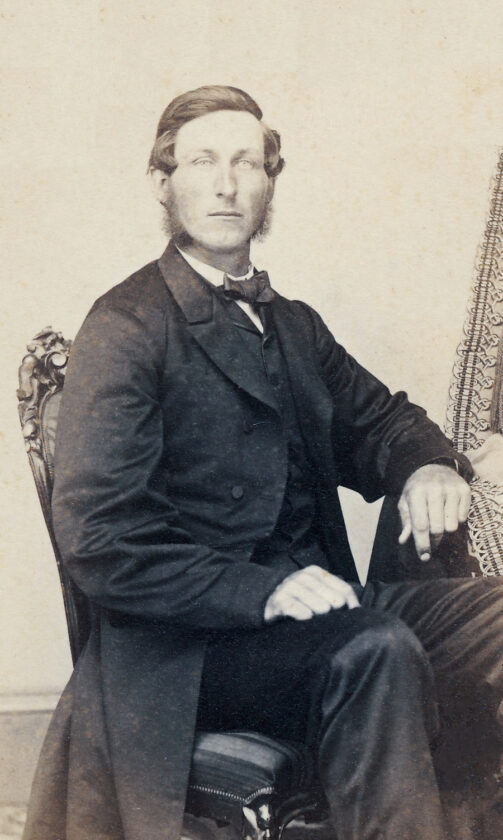
The original meeting place was demolished in 1880 and another constructed in nearly the same location on Pascack Road. By this time Dr. Neer owned the property, and so it was loaned to the lodge rent-free.
The final “borrowed” space was Foresters Hall, the home of another fraternal organization called the Ancient Order of Foresters. Built in 1893, this meeting place was on Kinderkamack Road opposite Madison Avenue (across the street from The James today). The lodge met at Foresters Hall from 1903 through 1925.
Ground was broken for the new temple at Kinderkamack Road and Perry Street in 1925, and the lodge moved in during the summer of 1926. Of the original seven charter members, only 88-year-old Henry G. Hering of Hillsdale, the first secretary of the lodge, lived to see the building.
On Saturday, April 3, 1926, a large parade led by the New Jersey & New York Volunteer Firemen’s Band marched through Park Ridge, beating and tapping drums and sounding.
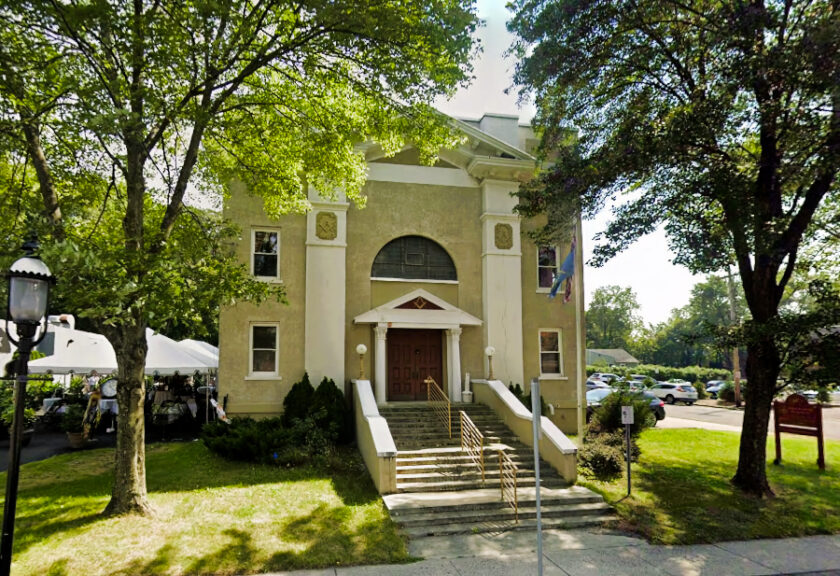
Arriving at the new lodge building, an impressive sight unfolded. Visiting Knights Templar members from the Ridgewood and Hackensack commanderies lined both sides of Kinderkamack Road.
Holding their swords high, they created an arch. Members of the Park Ridge lodge passed underneath to reach the speaker’s platform.
The afternoon’s ceremony culminated in the laying of the cornerstone with a time capsule inside. In addition to the aforementioned copy of the Park Ridge Local, placed in the copper box were various documents related to Masonry and the history of Park Ridge lodge, as well as an American flag and a collection of U.S. coins minted in 1926.