
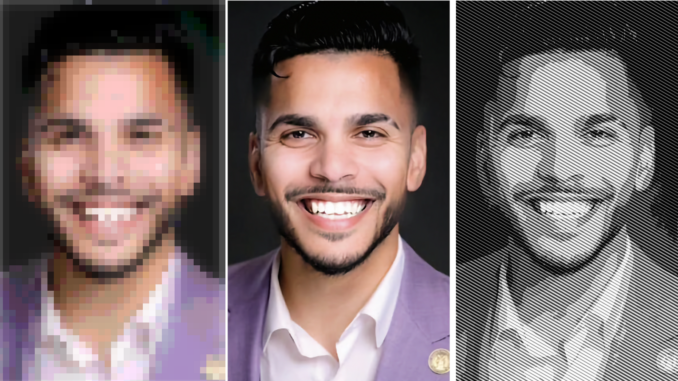
NORTHERN VALLEY—At 22, Intashan Chowdhury, MPA, became the youngest municipal administrator in New Jersey — and the first Bengali-American to hold the role in the United States. Now business administrator for Englewood Cliffs, he is known nationally for advancing innovation, equity, and operational efficiency in local government.
Chowdhury also serves as Englewood’s internal management consultant on smart-city strategy and A.I. integration; managing director of Government Strategy Group; director of the Municipal Innovation Summit; and adjunct professor at CUNY. His work spans clean energy, digital modernization, shared services, and workforce transformation, earning recognition from GovTech, Forbes, USA Today, NJBIZ, and the New Jersey League of Municipalities.
A Paterson native and summa cum laude Rutgers SPAA graduate, he continues to champion forward-thinking reforms while mentoring the next generation of public servants.
Hillary Viders: You have an impressive record of using technology to improve infrastructure upgrades in communities. Clean energy is a global issue. What clean-energy protocols have you initiated, and how successful have they been?
Intashan Chowdhury: In Englewood Cliffs and in my prior work, I’ve advanced clean-energy initiatives by aligning municipal actions with state and federal priorities. For example, in Prospect Park in my role as the borough administrator, I led the adoption of a clean energy plan — the first of its kind in the state that mirrors New Jersey’s Master Energy Plan — opening doors for over a dozen sustainability projects in partnership with Sustainable Jersey. This has allowed us to secure additional grant funding and reduce costs to taxpayers while making real progress on resiliency, efficiency, and climate readiness.
In Englewood Cliffs, we are building on this by submitting for a grant through Sustainable Jersey to do our own CEP, integrating energy-efficient LED lighting, soon to be leveraging smart poles with dual-utility functions, and setting the foundation for renewable-energy adoption across municipal operations. These projects have been successful not only in reducing long-term operating costs but also in positioning our community as a leader in sustainable innovation.
HV: You have also deployed A.I. in community management. How do you use A.I.?
IC: A.I. has become a tool for both efficiency and accessibility. We’ve used it to clear backlogs of records requests and meeting minutes, turning months of work into weeks. We’ve also applied AI to financial forecasting and operational planning, helping departments make data-driven decisions more quickly. Beyond the internal efficiencies, I see A.I. as a way to democratize access to government by creating tools like chat and voice platforms that give residents clear answers on permits, services, and schedules in just a few clicks.
HV: Do you see expanded use of AI in the future of Englewood Cliffs?
IC: Absolutely. We are only scratching the surface. My vision is a “two-click municipality” where residents can get almost anything they need from local government in two clicks or even by voice. That means expanding A.I. into areas like service requests, inspections, and public-works operations, while keeping a human touch for oversight and accountability. I also see opportunities to integrate A.I. into sustainability, workflows across departments, and smart-city projects — like using predictive analytics for energy consumption or real-time monitoring of infrastructure.
HV: What are the greatest challenges in your role as Business Administrator in Englewood Cliffs?
IC: The greatest challenge is balancing immediate needs with long-term vision. Residents understandably want to see tangible improvements now — such as better infrastructure (roads, sewers, sanitary sewers), navigating affordable-housing requirements, revitalized parks, and visible services — but my responsibility is also to build systems and infrastructure that will last 10, 20, or 30 years.
Before I arrived, many of our operations were outdated, and foundational structures had been neglected for years. That meant culture, accountability, and efficiency all needed to be reset before we could truly deliver on our potential.
At the same time, Englewood Cliffs has an extraordinary opportunity because of its location and corporate presence. With Samsung, LG, and other global companies calling us home, we are uniquely positioned to become the “Silicon Cliffs,” a hub for smart-city innovation, clean energy, and sustainable growth. The challenge is navigating limited resources, complex regulations, and sometimes political differences while modernizing neglected systems and laying the foundation for that innovation. It’s not easy work, but it’s essential if we want Englewood Cliffs to thrive today and for decades to come.
HV: What are the greatest rewards?
IC: The reward is seeing how local government impacts people’s daily lives. The buck will always stop at the municipal level. Whether it’s a newly paved road, a revitalized park, or the arrival of a major corporation that boosts our local economy, these changes directly improve quality of life. I take pride in knowing that the work we do doesn’t just sit on a shelf — it shapes the community in ways people can see and feel.
HV: Did you have role models who inspired you to pursue a career in public service?
IC: I’ve been fortunate to learn from mentors who believed in servant leadership. My family, especially my father, Golam Chowdhury, and mother, Syeda Chowdhury, instilled in me respect for community and hard work, and I’ve been guided by municipal leaders such as Robert S. Hoffmann, Yancy Wazirmas, Jerry Barberio, and professors at Rutgers SPAA who pushed me to think bigger about how government can innovate.
Growing up, I always modeled my approach around my favorite childhood athlete, Super Bowl-winning quarterback Tom Brady, and his mindset to be more about the process than the outcome — to enjoy the journey and pay attention to the details. I also look up to leaders who weren’t afraid to challenge the status quo, people who saw government not as a bureaucracy to manage but as a platform to improve people’s lives.
HV: How do you want to inspire the next generation of public servants?
IC: I want young people to see that government is not outdated — it’s a place where innovation can thrive and where you can make a tangible difference. That’s why I mentor students and teach as an adjunct professor. I tell them: if you want to change the world, you don’t have to wait until you’re in Congress or running a major company — you can do it right in your community. My hope is to show by example that public service can be both impactful and forward-looking.
Editor’s note: This feature has been edited for length and clarity.