
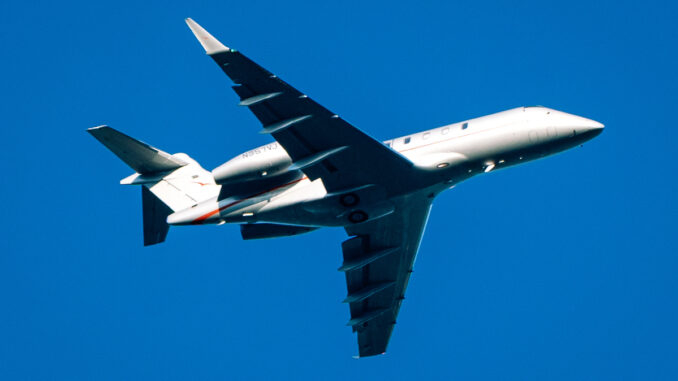
PARK RIDGE, N.J.—Assemblyman Robert Auth is pressing federal transportation officials to explain whether operations at Teterboro Airport comply with longstanding federal restrictions intended to keep the airport from functioning as a commercial passenger hub.
In a May 12 letter to U.S. Transportation Secretary Sean Duffy, Auth argued that increased private jet traffic over Bergen County communities may conflict with congressional limits historically intended to preserve Teterboro as a general aviation airport rather than “a de facto commercial facility.”
“These provisions were enacted to close public-charter loopholes, prevent de facto scheduled airline service, and ensure that Teterboro remains a general aviation airport rather than a commercial facility,” Auth wrote.
The letter, forwarded to Pascack Press by Park Ridge activist Audrey Herget and later confirmed by Auth’s office, references federal restrictions including prohibitions on scheduled charter operations, preservation of Teterboro’s longstanding 100,000-pound aircraft weight limit, and limits on FAA preemption authority. Auth asked the Department of Transportation to clarify how it intends to ensure compliance with those requirements.
Herget described what she characterized as increasingly concentrated low-altitude jet traffic over Pascack Valley communities located miles from the airport and without a seat at the table.
“For communities not adjacent or immediately next to Teterboro Airport, the issue is often misunderstood,” Herget said. “Neighborhoods in the Pascack Valley, 10 to 12 miles away, have been experiencing a highly concentrated pattern of low-altitude jet arrivals that repeatedly pass over residential neighborhoods.”
Aircraft, she said, often arrive on “continuous intervals,” passing overhead “every minute or two for extended periods of time.”
“The concern is not occasional aircraft noise,” Herget said. “The concern is the concentrated and repetitive nature of these flight paths which have become a constant source of disruption for suburban neighborhoods.”
Herget and Auth pointed to legislation advanced by former U.S. Rep. and two-term Englewood mayor Steve Rothman in 2003 and 2004 that seeks, as Auth wrote, “to prevent Teterboro from evolving into the functional equivalent of a major commercial airport such as Newark Liberty Airport.”
“That legislation was intended to limit the expansion of scheduled commercial-style operations and limit Teterboro’s operational role as a true overflow airport,” Herget said. “The airport has evolved in ways that circumvent the law, with increasing traffic volumes and flight patterns that place disproportionate burdens on suburban communities.”
The issue has become a growing focus — “a boiling point,” Herget said — for residents and local officials concerned about aircraft noise from jets approaching Teterboro.
Taxpayers for Aircraft Noise Solutions & Safety, known as TANS², a committee with its home on the Park Ridge webpage, describes itself as a community organization focused on finding “workable solutions” to aircraft noise and related safety concerns affecting Pascack Valley communities and neighboring towns.
The organization expanded its mission in 2024, adding “Safety” to its name and focus. TANS² says it is concerned not only with aircraft noise, but also the “volume, frequency, altitude, and size” of aircraft entering and exiting Teterboro Airport and their impact on area density, life, health and community environment.
According to TANS², voluntary noise-abatement efforts have not produced sufficient relief for residents in Emerson, Hillsdale, Montvale, Old Tappan, Oradell, Park Ridge, River Vale, Washington Township, Westwood, and Woodcliff Lake.
“The legislation we crafted to keep Bergen County communities surrounding the airport as suburban residential communities,” Herget said, “people did not move into neighborhoods expecting to live next to an airport, yet now they’re living as if they do.”
Frank DiScipio, a Paramus resident and attorney who became involved with TANS², said residents in communities farther north are experiencing frequent low-altitude overflights despite living well outside the airport’s immediate vicinity.
“I’m standing in my yard now talking to you and the planes come in approximately every three to five minutes at about 900 feet,” DiScipio said.
DiScipio, who said he lives roughly 7.5 miles from Teterboro Airport, said aircraft regularly pass over Paramus High School, East Brook Middle School and nearby recreational areas.
“As a community as a whole, not so great while parents are watching their kids play sports or kids are in school,” he said.
DiScipio said pilots already have access to an FAA-approved alternative approach route commonly known as the Route 17 approach, which TANS² argues would shift more aircraft over highway corridors instead of residential neighborhoods.
“The pilots have a choice to take Route 17 approach and hang a left further down, which would put them over highway traffic like we do in major airports like JFK, and simply don’t do it,” he said.
DiScipio said the route has been deemed safe by federal aviation officials and argued it should be used more frequently. He said the route is unpopular with some operators because it requires a left-hand turn during approach.
“It’s passenger comfort. They don’t love that turn,” he said.
“Why is this allowed?” Herget said residents believe federal legislation dating to 2003 and 2004 deserves renewed scrutiny from federal officials and New Jersey’s congressional delegation.
“To us, this is operating as a commercial airport with scheduled service, but they’re doing it under the radar,” Herget said. “We want the FAA and our legislators to look into why this is being allowed.” She said residents believe Teterboro increasingly functions like a scheduled passenger airport through private charter operators that allow travelers to book individual seats on recurring flights.
The Port Authority of New York and New Jersey’s aircraft noise complaints are verified for accuracy, compiled in a database, analyzed and mapped for reporting.
The agency says aircraft approach and departure routes are determined by FAA air traffic control and influenced by wind, weather, runway availability, airspace constraints, and safety considerations.
We requested comment from the Port Authority of New York and New Jersey regarding claims that Teterboro operations could be seen as conflicting with federal restrictions on the airport.