
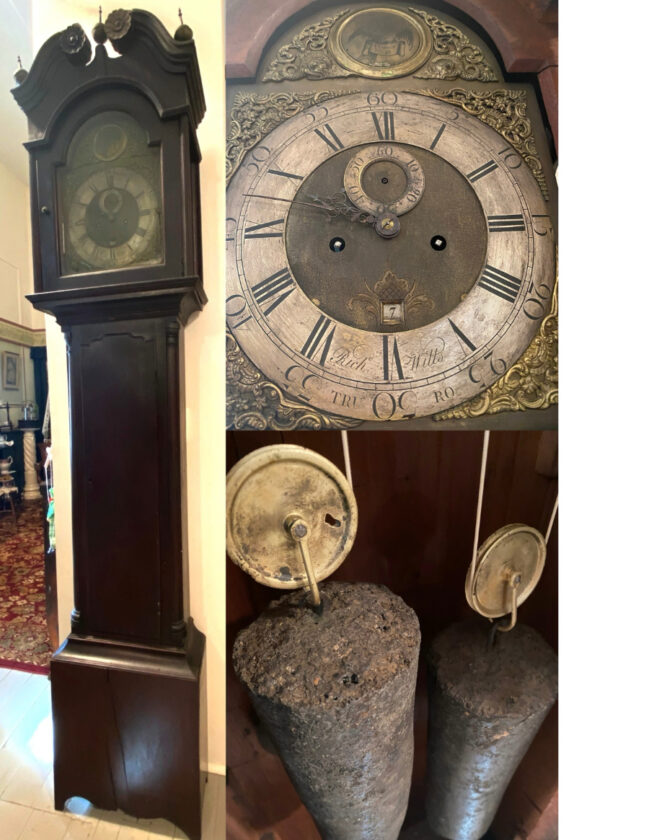
November 1776, New York City. After suffering a series of defeats, Gen. George Washington’s army has been driven out of Manhattan and retreated into New Jersey. The British have taken control of the city, nearly one-quarter of which has been left in charred ruins after the Great Fire. New York is under martial law, a place of turmoil and political volatility. And in a little shop in lower Manhattan, a clockmaker is busy at work, building the timepiece pictured on this page. It now stands in the Pascack Historical Society’s museum.
This was a milestone week for the 250-year-old grandfather clock —an excellent time to tell its story. We hope you will enjoy reading about this wonderful Hillsdale artifact.
This longcase clock came into the Pascack Historical Society’s possession through Judy Handwerg Williams, who grew up in River Vale. Judy’s roots in the Pascack Valley go deep. On her father’s side, the Handwergs were the family that started the River Vale Country Club. On her mother’s side, she can trace her ancestry back to the Pascack Valley’s earliest settlers.
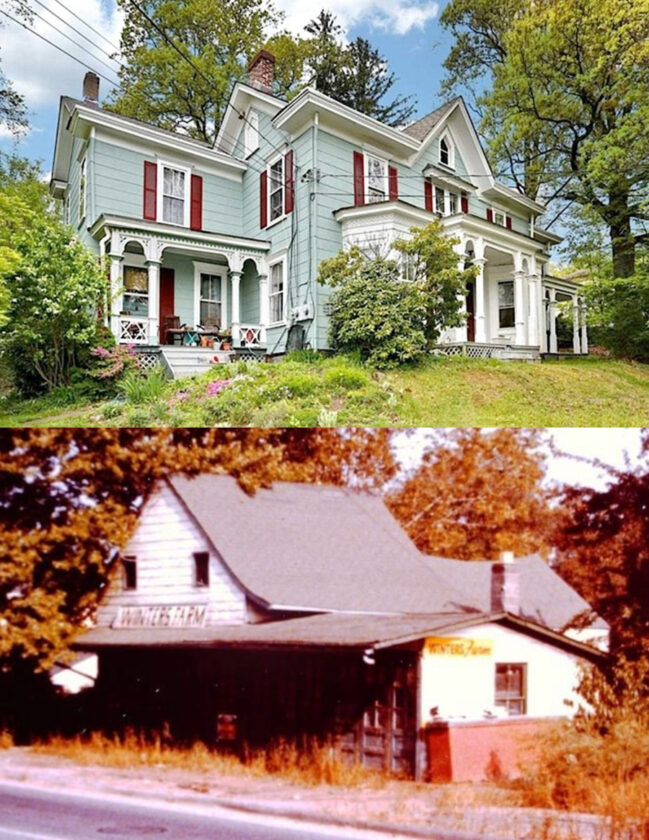
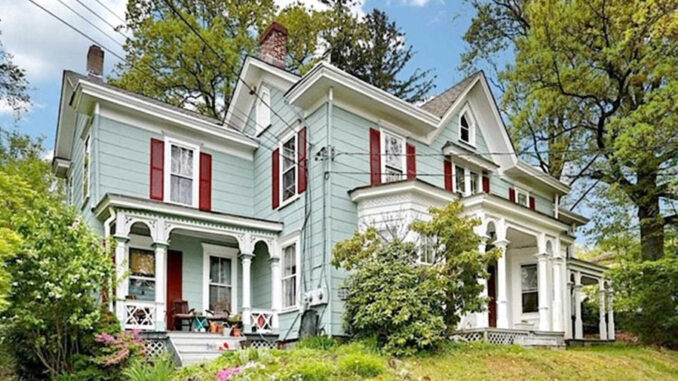
The house on the hill at 231 Wierimus Road in Hillsdale belonged to Judy’s grandparents, Chester and Helen Winters. Pascack Valley long-timers might remember that years ago they ran a farm stand across the street for 30 years until they retired in 1969. Chester died in February 1976, and Helen followed two months later. The home remained in the family, but in 2022 Judy and her brother put it on the market. The family had always talked about donating the 18th century clock, which long stood vigil in the dining room, to the Pascack Historical Society. Now the time had come to clear the house, and Judy called the museum.
Owners across time
The Italianate-style Victorian at 231 Wierimus dates to the late 19th century, but this replaced an earlier house that stood a short distance north and across the street, around the area of 300 Wierimus. The Winters property can be traced back within the same family since the 1760s at least. Back then this was Vanderbeek land, and the family built a sandstone homestead that served for generations.
Coenradus Vanderbeek of New York (b. 1695) married Angenitie Westervelt (b. 1690s) of Bergen County at the Dutch Reformed Church in Hackensack. They had a large family, and among their children was a son, Juryan (1730-1794). Juryan, sometimes alternatively spelled Jurrye or Yury on different records, married Marytje Ackerman (1734-1816). They had children Coenradus, Arie, and Maria.
Two old families were joined in 1789 when 18-year-old Maria Vanderbeek married 19-year-old Frederick Van Riper at the Paramus Dutch Reformed Church. The couple moved into the old Vanderbeek homestead at Hillsdale and had three children: Maria in 1790, Agnes in 1794, and Harman in 1800.
After Frederick’s death, Harman bought out the estate, which included about 127 acres, from his sisters’ families. He and his wife, Catherine Delamarter, raised a family there, with Harman residing at the homestead until his death.
After Harman Van Riper died in 1874, his will devised all the real estate to his son, Abraham (1825-1886). The land would later be divided between Abraham’s two children, Catherine and Daniel.
Daniel received the portion of the east side of Wierimus, including the old homestead, and Catherine receiving the land on the opposite side, where she and husband Sanford Bogert started building a new house—the current home on the hill at 231 Wierimus—in 1877. While in residence there, Sanford Bogert was elected as Hillsdale’s first mayor in 1894.
The house then passed to their daughter, Ada Bogert (1864-1960), who married Henry Winters, and thence to son Chester Winters, to daughter Beatrice Winters, and finally to Judy Handwerg Williams and family. It was an unbroken line going back centuries on the same Hillsdale land.
Colonial Clockmaker
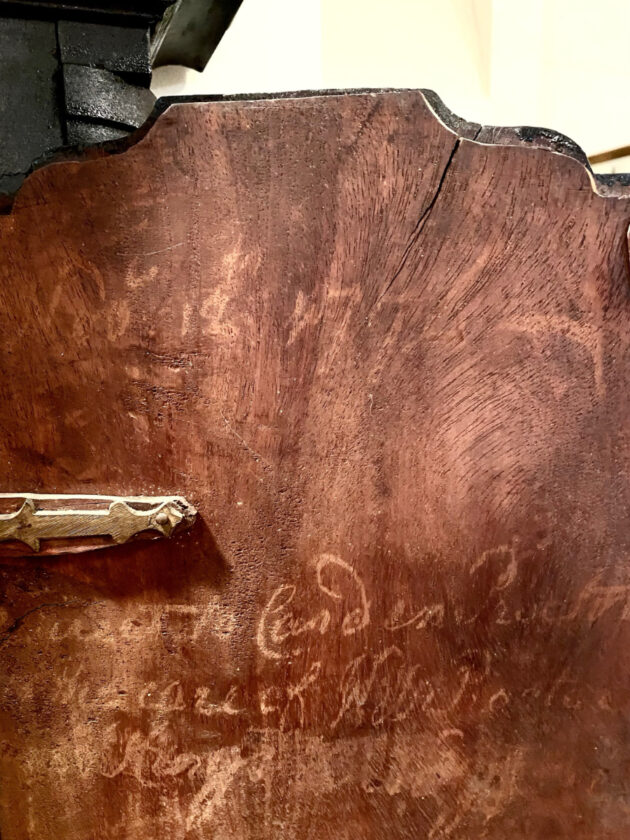
The clock’s cabinet has writing on the inside of the door. Four lines stand out in a color that is a few shades lighter than the surrounding stain, but it took some work to decipher what they say. We were excited to realize that the first line is a date: November 18, 1776.
The lines below the date read Deliver to Carden Proctor in care of Will Proctor, New York City.
A delivery note from the cabinet maker to the clockmaker—four lines of text, mundane in their time, that mean so much to us 250 years later.
Carden Proctor was a prominent clock and watch maker in lower Manhattan in the 18th century. William was his brother. By 1756, the Proctor shop was located on Queen Street—later renamed Pearl Street after the Revolution.
The clock’s movement was imported to America from a maker in Cornwall, in the southwest of England, and the face bears an inscription reading “Rich Wills, Truro.” Our research shows that Wills was rather well-regarded in his day.
According to Howard Miles Brown in his book “Cornish Clocks and Clockmakers,” “It is with Richard Wills that we reach the zenith of the Truro skill, and perhaps indeed that of the county. He began work about 1750 and was making clocks up to about 1805. Wills in his day speedily became a fashionable craftsman, if the quality and distribution of his work is any guide.”
The cabinet, standing at 92 inches, was almost certainly made in America, though the name of this colonial craftsman is lost to history.
Legend from the Revolution
At Carden Proctor’s shop, a Cornish movement had been married with an American cabinet, and the clock was ready for a buyer. Was the original owner a Winters ancestor?
According to family tradition, the clock was already in Hillsdale in the late 1770s. There is even a Revolutionary War legend surrounding it. In those days, Pascack Valley farms were ripe for the picking as soldiers passing through Bergen County foraged for food and supplies. They were known to steal valuables and destroy property. The rumble of approaching troops on the horizon would have the farmers scrambling to hide their most valuable possessions.
The 1953 book “Revolutionary War Days in Paramus” offers this:
“Much property escaped the invaders, such as the standing clock at the Van Der Beek, later the Van Riper farm on the Wearimus Road (now at Hillsdale). The grandfather’s clock was hidden in a box and buried on a hill on the farm before the arrival of the invaders. It is still in existence and is yet in running condition. The tradition of the clock was given to the compiler by Mr. and Mrs. Harry D. Winters, who live at the farm.”
Is there any truth in this story? All those who knew for sure are long gone. Either way, one’s imagination can run wild while thinking about the clock’s journey up until this point.
We picture the wrapped-up workings crossing the ocean in the cargo hold of an 18th century ship. We think of a busy clockmaker in his New York City shop. What does he see outside his window as he looks up from his work in the year 1776? We picture a clock crossing the Hudson River on a ferry, somehow surviving as it is jostled in a wagon on rutted, dirt farm lanes across the sparsely populated wilderness of Bergen County. We hope you will visit the museum soon and see this wonderful artifact for yourself.
Housed in a 150-year-old former chapel, the Pascack Historical Society’s museum tells the story of our local history through thousands of artifacts spanning centuries. It is open to the public every Sunday afternoon from 1-4 p.m. Admission is free.