
HILLSDALE—Amid frightening pushback from the Ku Klux Klan, Catholic residents of Hillsdale stood their ground in support of building a church in their town. Through their dedication, St. John the Baptist opened its doors on Hillsdale Avenue 100 years ago this week.
In the early 20th century, the demographics of the Pascack Valley were shifting. Protestant communities with Jersey Dutch roots were seeing an influx of Italian and Irish immigrants. By 1905, three Catholic churches had been built in the area within three years: St. Mary’s in Park Ridge (now Our Lady of Mercy), Assumption in Emerson, and St. Andrew’s in Westwood. The latter congregation, founded in 1889, was the oldest in the valley.
Not everyone welcomed this religious diversity. By the 1920s, the Ku Klux Klan had an active chapter in Hillsdale and counted many local white Protestants among its members. The hooded ranks sought to intimidate Italian and Irish Catholics because of their faith. They rode on horseback through Hillsdale in full regalia and held cross burnings at various sites around the community — including on the front lawns of those they intended to terrorize.
In a small town like Hillsdale, the hoods offered little anonymity. White robes could be seen billowing on clotheslines all over town the day after a rally. Many of the men wearing them were high-ranking officials from Hillsdale and surrounding municipalities. The group also drew traditionalists descended from the area’s early settlers who preferred to preserve the old order.
This was the local atmosphere in the mid-1920s, when Hillsdale’s Catholics began planning a church of their own. The pushback from the Klan began even before the first shovel touched the ground.
One of the congregation’s first tasks was securing a building site. Mrs. Helen Riley happened to have a vacant property for sale along the Pascack Brook on the south side of Hillsdale Avenue, directly across from her home.
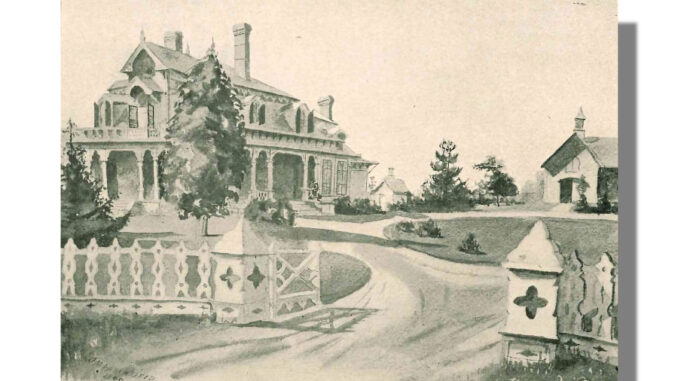
Mrs. Riley, 65, lived in a grand mansion with extensive grounds on Hillsdale Avenue near Patterson Street. Her late husband, John H. Riley, had been one of early Hillsdale’s most prominent citizens. He championed Hillsdale’s secession from Washington Township in 1898, served as a Bergen County freeholder in 1902, constructed the Riley Building on Broadway — still a major part of downtown Hillsdale — and was the fire department’s first president. The Riley estate, known as “Brookside Pines,” was regarded as the showplace of Hillsdale.
Members of the Ku Klux Klan warned Mrs. Riley not to sell her land to the Catholic group. In the most technical sense, she obliged them: she donated it instead. Construction began in spring 1925.
Later that summer, a lawn party outside Mrs. Riley’s mansion raised funds for the new church. With the half-built structure as a backdrop, hundreds gathered on her grounds for the sale of “fancy articles, candy, and cakes,” followed by dinner and dancing. Catholics from across Bergen and Rockland counties attended, raising $652 — roughly $12,000 today.
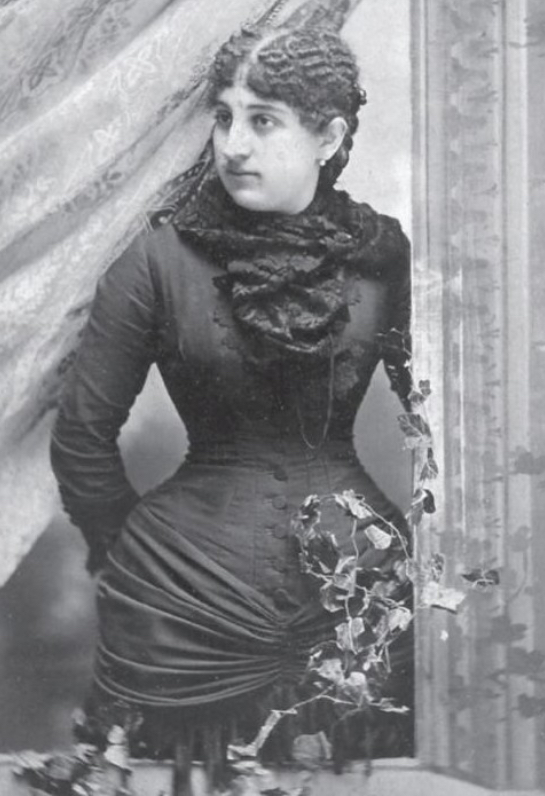
In addition to Mrs. Riley’s support, the building fund received a major boost from the family of Teresa Murray, a young widow raising four boys on Large Avenue. Her sister Mary, also recently widowed and left with a substantial sum, was likewise generous. Word of their support spread quickly — and the Klan took notice.
One day, a group of Klansmen rode to the Murray home towing a large burlap-wrapped cross soaked in gasoline. They burned it on her lawn as she and her children watched from inside. On a second visit, the Klansmen brandished flaming torches and threatened to burn the house down. Whether they truly intended to carry out the threat or meant only to intimidate is unclear; the Murray home, still standing today, was not burned.
The Klan also targeted John Buckley of River Vale, among the most active members of the church committee. Born in Ireland, Buckley immigrated as a child. He and his wife had a 7-year-old daughter, Rita, when the Klan arrived one night at their Cedar Lane home.
A handful of robed figures appeared at his door, threatening to run him out of town if he continued supporting the church effort. Buckley told them to try it and shut the door in their faces. He never wavered in his work.
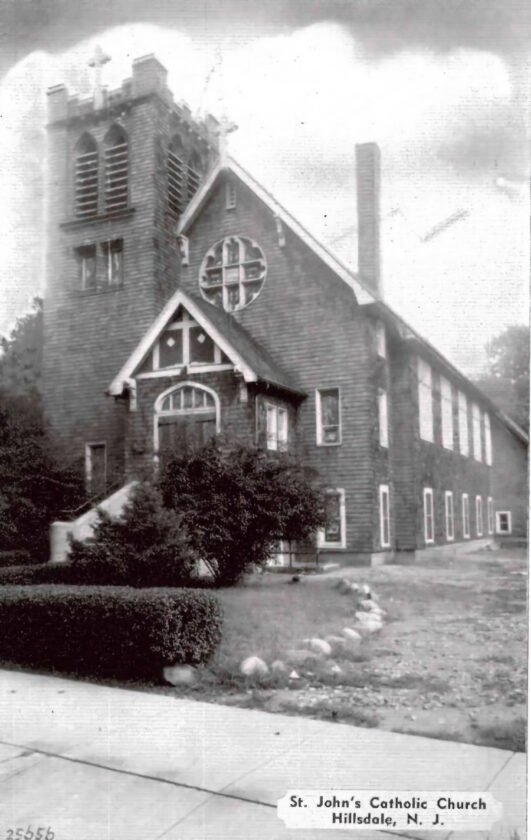
As 1925 progressed, the church took shape under the design of R.C. Sconce, a Westwood architect. Inspired by 15th-century Gothic architecture, the building featured a square belfry tower, archway, and stained-glass rose window. The exterior was shingled, stained silver-gray with white trim.
A “soft opening” took place on Sunday, Dec. 6, 1925, when the first Mass was celebrated by Father Thomas O’Donnell of St. Andrew’s in Westwood. Every pew was filled, with many more standing. It would be another two years before the parish welcomed its first resident pastor, Rev. Cornelius Corcoran.
The following Sunday brought the formal dedication of the church, attended by roughly 250 Hillsdale residents and many visitors.
The original church building at 455 Hillsdale Avenue still stands and now houses commercial space. In the 1960s, a larger church was constructed across the street to accommodate a growing Catholic population amid the Pascack Valley’s midcentury housing boom.
A century after its debut, St. John the Baptist Church and its school, St. John’s Academy, remain pillars of the Pascack Valley community. The same cannot be said of the Ku Klux Klan, which, by all accounts, faded from local presence by the 1930s.