
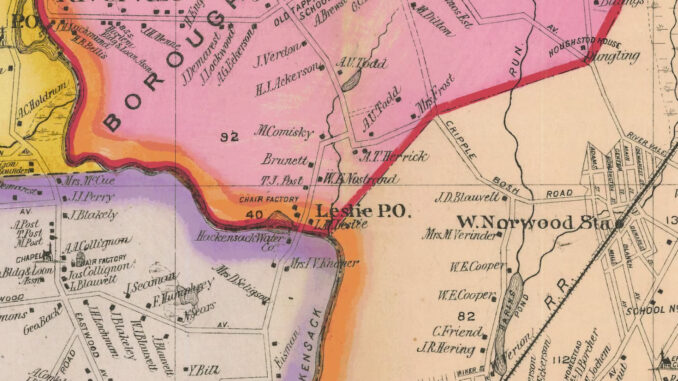
A section of River Vale was once known as Leslie. It was named for Leon M. Leslie (1862–1937) — landowner, postmaster and inventor.
Born in Ohio, Leslie spent his early years in the Midwest before moving east in the 1890s. He married in New York and settled in what is now Old Tappan. The Leslie family lived in the old Nicholas Collignon homestead on the east side of Westwood Avenue near the Hackensack River.
Leslie owned considerable land in what would become Old Tappan and River Vale. Today’s Cooper’s Lane and a portion of Westwood Avenue north of it were once known as Leslie Road. Where Westwood Avenue crosses the river was Leslie’s Bridge.
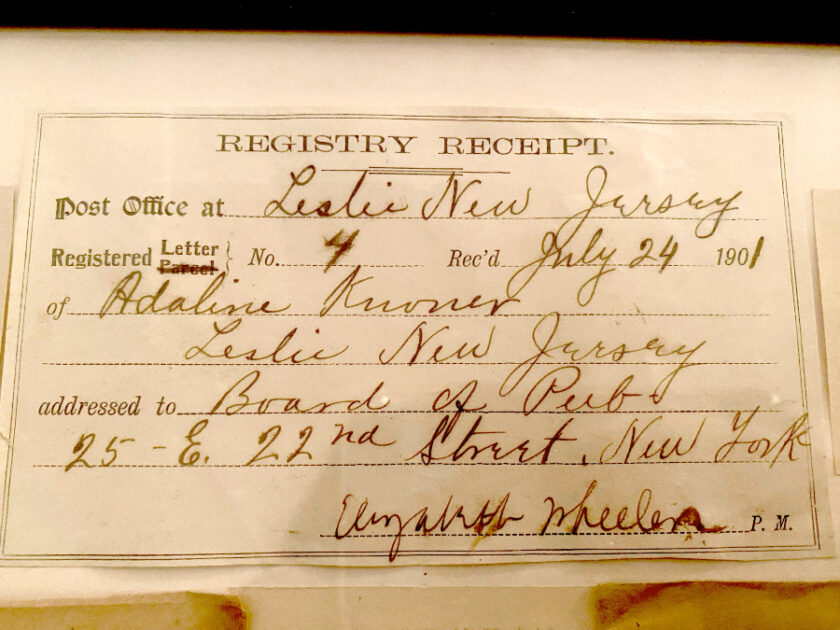
From 1900 to 1903, he operated the Leslie Post Office from his property. The Pascack Historical Society museum holds a receipt for a registered letter sent July 24, 1901, from Adaline Knoner through the Leslie, New Jersey, post office. The receipt is signed by postmaster Elizabeth Wheeler, who held the position from 1900 to 1902. Elizabeth and her husband boarded at the Leslie residence.
In the post office’s final year, Leon Leslie himself served as postmaster. In 1903 the office closed, and its operations were transferred to Westwood.
In 1901, the Westwood Chronicle announced a new rural free delivery route that would bring home mail delivery to area residents for the first time. The route was described as running “from Westwood, through Old Hook, to Bogert’s Mills, Eastwood, Leslie, River Vale, and Old Tappan.”
The 1905 New Jersey Census lists Leslie’s profession as inventor. He devoted years to perfecting an innovation still in daily use: the loose-leaf binder.
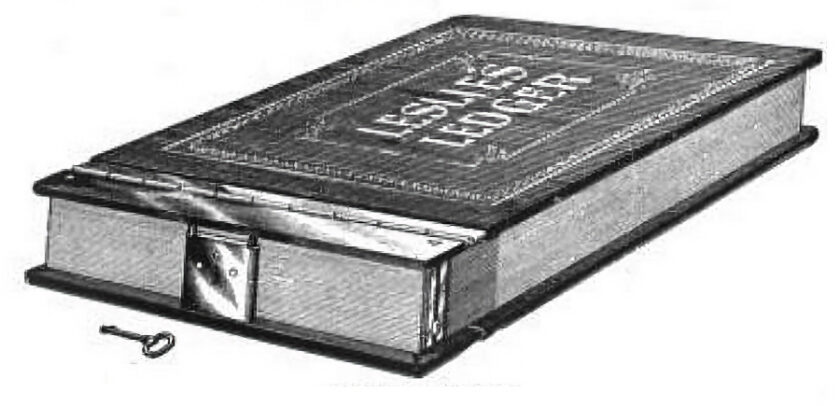
Marketed as Leslie’s Ledger, the product was a boon to bookkeepers. Pages could be removed, replaced and reorganized — a major advantage for businesses with constantly changing accounts that needed to remain alphabetized. Before the loose-leaf system, keeping ledgers orderly often required copying information into entirely new books.
An 1896 advertisement explained: “With this ledger a firm can start with 50 accounts and increase to 50,000, or to any number, without having to reopen a single ledger…Inactive closed accounts may be removed and filed…Reopening a closed account…only necessitates its return from the transfer binder to its position in the ledger.”
Leslie’s Ledgers were used by major firms including American Exchange Bank, National Lead Co., Chicago Daily News, Monarch Bicycles, Elgin Watches and Western Union Telegraph Company. National Lead was among the original 12 stocks listed when the Dow Jones Industrial Average debuted in 1896.
Leslie continued refining his design and received additional patents. In 1904 he secured a patent for a binder with rings that could lock open, allowing pages to be added or removed more easily — an early version of the three-ring binder found today in nearly every student’s backpack.
Annual Museum Curiosity Sale March 14 and 15
The Pascack Historical Society will host its annual Curiosity Sale Saturday and Sunday, March 14–15, from 10 a.m. to 4 p.m. at the museum’s lecture hall, 19 Ridge Ave., Park Ridge. Admission is free.
The indoor sale features antiques and collectibles ranging from Victorian-era pieces to mid-century items. This year’s offerings include fine china, glassware, crystal, pottery, artwork, lamps, jewelry, linens, antique books, Easter items and a large selection of American Brilliant Period glass (1890–1910).
Organized and staffed by volunteers, the sale is an important fundraiser supporting preservation work, educational programming and museum operations.
Cash and Venmo will be accepted.
PHS members current on 2026 dues receive early access Friday, March 13, from 11 a.m. to 2 p.m. Membership begins at $40 and includes admission to lectures and a subscription to RELICS, the Society’s publication.
For more information, visit pascackhistoricalsociety.org, email info@pascackhistoricalsociety.org or call 201-573-0307.