
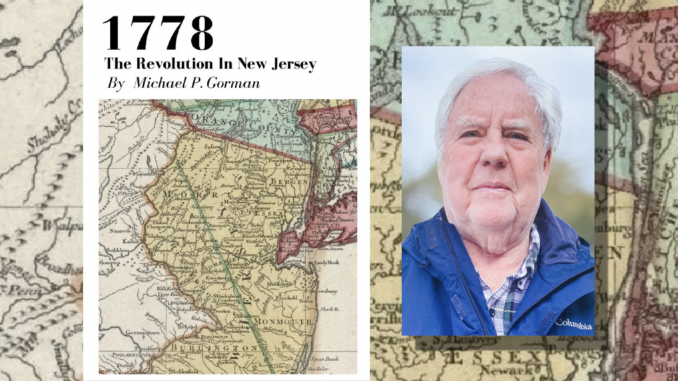
WESTWOOD—WE HAD THE PLEASURE recently of spending time with Michael P. Gorman, an Oradell resident and longtime volunteer with local historical organizations, and the author of 1778: The Revolution in New Jersey (Barnes & Noble Press, 2024).
The work is built on five years of research and one central argument: that 1778 was the hinge year that transformed the Revolution from a desperate fight for survival into a credible international cause—one that would help secure American victory.
He’s not trying to make money off it, he said. In fact, he has donated many copies to libraries and institutions and says he does not take profits from sales.
“The biggest satisfaction,” Gorman said, “is when people tell me they see somewhere they never would have gone before—because they didn’t realize what was right here.”
Gorman’s work has also drawn notice in Trenton. A joint legislative resolution, presented in connection with his recent Barnes & Noble signing in Paramus, commends his book and recognizes his service as a docent at the Hermitage Museum and a member of the Bergen County Historical Society. The citation frames his work as especially timely as New Jersey reflects on its role in the nation’s 250th anniversary.
‘Think of it like a comic book’
In a chat at our offices in Westwood on Feb. 16—Presidents Day—Gorman traced his love of history back to an early lesson from his father. In grade school, he said, his report card showed middling performance in math but stronger marks in reading. His father pointed out how easily Michael and his brother could explain the plot of a comic book—then offered a reframing.
Why not treat history the same way, his father asked: not as a math problem, but as a story?
Gorman uses that idea throughout the book, presenting the Revolution not as a set of disconnected facts, but as a narrative full of turning points, near-misses, and ripple effects—narrative logic that draws people in.
He and his brother lost their voluminous comic book collection, sadly. The Superman, Batman, Archie, etc. library took wing as so many have: decluttered by mom.
Why 1778?
The book opens with a quote often attributed to French foreign minister Charles Gravier, Comte de Vergennes: “The power that will first recognize the independence of the Americans will be the one that will reap the fruits of this war.”
Gorman uses that idea to frame 1778 as a bridge year.
In his view, the American victory at Saratoga in October 1777 triggered a “sea change” in European expectations about the war’s outcome. If the Americans could defeat a major British force, the thinking went, the cause might be worth backing more openly and decisively.
France, he said, began to deepen its support with ships, supplies, and other aid. By 1778, the war was no longer only a colonial rebellion playing out in woods and fields; it was becoming part of a larger geopolitical contest.
Gorman pointed to the Battle of Monmouth Courthouse, fought on June 28, 1778, as one of the year’s defining moments. Whatever readers know of the battle, he sees it as symbolic: Americans, trained and hardened, could stand their ground against the British Army and emerge with a new confidence.
“The Americans became the pursuer, not the pursued,” he said.
Where Bergen County fits in
For Pascack Valley readers, the most interesting local takeaway may be a counterintuitive one: much of the region, Gorman argues, was comparatively peaceful during the war—at least compared with more heavily trafficked corridors and population centers.
The reason, he said, was geography and roads.
British movements tended to follow strategic arteries that mattered most for reaching key crossings and routes north toward Rockland County and the Hudson River corridor. In between, much of what is now Bergen County was farmland. With the Palisades forming a natural barrier to the east, there was often “no reason to come over here,” as he put it, except for reconnaissance or foraging.
That context matters, he said, because it helps explain why one event looms so large for this area: the Baylor Massacre, also known as the Baylors Massacre of 1778, in which British forces attacked sleeping Continental troops in River Edge.
Gorman covers that episode in Chapter 21, he said, and he describes it as an isolated shock in a region that otherwise saw less direct action.
“Why you didn’t have more events like that around here?” he asked rhetorically. “Because it was peaceful around here.”
Our friends at the Pascack Historical Society’s John C. Storms Museum can tell you all about the Baylor Massacre. Start at PascackHistoricalSociety.org.
A book born from volunteering
Gorman said his historical work grew out of decades of involvement with local history groups and sites. His interest in history, he said, has always been an avocation rather than a career—and he speaks with the ease of someone who has spent years explaining the past to visitors.
He holds an M.A. in history and political science from Fairleigh Dickinson University and is a member of Phi Alpha Theta, the national history honor society.
Now retired, he continues to contribute as a board member, historian, and volunteer at the Hermitage Museum in Ho-Ho-Kus. He is also a past board member of the Bergen County Historical Society.
He sees the nation’s upcoming 250th anniversary as an opening to reintroduce Revolutionary history not as a faraway myth, but as a local landscape of real places—historic homes, museums, and sites that many residents pass without connecting them to the larger story.
He mentioned the Hermitage as one location that can spark those connections. He enjoys the way a single detail can prompt new questions about the people who lived through the era and the networks they belonged to.
More broadly, he said, he wants readers to come away with the sense that New Jersey was not merely a backdrop to the Revolution, but one of its central stages—especially in 1778.
‘I bet he does’
That impulse shows up in small moments. At a museum, he said, he once found himself sitting on a bench outside when visitors asked him questions. He answered one, then another—and soon strangers were pointing others in his direction.
“We don’t know,” he recalled one couple saying to a newcomer, “but I bet he does.”
For Gorman, those exchanges are the point: making history accessible, conversational, and worth stepping into.
“If you phrase it correctly,” he said, “somebody might say, ‘That’s interesting.’”
And for a region preparing to commemorate the country’s founding (our towns are all over this, notably Park Ridge and Westwood in recent coverage), that starting point—that matter: the rekindling of curiosity close to home.
1778: The Revolution in New Jersey was published through Barnes & Noble Press in 2024 and is available through retail and library channels.