
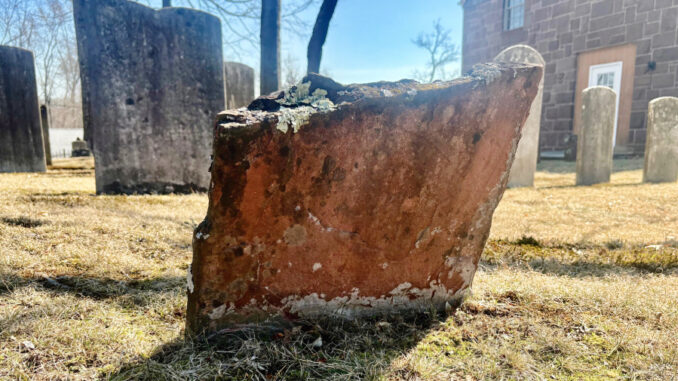
PARK RIDGE, N.J.—As part of the borough’s ongoing 250th anniversary celebration, Mayor Keith Misciagna told the Borough Council on Aug. 11 that he hopes to honor two Revolutionary War veterans buried in Park Ridge.
No plans have yet been set for either ceremony, the mayor said. The two veterans, Peter G. Haring and Jacob Wortendyke, are little known among residents—an oversight the mayor hopes to correct.
Pascack Press recently featured Haring’s Revolutionary War service and focused on the deteriorating condition of his tombstone. He is buried in Pascack Reformed Church Cemetery, just off Pascack Road.
See “Featured local patriot to get ‘250th’ honor,” by Michael Olohan, June 21, 2026, thepressgroup.net, and “A patriot’s grave in the Pascack Cemetery,” by Kristin Beuscher, March 17, 2026, thepressgroup.net. Beuscher also writes the Pascack Press Back in Time column.
Misciagna said current discussions call for replacing Haring’s headstone with an appropriate marker and holding a memorial service that honors his service and recognizes his role in the Revolutionary War.
Misciagna said several meetings have included town historian Ralph Donnell; administrator Maggie Giandomenico; Councilman Robert Metzdorf, liaison to the Jedh C. Barker American Legion Post 153; and the post’s commander, Ryan O’Hara.
“We discussed an appropriate military design for the Haring headstone and the framework of a proper military ceremony, including an honor guard and a 21-gun salute, once we are ready for the dedication. I will invite our local, county, state and federal representatives to the service,” Misciagna told us.
The mayor said he met with Pascack Reformed Church pastor Sharon Grossman, who wants to see the ceremony take place. Misciagna said they have a mockup of a headstone.
“We are looking for any individuals who are interested in making monetary donations or volunteering their time,” he said.
Misciagna said local veterans groups are “happy to honor what we all believe is our first military veteran.” He hopes other groups and local schoolchildren will become involved in the effort to honor Haring.
Moreover, Misciagna said meetings will soon be held with a committee that plans to research Jacob Wortendyke’s history in Park Ridge more deeply. We reached out to local historians and the mayor and will follow up when more details about Wortendyke’s life become available.
The borough recently acquired the Wortendyke Homestead at 12 Pascack Road and plans to restore the structure. The historic Dutch-style homestead was built between 1750 and 1755 and is listed on the New Jersey and National Registers of Historic Places.
Haring’s local history
Born in 1760, Peter was the fourth of eight children of Garret Haring and Cornelia Lent of Old Tappan. During the American Revolution, he served as a private in Capt. Abraham Haring’s company of the Bergen County militia, which was raised at Harrington. That township then included all the land between the Hudson River on the east and the Saddle River on the west, extending north to the New York border.
After the war, he married Elizabeth in 1784, when he was 24 and she was 21. They went on to have 11 children, with the youngest arriving in 1807. Unlike many women of her era, Elizabeth survived all of these births and lived to be 58, which was a long life for the time.
The Haring homestead was off what is now Grand Avenue in Park Ridge. Their farm was quite large. Records show that Peter was taxed for 140 acres in 1790. During Peter’s lifetime, present-day Park Ridge and the surrounding area were known generally as “Pascack.”
Peter’s service in the militia would have put him at odds with many of his neighbors. The majority of the Jersey Dutch who lived at Pascack were Loyalists.
Peter died on Oct. 25, 1818, and Elizabeth followed three years later. Husband and wife were laid to rest at the Pascack Cemetery, next to the church they helped establish.
—With reporting by Kristin Beuscher