
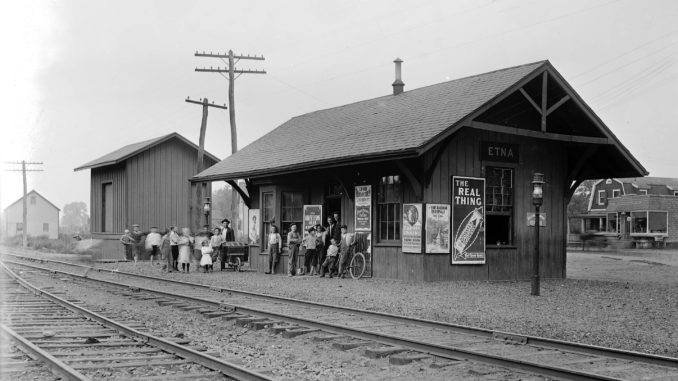
EMERSON—“Mrs Emil Buerk of this village is gaining a reputation as an up-to-date woman of nerve and prowess,” began the New York Herald on Jan. 12, 1896.
The story comes out of the rural village of Etna, a station stop on the Erie Railroad line through the Pascack Valley. In 1909, the growing community would be renamed Emerson.
In the 1890s, farmland in Etna was being subdivided for residential development through the New York and New Jersey Investment Co. At the forefront of this effort was local real estate man and Etna resident George A. Weaver.
Mrs. Buerk was among the company’s buyers. She and her husband had paid more than $1,000 for a grocery store and a house opposite the railroad station — serious money at the time, and real estate was a whole lot cheaper in the Pascack Valley in those days.
Then came the problem: After the Buerks missed a payment, Weaver pointed to a clause in the contract that he said allowed him to retake possession of the property.
Both sides retained lawyers as they tried to sort it out. Meanwhile, Mrs. Buerk moved her business — and nearly all of her household effects — to another building about 300 yards east of the station, leaving a portion of her belongings in the disputed property to assert her claim. As she waited for a decision from the courts, she kept a constant watch on the building.
“Yesterday her vigilance had its reward,” the Herald wrote. “When Weaver, aided by a lawyer, attempted to enter the premises, Mrs. Buerk went after them with a club.”
“Mrs. Emil Buerk went on the war path this morning against a real estate agent and lawyer,” added the New York Tribune, which also picked up the story.
“Her weapon was a heavy club, which she wielded so effectively that both men were put to flight. Efforts at argument were useless. Mrs. Buerk flourished her formidable weapon so vigorously and in such close proximity to their heads that the lawyer and his client left the house.”
The Tribune added: “As the lawyer went away from Etna standing on the rear platform of the train, the last thing he saw was the storekeeper’s wife shaking the stick alternately after him and Weaver, who went up the road on foot.” The story of Mrs. Buerk and her wooden club became the talk of the town in Etna, but the saga did not end there. A few days later, as the woman kept a watchful eye, a furniture van pulled up in front of the building.
“A furniture van drawn by four horses was driven up to the unoccupied building, and Peter McCloskey, the driver, soon had his assistants unloading furniture. Before they had taken out half a dozen articles, Mrs. Buerk ran across lots to the scene brandishing her hickory club. McCloskey and his assistants surrendered and drove away.”
The furniture was the property of Paul Decker of Jersey City, who said he purchased the building and land from the investment company.
“Justice Angell and two constables appeared later, but Mrs. Buerk was not intimidated. Mr. Decker agreed with the justice that conciliation would be better than force. Mr. Decker said that if necessary he would seek redress from the company.”
Whatever happened to the Buerks is unknown — but for a short period of time, Etna earned a strange kind of fame in the New York papers, thanks to the woman who took matters into her own hands.
