
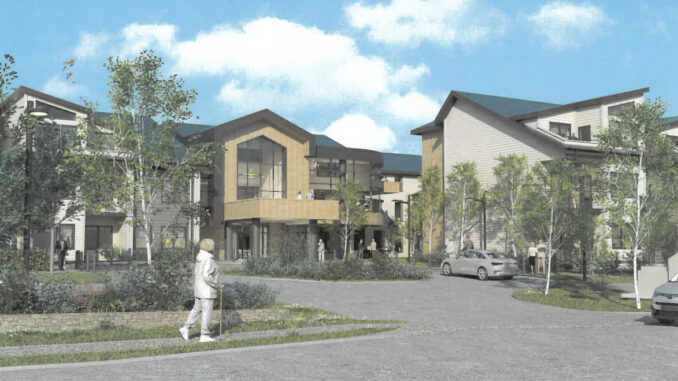
EMERSON—Residents urged the Land Use Board on Jan. 8 to reject a proposed 122-unit assisted living and memory care facility at 70 Main St., citing concerns about the project’s size and height, stormwater runoff and traffic impacts in the surrounding neighborhood.
The plan would replace the former Armenian Nursing Home and Rehabilitation Center on the 3.5-acre site. Testimony is scheduled to continue Thursday, Jan. 22, at 7:30 p.m. at Borough Hall. The board does not broadcast or record its meetings.
An architect, the operator’s chief operating officer and chief clinical officer testified at the Jan. 8 hearing, describing the project’s design, operations and state licensing requirements. The applicant’s attorney said expert testimony is expected at the next hearing.
Proposal and variances
The application, filed by Armenian Home for the Aged, Inc., seeks approval for a 122-unit facility consisting of 86 assisted living units and 36 memory care units.
The prior nursing home on the property, which has been closed since April 2020, operated in Emerson for 83 years and provided 86 beds.
At the meeting, officials said the new proposal would require at least two “d” use variances — including one for a health care use in a residential zone and another related to building height — a higher standard than the “conditional use” approval that previously applied to the nursing home.
Applicant attorney Brian Chewcaskie said the proposal qualifies as an “inherently beneficial use” under municipal land use law. He said Armenian Home for the Aged, Inc., would own the site and operate it in conjunction with Viva Senior Living.
Chewcaskie said the New Jersey Department of Environmental Protection is reviewing the project for stormwater and riparian buffer impacts.
Testimony on design and operations
Architect Michael Freedman, of MDSA Architects in New York City, said the plan breaks the facility into three connected wings intended to “reflect the scale and rhythm of nearby homes” and blend into neighborhood surroundings. He said building setbacks from Main Street would help reduce the appearance of mass from the street.
Freedman said the facility would have about 40 employees working three shifts around the clock. He said the facility would be regulated by the state Department of Health and would provide 24/7 nursing coverage.
Freedman said the project includes three parking lots totaling 63 spaces, with access points from Main Street, Broad Street and Glenwood Avenue. He said two ground-mounted signs are proposed along Main Street and Broad Street for the owner-operator, “Sireli Senior Living, A Viva Senior Living Community.”
Christopher Metternich, chief operating officer for Viva Senior Living, said the company operates about 1,600 assisted living units in 12 states and employs about 2,000 people, including in New Jersey.
He said the Emerson facility would staff about 40 employees over three shifts and would receive an average of six to eight deliveries per week.
Metternich said the facility would provide 10% of its beds for Medicaid patients. He cited caregiver ratios of 15 residents per caregiver in assisted living and 10 residents per caregiver in memory care, comparing those ratios to higher ratios in nursing homes.
Afrika Parks, Viva Senior Living’s chief clinical officer, described the state licensing process, including certificate-of-need review, background checks and inspections prior to licensure. She said licensing requirements for nursing homes and assisted living facilities are “very similar” and that the state typically conducts annual inspections during a facility’s early years of operation.
Public comments
Seven residents spoke during public comment, raising objections about the project’s footprint, height, increased impervious coverage and potential stormwater runoff in a single-family residential zone.
Several also said the building would be visible from nearby streets and homes and asked for clearer public access to application documents and project renderings.
Michelle Whitney-Rizzo, who said she organized an online petition opposing the proposal, read a letter listing objections including density, traffic and safety concerns, parking and driveway configuration, flooding and drainage, neighborhood character and environmental impacts.
[She provided a copy of her letter to Pascack Press; we’re run it in this week’s Letters section, and welcome additional voices. — Ed.]
Nicole Argenzia, a Broad Street resident and councilwoman, said a nursing facility approved by the board in 2012 “was half the size of this” and did not include deliveries or parking on the Broad Street side.
She said the proposed building’s scale would not fit the surrounding area.
Irene Whitney cited traffic concerns near curves by Villano Elementary School and Emerson Junior-Senior High School.
Amy Mara, a Jefferson Avenue resident and the school board vice president, said she wanted more information on traffic and emergency access, the amount of permeable surface on site, and how deliveries and trash pickups would be screened from neighbors.
She also raised concerns about memory care residents and site security near Main Street.
Resident Adam Strobel asked where the public could access application documents and project renderings. Mayor Danielle DiPaola requested that the borough make the link easier to find on the municipal website.
Application documents are posted under the Land Use Board’s materials for the Armenian Home application.