
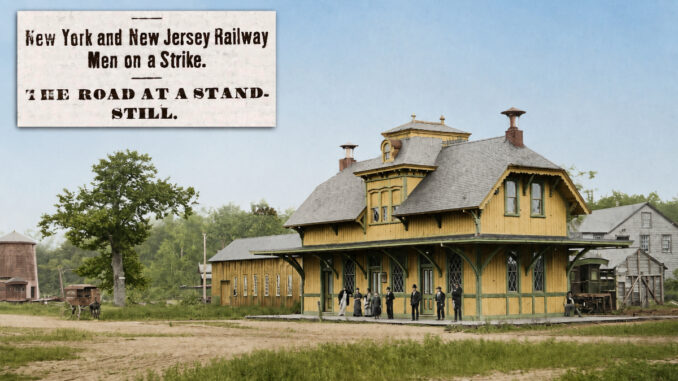
PASCACK VALLEY AREA, N.J.—By August 1876, the railroad workers on the Pascack Valley line were fed up. For months, they had gone without pay. Now it was time to send a message. This week, 150 years ago, the trains stopped running.
The railroad had come to the Pascack Valley only six years earlier. The lower portion of the line, which included modern-day Emerson, Westwood and Hillsdale, opened in 1870. Construction continued northward the following year, along the east side of the Pascack Brook through Woodcliff Lake (then called Pascack), and continued into Park Ridge and Montvale before connecting to the existing railway in Nanuet. On May 29, 1871, the full Pascack Valley line opened for the first time.
Before the trains, a trip to New York City took hours in each direction by stagecoach and ferry. In 1859, things got a little better with the opening of the Northern Railroad, which went through Closter. A stagecoach ran from Park Ridge to that station, picking up folks along the way as it meandered through Hillsdale, Westwood and Emerson before heading east.
The building of our own line through the Pascack Valley opened up this area to the outside world. A train station was constructed in each village along the tracks. Travel, communication, access to goods and services from outside the area — all of these things became easier. The people quickly grew accustomed to this new convenience, and they relied on it.
In August of 1876, for the first time in six years, railroad service stopped.
“The employees of the New Jersey and New York Railroad struck yesterday on account of the non-payment of their wages,” wrote The New York Times on Aug. 22, 1876. “For the last eight months the conductors, engineers, brakemen, trackmen, and switchmen have failed to receive any money from the company.”
During those eight months, the men had been paid in written IOUs that railroad officers promised to make good on. The local general stores and other businesses had accepted these notes in exchange for goods for the first few months, but some had never been reimbursed. The stores needed cash, not promises. They refused to accept the notes any longer.
“In consequence, the families of the men for the past five months have been in great distress,” wrote The Times. “The men informed the officers of the railroad of the condition of affairs, yet no money was given to them.”
The Bergen Democrat wrote on Aug. 25, 1876, “For eight months past the engineers have been promised their pay, and placing confidence in those promises they continued working, although the families of many of them were suffering for the necessaries of life.”
Why were the men not being paid? A New York Times reporter did some investigating. He learned that the New Jersey and New York Railroad Company had overextended itself expanding its track and adding to its fleet of locomotives and passenger cars, and now there was no cash to pay the men who made them run.
On Saturday afternoon, Aug. 19, 1876, the first train that left the Jersey City depot did not go farther north than Hillsdale. The second train stopped at the same station, and all the ones that followed did as well, until the track was backed up with locomotives.
This must have been a dismaying sight for the president of the railroad, David Patterson, who lived in Hillsdale and owned a huge part of the land there. He had a beautiful Second Empire-style mansion on Hillsdale Avenue, just west of the aptly named Patterson Street. In the 19th century, this was one of the grandest estates in the area.
Now the railroad workers were making a statement right under the company president’s nose. They didn’t just stop the trains. They disabled them.
“On Saturday night, the men removed the throttle valves and couplings from the engines and hid them in the woods,” The Times wrote. “The passengers who resided at Stony Point [at the end of the line] had to pass the night at Hillsdale or walk the other 20 miles, and this very few attempted.”
The trains stayed in place all day on Sunday. On Monday morning, commuters arrived at the station only to learn that the railroad men were still holding out.
The railroad secretary issued a statement asserting that it was actually the workers who were being unreasonable.
“Almost all of the men have been paid to May 1, and some to date. Measures were being taken to pay them in full when they struck — a suicidal piece of business on their part, as it puts it out of the power of the company to do anything,” the statement read. “Practically, the company is not more than three months behind [in wages]. A great deal of the present trouble is owing to the fact that in paying the men, there was some discrimination shown, in order that those who needed the money most might get it.”
With the Pascack Valley line at a standstill, it was back to the old ways of traveling.
Genest Ottignon, a well-known Civil War veteran who lived in Westwood, resumed the stagecoach service. He drove the stage back and forth from Westwood to Closter so that people might utilize the Northern Railroad line, which continued running.
A group of men from Park Ridge who had business in the city traveled in their carriages to Allendale to catch the Erie line. One of them did not have a return ride home and had to walk from Allendale to Park Ridge. There were many similar stories.
“Pedestrianism was promoted by the strike on the railroad,” the Bergen Democrat declared.
The strike lasted five days. As it continued, the railroad’s financial troubles came to a head. On Aug. 22, 1876, the company went into receivership. After a negotiation with receiver Valentine L. Lary that went back and forth via telegraph, the men agreed to return to work. Their stipulation was something that we all take for granted 150 years later: They wanted to receive their wages on a regular schedule. Going forward, payday was to be on the 15th of every month — and this time, in cash.