
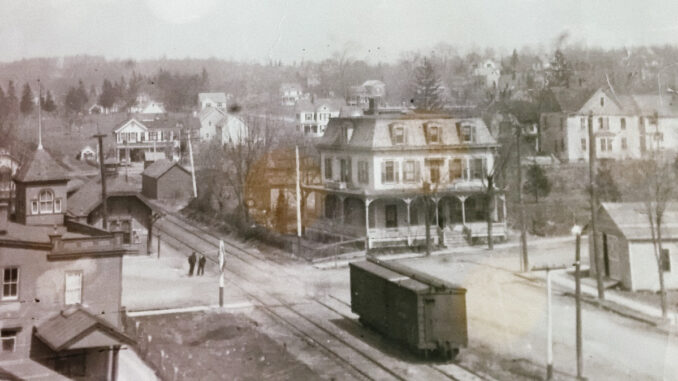
PARK RIDGE—“A narrow escape from serious injury or perhaps from instant death occurred at the Park Avenue crossing of the railroad, Park Ridge, at about 6 o’clock Monday evening, when a train struck an automobile,” wrote the Westwood Chronicle on Feb. 17, 1916.
This week we go back 110 years for a close call that was the talk of the town in the days that followed. The story spread quickly not just because of the accident itself, but because the group had nearly been killed returning from a funeral.
The vehicle in question was a motorized hearse—what the newspaper described as a “closed funeral automobile.” This was an important distinction at the time, when just a handful of years earlier horse-drawn funeral coaches were the norm. It had just been in service for the funeral of Mrs. Mary A. Schaefer of Spring Valley Road, Park Ridge. The 74-year-old was buried at North Bergen.
On their way home after the interment, the group inside the automobile included the widower, Mr. William Schaefer, as well as his niece, Miss Mary Brown, and the family housekeeper, Miss Augusta Glumlick. There was also a family friend, the funeral director, and the chauffeur. Their destination was the Shaefer residence, which sat on a large property on the east side of Spring Valley Road, just about across from modern-day Brae Boulevard.
The party of six was traveling in the darkness of a February evening, in what must have felt like an icebox on wheels. Vehicles, of course, were unheated back then, and the area was in the middle of an intense cold spell. Monday night—at the time of the accident—the temperature had plummeted.
Early Tuesday morning thermometers across the Pascack Valley were reading from 6 to 12 degrees below zero.
Coming up Railroad Avenue (now called Broadway) in Park Ridge, the driver was attempting to turn left across the tracks onto Park Avenue. He failed to see the 6:15 passenger train that was about to pull into the station.
At the last second, to avoid a direct collision, the chauffeur turned his automobile to the right, parallel to the oncoming train. The hearse received a glancing blow from the locomotive—but the force was enough to overturn the car and carry it some distance down the track.
At the time, there were no gates at any of our local railroad crossings. When approaching the tracks, it was up to the driver to notice the warning signs and be on the lookout for a train.
While the chauffeur’s mistake had caused the accident, it was also his quick action at the last moment that thwarted death for the funeral party.
Aside from shaken nerves and some bruises, the only person with more serious injuries was funeral director Mr. Robert Morton, who was cut about the face and head by the broken glass.
Railroad crossing gates were installed in Park Ridge in 1979—more than a century after the tracks were put down. Borough officials and local citizens pressed the state government and railroad for 22 years to have them installed before it finally happened.