
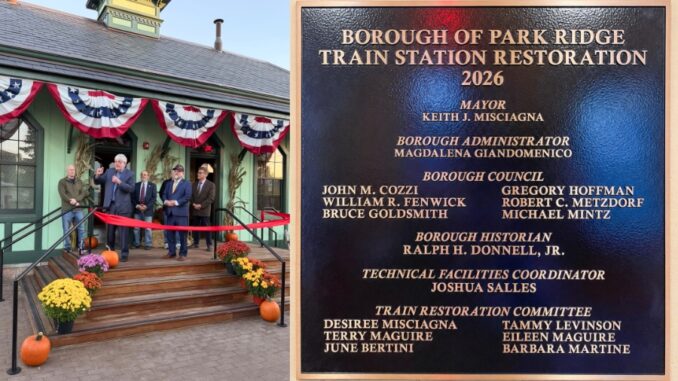
PARK RIDGE, N.J.—More than 100 residents, public officials and a former Park Ridge mayor gathered Oct. 20 to celebrate the grand reopening of the borough’s newly renovated historic train depot, originally opened for Pascack Valley train commuters in 1871.
“The heart of Park Ridge is beating again,” Mayor Keith Misciagna told Pascack Press after the ribbon-cutting ceremony. “Not since [President] Ulysses S. Grant have we had this building in the shape it’s in right now. And I’m thrilled.”
The mayor said he hopes to soon start restoring the borough-owned Frederick Wortendyke Homestead, 12 Pascack Road, a historic home dating to the 1750s, acquired in late 2024 for $580,000 by Park Ridge. (See “County panel steps up for a borough gem” by John Snyder in the Oct. 12, 2026 Pascack Press.)
Borough Clerk Maggie Giandomenico told us that the estimated cost of restoring the station was around $900,000, with restoration work costing $680,000, plus about $100,000 for a required change order and $125,000 for a historical architect’s professional services.
She said funds would come from a $412,000 county Open Space Trust Fund matching grant, matched by a similar amount from the local Open Space Trust Fund.
Moreover, she said Park Ridge received a $147,000 “transit village” grant from the state for upgrades.
Giandomenico noted that without matching funds from its local Open Space Trust Fund, the borough might not have been able to get the county Open Space funds for restoration. She noted that a ballot question this year in Park Ridge seeks to continue that funding and make the local Open Space Trust Fund permanent. Other projects supported by local funds included Memorial Park improvements, the North Fifth Street acquisition, Davies Field improvements and the Sulak Lane basketball court, she said.
Misciagna and former Mayor David Grubb (served 1984–1988) talked about the significance of restoring the 1871 rail station.
“I am thrilled because this is very important to the community. It’s the most important building in Park Ridge. Our motto is ‘By industry we flourish,’” Misciagna said, noting “the railroads are what made us what we are today.”
“To have this in this condition now warms my heart,” he added.
Misciagna said the train station was almost destroyed about 40 years ago. He credited the hard work done then and over the past year or so, thanking municipal employees for their roles “behind the scenes” in making the restoration happen.
He also thanked councilors and noted the important role of Park Ridge’s Open Space Trust Fund in getting county and state Open Space funds for the borough. He said the local Open Space funds “do great things for us,” including restoring the downtown station.
Misciagna also mentioned the critical role played by George Peed, his wife, Penny, and a band of volunteers in the late 1970s and early 1980s who helped rescue and restore the deteriorated train station, which faced possible demolition.
“Without them this building would be in the ground right now. What he did was he saved it,” said Misciagna, noting they were the original savers of the building.
He said the station was constructed in 1871, when Ulysses S. Grant was president and the United States had only 37 states, with Nebraska being the latest addition. He said artifacts inside the station include a 37-star flag and a few historical pictures, most of them from George Peed. He urged the crowd and residents to come in and view the restored train station and its history.
Misciagna acknowledged the assistance of borough historian Ralph Donnell Jr. and Kristin Beuscher, a historian with the Pascack Historical Society and author of Back in Time, Pascack Press’s popular local history column. He called them “resources” who help keep local history alive.
“So thank you for helping make this the way it’s supposed to be,” said the mayor.
Former Mayor David Grubb, who served from 1984 to 1988, said the building still exists because of a group of volunteers led by George Peed, who took on the station’s rescue as a project starting in 1981.
“The building was literally falling down. It never had a foundation,” he noted. He said the volunteers “literally lifted the building up and put a proper foundation underneath it, and then set it down again. That’s the reason we still have the building.”
He said that to match the original station paint, volunteers went down to the original layer and went to Benjamin Moore to produce a batch that matched the color from 1871.
“This was all volunteer,” Grubb noted of the prior rescue and restoration.
Almost exactly 40 years ago, on Oct. 11, 1986, the newly rescued and restored Park Ridge train station was unveiled at an official ceremony.
“It was a project of love for the entire community, it was all volunteer work,” said Grubb. He said the town spent no tax dollars on its rescue and restoration in 1986, except for the cost of a site plan.
“Let’s all thank George Peed, and his group of volunteers. That’s the reason why we’re here today,” said the former mayor, remembering the all-volunteer effort that kept the station intact and historically accurate.
As mayor, Grubb was at the 1986 restoration’s grand opening ceremony. He showed a Pascack Press reporter a 1986 newspaper clipping that documented the occasion, including a photo of Grubb at the ceremony.
Misciagna said the newly restored station has a new cupola, a new slate roof similar to the original, all-new copper flashing and woodwork reflecting its 1870s origins. The interior is furnished with long wooden benches for waiting passengers, historical photographs, a potbelly stove and a working bathroom.
Building the Park Ridge station
When Pascack Press toured the station, two easels featuring historical station photos and write-ups by historian Kristin Beuscher were displayed. One display, “And the next station stop is Park Ridge,” offered a brief history of the railroad and train stations.
“When the Hackensack & New York Extension Railroad Company said they would have their express trains stop in Park Ridge in the morning only if the town built a depot, the townspeople gathered funds and made it a reality. Constructed in the Railroad Gothic style with board and batten siding and balloon roof with matching window lines, the station was completed in October of 1871,” the display notes.
It continues: “Its location marked the crossing of the railroad with the old road to Tappan (now Park Avenue). The center of action in the town shifted to Hawthorne and Park avenues, thence known as Depot Square. By the mid-1970s the station had fallen into disrepair and it was deemed unfit for occupancy.
A restoration effort began in 1981 and the station was restored to its original splendor. It was re-dedicated on Oct. 11, 1986 and today the station, painted mint green with hunter green accents, is on the National Register of Historic Places.”
Architect traces the railroad’s influence on the Pascack Valley
The railroad helped turn Emerson, Westwood, Hillsdale, Woodcliff Lake, Park Ridge and Montvale from rural crossroads into commuter communities, architect and professional planner William J. Martin notes.
Daily rail travel to Hoboken and onward to New York opened new possibilities for residents and businesses. The depots became centers around which downtowns and neighborhoods developed.
“These station depots weren’t just transit points — they were the civic anchors around which commercial districts formed, street grids expanded, and neighborhoods took shape,” Martin told Pascack Press Oct. 21
Park Ridge’s depot has an additional distinction: Residents funded and built it themselves to secure a stop on the line. Martin sees that investment as an early expression of the community pride behind later efforts to rescue and restore the building.
Martin describes the depot’s architecture as “Carpenter Gothic / Stick Style,” pointing to its board-and-batten siding, bracketed eaves and proportions typical of small 19th-century commuter depots.
Many wooden depots of that era were demolished or heavily altered, he said. Park Ridge’s survival preserves a physical link to the period when rail service shaped the valley’s growth.
He places the restoration within a broader local preservation tradition that includes the Wortendyke House and the borough’s early stone farmsteads.
“The borough has repeatedly chosen to preserve its historic fabric rather than replace it,” Martin said.
The building carries several kinds of significance, he explained: architectural character, a place in the borough’s historic core and a connection to the region’s development.
There is a distinction in the terminology, too. A “station,” Martin notes, is a named point on a railroad timetable, even without a building. The “depot” is the physical structure.
He says that structure tells a continuing community story: “It is a physical reminder of how Park Ridge came into being, how it grew, and how it continues to value its past.”
— Interview with William Martin by staff writer John Snyder