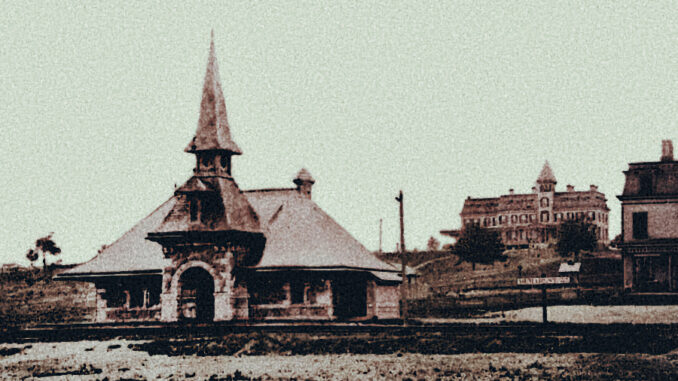
DEMAREST, N.J.—The location of this 1880s photo should be easy to place—the Demarest Railroad Station has been a focal point in town since it was built in 1874, and it has changed little over time.
What might have some readers puzzled is that castle-like building on the hill in the background. In the latter half of the 19th century, that was a hotel.
After the railroad came through in 1859, the Northern Valley changed dramatically. Now easily accessible to New York City by ferry and rail, our little towns became tourist destinations for city dwellers who wanted a taste of the fresh air, open space, and country life. Hotels sprang up to house summer visitors.
Constructed in 1860, Demarest’s three-story wooden hotel could provide accommodations for about 200 guests. It was probably built and operated early on by Ralph S. Demarest—the town’s namesake and a state senator who helped bring the railroad through—but in the succeeding decades, it changed hands and names more than once.
In the 1870s, the operation was Harrington House, followed by Murray Hill House when it was under the ownership of New Yorker John B. Murray. By the 1880s, it was called Hotel Tenakill, and in the 1890s, it was the Hotel Highview.
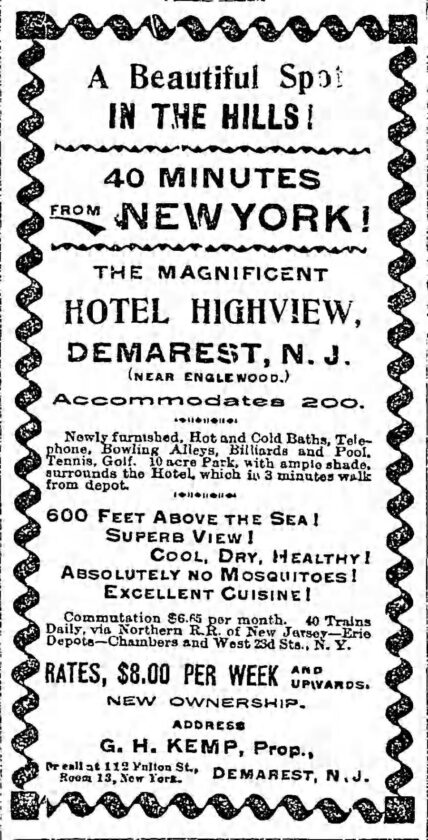
“Noted for high grounds, pure spring water, pure air and perfect health. No malaria and no mosquitoes,” reads an 1879 newspaper advertisement for the hotel.
In 1878, the New York World reported, “The Murray Hill House, at Demarest, on the Northern Railroad, is overrun with beautiful girls, and not one single man there to charm them or be charmed.”
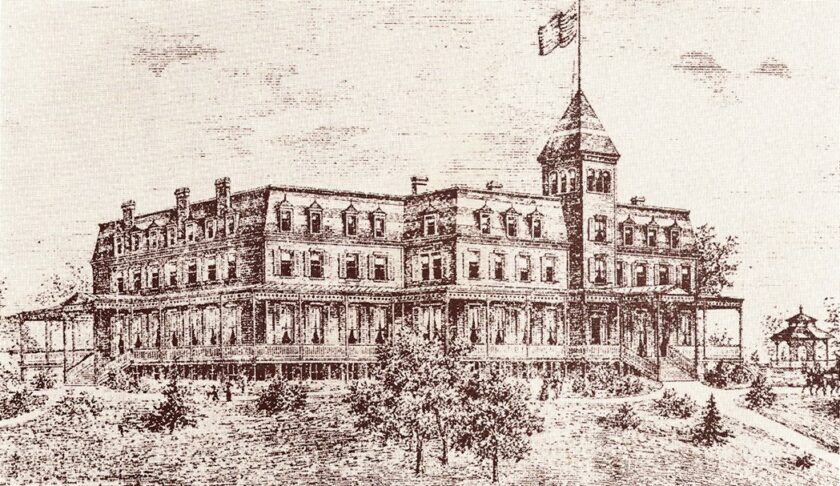
A boardwalk ran down the hill in front of the hotel and connected it with the railroad station. The Tenakill Brook was deeper and wider than it is today, with a center island, bridges, docks, and footpaths upon which hotel guests strolled to take in the scenery.
The hotel was advertised widely in New York City newspapers and attracted a well-to-do clientele. Its proximity to the railroad was a huge benefit—some families stayed all summer while the fathers used the Northern Railroad to commute into the city for work each day.
In addition to billiards and bowling on-site, guests could play lawn tennis, canoe on the pond, or venture over to the Knickerbocker Race Track—the present site of Northern Valley Regional High School—to watch the horse races.
By the time the Brooklyn Eagle wrote the following report on June 19, 1898, the Hotel Highview’s amenities had expanded considerably:
“The hotel is a magnificent structure, costing $70,000 to build, and is fitted with every modern convenience. In style, it is Queen Anne, and it is surrounded by 13-foot piazzas. The hotel park contains 10 acres of well-kept and beautifully shaded lawns and groves, with tennis courts, croquet grounds, rustic seats and tempting walks. In the club house are bowling alleys, billiard and pool rooms…there are golf links in the neighborhood, while the magnificent cycling roads of northern New Jersey make the hotel as easily accessible on the wheel as by the cars.”
With this glowing review, the hotel, then under proprietor G.H. Kemp, began the summer of 1898 on a high note. A month later, however, the place made headlines again, this time for the wrong reason. Burglars had blown open the safe and made off with a tidy sum and a collection of guests’ expensive jewelry.
The New York Times reported on July 18, 1898, “At 2 o’clock this morning an explosion of great force awakened the hundred or more guests in the Highview Hotel.”
Kemp sprang from his bed and raised his window in time to see two men running across the hotel grounds toward the road. He fired two shots at them. One of the men stumbled, and Kemp was sure his bullet had hit its mark, but then the man continued running.
“An investigation was made, and it was found that the doors of the large safe had been blown across the hotel office, and that the thieves had obtained $300 in checks, all of which were endorsed, and also $450 in cash, besides several envelopes containing jewelry belonging to guests.”
That $750 in cash and checks is equivalent to about $30,000 today—not bad for a night’s work. The windows in the office were shattered in the explosion, and the furniture was wrecked. As it was dark outside, and the men were running away from Kemp, he could offer no useful description of them.
Just two years later, the hotel was destroyed in a fire. The Demarest Methodist Church stands at its former location.