
TOWNSHIP OF WASHINGTON, N.J.—A team of Montclair State University students studying the township’s tree canopy health told the governing body that projections indicate local tree canopy coverage could fall below 40% in 2032, which is considered “not optimal” and may present potential health impacts for vulnerable populations, including infants, elders and certain people with preexisting medical conditions.
However, the MSU students reported that the township’s tree canopy had declined only about 6% overall between 1985 and 2023 — nearly four decades — and suggested ways local officials and residents could work to improve and expand tree canopy coverage.
They noted that one area of town saw tree canopy coverage decline by 15% over the same period.
The Montclair State University student team presented its findings during a special council meeting Monday, Aug. 3, at 11 a.m. The meeting was livestreamed and can be viewed in the council’s YouTube channel at WCTV-NJ.
The students’ study and presentation were part of the local Green Team’s efforts to highlight the issue of local tree canopy loss. The five students are interns with Montclair State University’s PSE&G Institute for Sustainability Studies, and they worked this summer studying the local tree canopy and residents’ perceptions of trees and tree canopy loss.
Councilman Tom Sears, a longtime Green Team member and advocate, helped facilitate the MSU students’ study. He said tree canopy loss was a “very important issue” that Green Team members have focused on for years and thanked the students for their work and presentation.
Based on the data they developed, the students estimated that tree canopy coverage could drop below 40% by 2032, which research has shown may affect vulnerable populations. As future actions, they suggested the township assess air quality near areas with reduced or minimal tree canopies and recommended that it continue community outreach to increase residents’ engagement with the importance of green spaces and trees.
In reaching their conclusions, the students conducted a 20-question community survey at four locations over four days; produced a “planting guide” for residents to promote trees; created easy-to-understand graphics about tree canopy impacts; and participated in community education outreach, including the town’s 250th anniversary event.
The survey reached 140 respondents — 80 residents and 60 nonresidents. Among residents, 74% noticed a decrease in trees in their neighborhoods, and 79% noticed an increase in construction in their areas.
Residents and nonresidents were nearly equal in recognizing that tree canopy loss affects public health, at 86% and 87%, respectively. Equal shares of both groups, 33%, recognized all the potential benefits of a strong tree canopy.
The students also created a “planting guide for residents” that explains the township’s 2-to-1 tree replacement policy, offers a list of native plants and cites the “50 Best Trees For NJ” list and other successful planting guides.
Through discussions, the students found that most people removed trees only when they had been damaged by storms or affected by diseases that could not be treated.
For continuing education, the team created an online StoryMap feature that residents can access through a QR code. It highlights the benefits of a strong tree canopy and the data collected and shows satellite snapshots of tree canopy coverage in four areas of the township, comparing data from 1985 with data from 2023.
Several councilors noted the dramatic differences between the two data sets, which can be seen by swiping from side to side on the screen. Sears said the “amount of loss is unbelievable during this time frame” and noted that is why the Green Team is focusing so much attention on expanding the township’s tree canopy.
Council Vice President Steven Cascio called the satellite data maps “a really dramatic finding of your team.” Councilwoman Daisy Velez said seeing the difference between the 1985 and 2023 data was “impactful.” She asked whether the students had advice for homeowners on taking responsibility for trees and the environment.
Team members suggested adding native plants or a natural habitat, planting more than the two trees required by local ordinance for every tree removed and adding more plants to local properties. Others suggested keeping properties “green” with small gardens, less paved surface and more grass and trees.
Other actions suggested by the MSU team included refraining from removing trees unless absolutely necessary; caring for trees and plants; keeping up with and supporting the township’s efforts to restore, protect and expand the tree canopy; and supporting or volunteering with the township’s Green Team.
Two residents attended the session: One asked about the health of a sycamore tree on her Meisten Street property. Another called for expanding the tree canopy, or “green space,” as a “major argument to fighting overdevelopment.” She said she was glad the town was able to acquire the property at 450 Pascack Road.
At the end of the presentation, Mayor Peter Calamari and several councilors recognized the five MSU students with certificates of appreciation from the township.
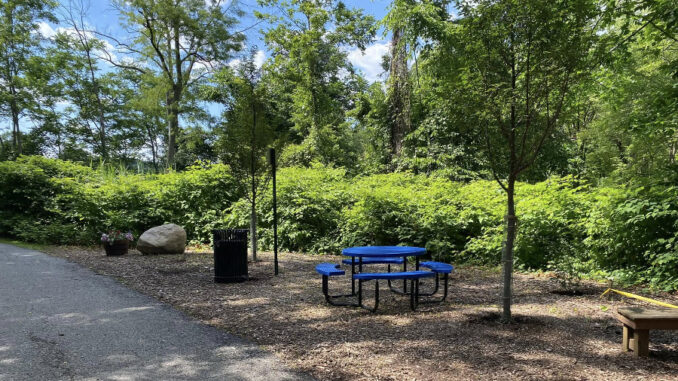
Recently, Pascack Press reported on the township’s purchase of 3.2 acres of mostly wooded property at 450 Pascack Road. The site was recently cleared of a dilapidated home and barn, with future plans for passive recreation, including possible nature trails, an exercise area, benches and parking.