
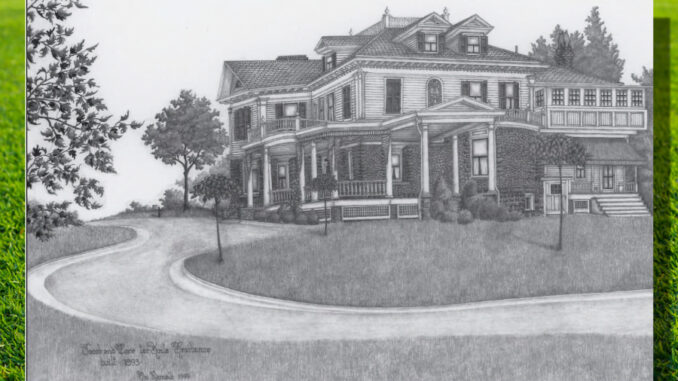
Montvale’s former mayor, Jacob Ter Kuile, had equipped his mansion with an elaborate burglar-alarm system, but the one night it wasn’t wound, burglars entered undetected—only to be frightened away by two young children calling for their nurse.
This week we go back 120 years to the first week of November 1906, for an event the Montvale Standard called “one of the most daring robberies ever heard of in this neighborhood.”
The Ter Kuile family lived in a beautiful mansion on West Grand Avenue across from the Pascack Road intersection, next to modern-day Terry Court. Born in Holland, Jacob Ter Kuile came to America in 1872 and made a fortune as a steamship agent. He was among the Pascack Valley’s elite class of “gentleman farmers” and was the wealthiest man in Montvale at the turn of the 20th century. He served as the borough’s first mayor in 1894.
Even with a spacious residence that included seven bedrooms plus two rooms for the maids, Jacob and his wife, Cora, had a full house. The couple had eight children, the youngest of whom were twin boys Reinold and Roger, born in 1903.
Rural Montvale’s population in 1906 was approximately 470, and the luxurious Ter Kuile mansion stood out as a showplace. It would have been tempting to burglars, and we know Jacob Ter Kuile was concerned about this because the windows and doors were equipped with alarms.
These alarms were a far cry from those we are accustomed to today. Who ever heard of a keypad? Montvale was not even wired for electricity in 1906. The alarms in the Ter Kuile mansion had to be wound by hand. Turning a key tightened a spring, much like winding a clock. Opening a protected door or window would release the mechanism and set off a loud bell or gong.
Setting the alarms was a nightly ritual at the Ter Kuile house, a job that would have been assigned to one of the servants. But on this particular night, for some reason, the step had been skipped.
“It is a remarkable fact that Tuesday night for the first time in a long while, through an oversight which is not likely to be repeated in the near future, the alarm was not wound up and the burglars had no trouble in gaining an entrance to the house,” the Montvale Standard wrote.
The criminals entered noiselessly and moved through the home with the precision of a professional crew. In targeting the mansion, the burglars must have thought they would walk away with the haul of a lifetime. They nearly did, but something spooked them.
Even though those newfangled burglar alarms were not activated, the Ter Kuile family could still rely on that age-old alert that requires no winding—the cry of a small child.
“The robbers would have had a clear field with a good prospect of carrying off a wagonload of plunder, had it not been for the Ter Kuile twins, two stout youngsters who not infrequently wake up during the night and, naturally, shout for their nurse,” the Montvale Standard wrote. “This they did Tuesday night, between 12 and 1 o’clock, and by this incident the burglary can be timed. It is certain that nothing else could have scared them off.”
The burglars fled shortly after midnight, but it wasn’t until after dawn that the family learned of the crime committed as they slept.
When one of the maids entered the dining room early Wednesday morning, she found it in disarray. All the drawers and cabinets were open. A small table beneath one of the bay windows had been moved to the middle of the room, and the window was wide open.
“With frightened eyes she took in the general disorder of the room, for the burglars had gone through every drawer and cabinet in search of silverware,” the Montvale Standard reported. “The maid screamed and soon all the members of the family and servants were on the spot.”
A thorough search of the house revealed that the burglars had not done as much damage as they had likely intended. They did not know that the Ter Kuiles, very sensibly, did not keep large sums of money at home. Mrs. Ter Kuile paid all her bills by check, not cash, and the family silver was stored in a safe deposit vault in New York City.
At first, a chafing dish was believed stolen from the dining room, but it was found in the bushes beneath the open window—a testament to the burglars’ quick exit.
Thanks to two little boys who did not sleep through the night, all the burglars managed to steal from the wealthiest family in Montvale was a pocket watch, a wallet containing about $4 and a couple of overcoats.As we send the kids back to school, let’s take a look at one of this author’s favorite photographs from the Pascack Historical Society’s archive. Dated to between 1887 and 1890, this was the entire student body of the Park Ridge schoolhouse.
The snapshot captures so many little faces, so many different personalities.
The woman standing on the far right, who looks like she should be in high school, was the teacher. The school budget for 1889, as reported in the Bergen Index newspaper, included $120 for her salary. There was also $70 set aside for repairs, $45 for coal to heat the building, and $40 for cleaning.
The schoolhouse these children attended was set back from Pascack Road (Main Street to them) and Park Avenue. The land is now part of the Park Ridge High School campus. Built in 1856 with just one room, an 1876 addition had added more space on the north side.
Still, the population of rural Park Ridge was very small, and not everyone saw the value of staying the course when it came to education. One can tell by this photograph that there were many more young children than older ones. Most had already left school by the time they reached their teen years, taking up work on the farm or learning a trade. The number of graduates each year could usually be counted on one hand, and we know that in 1887 the graduating class (completing what might be comparable to eighth grade today) was just two students, one boy and one girl.
The school year generally began on the first Monday of September. During the months of summer vacation, which started on the last Friday in June, the school was locked up and deserted. At the end of August, the doors and windows would be thrown open to air out the building, the floor was scrubbed, blackboards given a fresh coat of paint, and the walls whitewashed.
The grass and weeds had grown out of control since school ended in June. A laborer would be sent in with his scythe to cut it all down. It was not thought necessary to remove the clippings; these would soon be flattened by all the little feet.
The world this group knew was so different from the one children know today. People traveled in horse-drawn wagons, not automobiles. Nights were darker, illuminated by the flicker of kerosene lamps, not electric light. People got their water from wells, and they used outhouses, at home and at school. They wrote letters and waited days or weeks for a reply, as houses did not have telephones.
As for entertainment, they couldn’t have in their wildest dreams imagined a PlayStation or an iPad. Even the ability to listen to pre-recorded music at home was still a few years away, and movies and television would have sounded like science fiction. In their adult years, they saw all of these breakthroughs become commonplace.
Soon after this photograph was captured, another building addition in 1890 would add a second story to the school, and this allowed more separation between different age groups. The addition would house grades five through eight, the original 1856 school room housed grades three and four, and grades one and two had lessons in the portion from 1876.
It was also a step forward in that while the building still did not have indoor plumbing, there were now two outhouses, one on each side behind the school. The building also had its own hand pump for well water, which was a marked improvement over having to run to nearby farms with a bucket.