
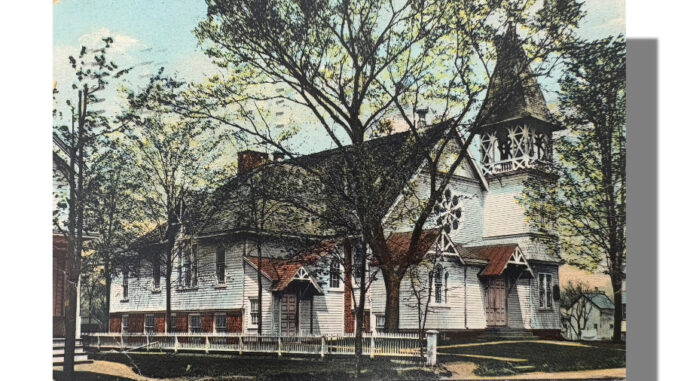
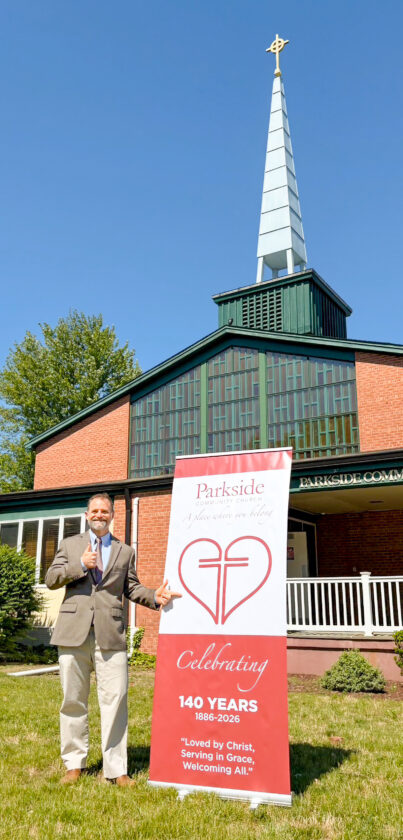
WESTWOOD, N.J.—Standing outside the Parkside Community Church building at the corner of Third and Park avenues, one would never guess that this contemporary house of worship has a 140-year history. The present sanctuary was built in 1961, but some longtime residents will recall that this replaced a much older building that stood in the same location.
This week we take a look at the past, present and future of Parkside, founded in 1886 as the Westwood Reformed Church.
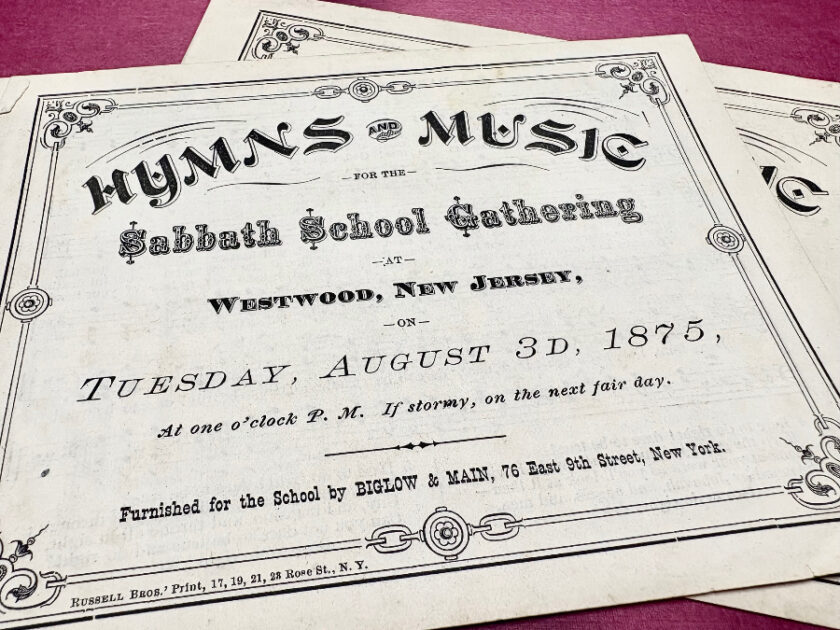
For this story we must begin back in the 1870s. Newly renamed “Westwood” from the former “Pleasantville,” the future borough was a small farming community within greater Washington Township. It was home to fewer than 300 people, most of whom were of Jersey Dutch ancestry. The Jersey Dutch language was still commonly spoken in homes, especially among the older generation.
The opening of the New Jersey & New York Railroad in 1870 had recently given this long-isolated village a lifeline to the outside world. Travel time was shorter, communication was faster, and this ease of access planted the seed for suburban development. Along with the new train station at Broadway and Westwood Avenue, there was now a hotel and a general store at the same intersection, marking the birth of downtown Westwood.
The village also had its own physician, in Dr. Simeon Zabriskie, plus a bakery, a meat and vegetable market, and several mills. There was a wooden schoolhouse at Old Hook and Sand roads. And, at the southwest corner of Third and Park avenues, there was a small independent chapel, built in 1872, where visiting clergymen from Closter, Schraalenburgh and other villages would conduct weekly services. The future was looking bright for Westwood.
Then, on one Sunday afternoon in the autumn of 1885, the skies darkened.
A cyclone hits Westwood
On Oct. 4, 1885, a quick and furious tornado descended on Westwood and left a path of destruction in its wake. Touching down near Fourth and Forest avenues, and following a narrow path northeast toward River Vale before fizzling out, the dark funnel cloud tore up roofs, uprooted hundreds of trees, blew out windows in explosions of glass shards, and destroyed barns. On Third Avenue, the chapel was picked up off its foundation.
The Hackensack Republican reported on Oct. 8, 1885, “[Receiving] the full force of the cyclone was the beautiful chapel where the villagers worshipped. A gentleman saw the cloud strike it. He said the structure was lifted 20 or 30 feet in the air and dashed to the ground with a terrible crash, completely demolished.”
It was not lost on the people of Westwood how close they had come to an unthinkable tragedy that afternoon. Had the cyclone struck one hour later, all of the village’s children would have been inside the chapel for Sunday school. Well into the 1900s, the older folks in Westwood spoke of the “big wind” of 1885, both the damage it caused and the miracle that no lives were lost.
So it was that Westwood found itself with a big cleanup job, and no chapel.
Westwood’s oldest church
The people of the village regrouped, and former trustees of the chapel founded the Westwood Reformed Church in 1886. The following year, a beautiful new building went up in the same location where the destroyed chapel had stood. It was 65 feet long, 38 feet wide, and seated 300 people — all at a cost of $5,800, including furnishings. That is equivalent to about $200,000 in today’s money.
The Bergen Index reported in its edition of Friday, Dec. 9, 1887, “The new Westwood Reformed Church was crowded Wednesday afternoon at the dedicatory services. It will be remembered that this structure was erected to take the place of the Union Chapel which was converted into kindling wood by the only cyclone that ever visited Bergen County.”
This was the first denominational church in town, and it remains the borough’s oldest congregation. While its name was changed to Parkside Community Church in the late 1990s, it retains its ties with the Reformed Church in America.
Old church documents read like a “who’s who” of Westwood in the late 19th century. Among its founding families were old names like Bogert, Hopper, Demarest, Collignon, Voorhis and Terhune.
The first pastor, Rev. David M. Talmage, was installed in 1888. The Bergen County Democrat reported on April 13 of that year, “Mr. Talmage has a good field before him, his church being the only ordained church in the place, and as Westwood is growing rapidly, the prospects of a large and growing congregation are good.”
Baby Boom and suburban sprawl
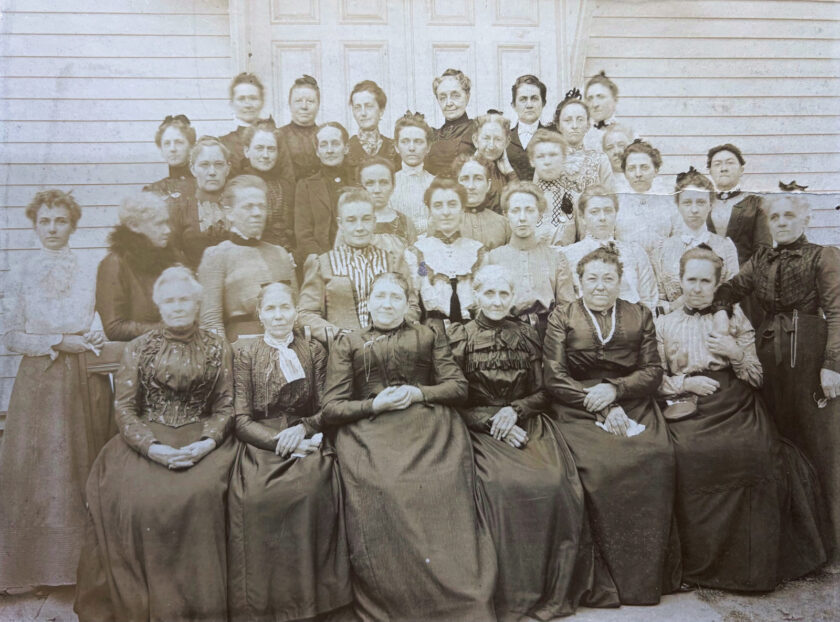
By the time the church celebrated its 70th anniversary in 1956, there were 500 members and counting. There had been only three pastors in its history. Rev. Talmage had served 20 years through 1908, followed by Rev. E. Ward Decker through 1932, and then Rev. Joseph Holbrook, who would occupy the pulpit through 1962.
Westwood Reformed was one of many Pascack Valley churches that found itself bursting at the seams by the 1960s, when weekly attendance was at its apex in the wake of the Baby Boom and the suburban development surge. In Westwood, a population of 5,400 in 1940 had risen to more than 9,000 by 1960. During this era, across Bergen County many late 19th-century churches were razed in favor of modern buildings that could accommodate the crowds of parishioners on Sunday mornings.
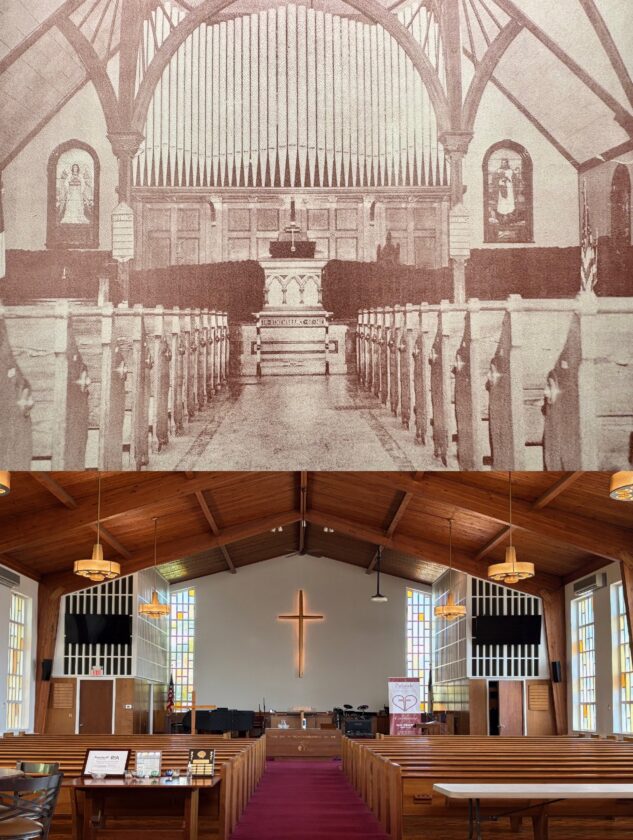
The final service in the original Westwood Reformed Church building took place on April 30, 1961, and the building was demolished shortly thereafter. Most of the beautiful stained glass windows were saved and transported to Oklahoma, where they were installed in the church of a former member. On Oct. 1, 1961, the cornerstone of the present building was placed. At a cost of $363,000, the new building had a capacity to seat 600 people. It opened in time for Christmas Eve.
Parkside at 140
This is a milestone year not just for Parkside Community Church, but also for Pastor Rodney Haveman. This is his 25th year leading the Westwood congregation.
A husband and father of two young adult children, Haveman and his wife, Jennifer, came east from Grand Rapids, Michigan, in 2001, shortly after he graduated from the Western Theological Seminary. With the family residing next door in the church parsonage, the Westwood community, and Parkside, are home for the Havemans. The pastor has been active in the Westwood Clergy Council, as well as serving as the clerk in the local Reformed Church in America classis.
The church has come a long way from those early days when Westwood’s founding families drove their horse-drawn carriages to hear Sunday sermons. Haveman recently met with this writer at the Pascack Historical Society to chat about what things look like at Parkside these days, as well as plans for the future.
He notes that the most significant ministry at Parkside in 2026 is the food distribution program that feeds hungry people in the area. Each Tuesday, volunteers cook hot, fresh meals that are available to those facing food insecurity.
“We cook more than 100 meals every week and have a food distribution in which we gather, from local grocery stores, fresh produce, fruit, vegetables, and distribute it to the people,” says Haveman. “We have a main chef in our kitchen who comes up with a recipe based on whatever we’ve had donated, and then we supplement it with items that we buy.”
The church’s food pantry also provides kitchen staples, from non-perishable foods to paper products. The program welcomes both donations — there is a bin at the church’s main entrance on Park Avenue — and volunteers.
“Everyone running it is a volunteer—whether from inside the church, or community partners we have formed friendships with,” says Haveman. “It’s a way to put faith into action.”
Another highlight of the Parkside community, Haveman says, is the worship that takes place every Sunday morning at 10:45 a.m.
“Our worship is great. We have a mix of new contemporary music and liturgy with more traditional. Our talent on our Praise Team is top notch,” says Haveman.
The Praise Team is a modern version of a choir, but smaller. There is singing, piano, guitar and drums. According to the pastor, the Praise Team volunteers bring a professional level of musical talent to the services.
“They are truly talented,” he said. “It’s a true blessing in worship every week.”
Still, like churches of all denominations, Parkside has struggled with having fewer people in the pews. In recent decades, attendance has declined. Quarantine restrictions during COVID-19 further reduced an already modest congregation. Now the church is working to increase membership, especially among young families.
“One of the things that we’re starting, that we’re hoping will take root and grow, is a new program called Simple Church. We hope to reach millennials with this, families with young children, and older Gen Z that might be interested in coming back to church,” explains Haveman.
“Simple Church will be a midweek service with a dinner and conversation. The sermon, or the message, might only be two to five minutes long,” he said. “It’s really just setting up a question, or a couple of questions, for people to engage with what’s going on emotionally, what’s going on spiritually, what’s going on in their lives. There won’t be a lot of hymns. There will be a little bit of guitar music, a little bit of reflection and conversation, and then a meal.”
For busy young families, it will be a night off from cooking dinner, as well as a chance to slow down, enjoy each other’s company, and maybe take home some food for thought.
“It won’t be a long sermon you have to sit through. We will read a text, find the question in it, and open the conversation around the table,” Haveman explained. “Our plan is to start this new ‘church’ in September.”
According to the pastor, Parkside is among a minority as one of the more liberal Dutch Reformed churches.
“Parkside is still a part of the RCA, the Reformed Church in America, but we’re no longer a very Dutch church. In fact, I might be one of the only people left in the building with some Dutch ancestry,” he said.
“We are open and affirming. We welcome everyone, but our welcome is not just, ‘You’re welcome to come here.’ You are welcome in leadership, you’re welcome in every level of the church,” he explained.
According to Haveman, “Most of the RCA churches in and around us do not welcome LGBTQ people. We are more liberal in that manner. Many of the Reformed churches do not have Praise Teams, or they’re still using organs, still using hymns. Our liturgy has more symbols in it. It’s more modern than a lot of other Reformed churches. So, we’re definitely different. We’re not unique; there are other Reformed churches that do this, but we are among a very small minority.”
The next major project for Parkside is opening up a mental health counseling center. All of the church’s fundraising this year is earmarked toward that endeavor.
“The Healing Grove Counseling Center will bring high-quality affordable outpatient counseling to people who are underinsured, or cannot get insurance or afford counseling,” the pastor said. “The Healing Grove will provide this therapy, while training graduate interns and counselors-in-training through supervised clinical experience.”
Parkside will celebrate its 140th anniversary with three fundraisers, all of which will benefit the counseling center. The first will be a Bingo Night and silent auction in the fellowship hall on Saturday, June 13, at 7 p.m. In addition to two 50/50 Bingo games, the event promises a total of $725 in prize money over 10 bingo games. A silent auction will offer a chance to bid on high-value items, from Mets and Yankees game seats to fine jewelry. Visit parksidechurch.net for a link to register.
Other events this year will include a concert series in August, September and October, as well as a gala at Seasons that will celebrate the pastor’s 25-year ministry. There will be more information about these events as they approach.
“The history of the Westwood Reformed Church shows an amazing impact on the community, serving Westwood and beyond for 140 years. We are proud of who we were, but we rejoice in who we are today and the ways we continue to serve the community of Westwood and the Pascack Valley region,” says Rev. Haveman. “Our vision for this year and many years going forward is: LOVED BY CHRIST, SERVING IN GRACE, WELCOMING ALL. As we live into our future, we can’t wait to see all the ways that God will bless us and the community through this love, grace, and welcome.”