
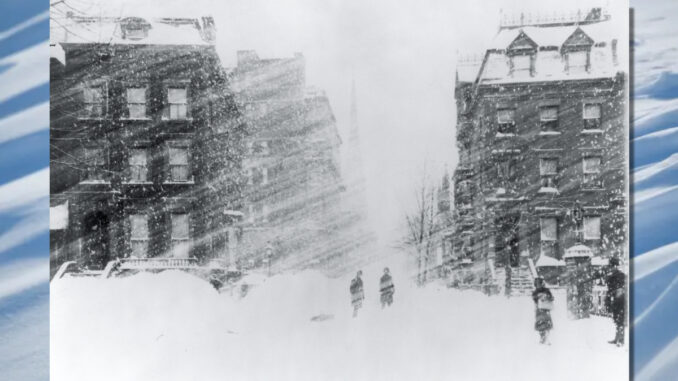
“So, you call this a blizzard, eh? Why, this is merely a dusting. Let me tell you about the big one. The ’88. Now that was something…”
This is what we imagine the young people of the early 20th century Pascack Valley heard from their elders every time they attempted to complain about the snow. Their parents and grandparents held the rights to grumbling about winter precipitation—they had lived through the Great Blizzard of 1888.
No local photographs of the blizzard are known to exist, as very few people here owned cameras in those days. However, the Pascack Historical Society’s archives abound with stories recorded by those who experienced the ordeal.
The blizzard that lasted March 12–14, 1888, took nearly everyone by surprise.
I say nearly everyone, because Mr. Andrew Jackson DeVoe of Cherry Hill (now North Hackensack) had predicted it. DeVoe was a sawmill operator, a writer of almanacs, and an amateur weather prophet. When he had said there would be a blizzard, everyone laughed at him. As it was, his prediction was off by only 48 hours.
Before the first flake fell, the weather had been unseasonably mild. It was an early taste of spring, and on the sunny Sunday afternoon of March 11 the dusty roads were full of people out enjoying rides in their horse-drawn buggies.
Then came the rain—gentle at first, then stronger, and with a howling wind. Temperatures dropped rapidly during the night, with a recorded 33 degrees in the New York City area plunging to 6 degrees in a matter of hours. People had been lulled to sleep by a rain shower, expecting that they would awaken to a dreary March day. By dawn, the world was eerily silent and buried in snow.
The blizzard pounded the East Coast for a day and a half, dumping nearly 2 feet of snow on this section of New Jersey. What made the situation extreme, however, was not the total amount of snow that fell. This past week’s blizzard saw higher numbers in many parts of Bergen County.
The real danger in 1888 was immense snowdrifts caused by sustained high winds. Across the Tri-State area, snow piled up to the second story windows of houses. Rooms were dark during the day because snow was blocking the sunlight. All travel, whether by road or rail, was shut down for days. Some people were able to tunnel out of their homes, but many others were trapped inside. The highest snow drift, 52 feet, was recorded in Brooklyn.
As telephone service had not yet come to the Pascack Valley, there was no way to check on friends and family. You could only hope they were warm, had enough to eat, and had not fallen ill.
The level of isolation the people experienced is difficult for a modern person to imagine. The Pascack Valley did not yet have newspapers or home mail delivery—and even if it did, it is unlikely these services would have operated in the days after the storm. Home radios were many years away, let alone televisions. Many people, particularly those who lived farther out in the countryside, must have felt like they were alone on an island.
On the second day of the storm, one Park Ridge farmer started out bravely for the barn. There were cattle to be fed and chores that needed to be done. That trip to the barn proved an all-day affair. It took him nearly until noon to reach it. When he finally got back to the house, it wasn’t long before he had to start out again for the evening meal for the cows. Leaving the house at about 2 p.m. for his second voyage, it was nearly dark as he fought his way home.
We know the aforementioned person was a relatively young man in 1888, because he was interviewed about the storm in 1934. For elderly farmers, their animals went without food for several days. They simply could not make it through the snow.
Another account comes from a young woman in Hillsdale, who wrote to her parents in Park Ridge detailing life after the storm. The letter, which is in the Pascack Historical Society’s collection, is dated March 14, 1888, although it was likely mailed later.
“This is Tuesday morning. How to get out of the house I don’t know. The backyard is full of snow up against the door and only a foot from the roof,” she wrote. “The south side of the house is under 8 feet of snow. [My husband] dug through a 5-foot drift so he could get to the barn. At the woodhouse he was at a loss what to do for coal. The front had snow up to the beams. Plenty of coal, but how could he get it? From a stepladder he opened the slide at the back and dipped with the scuttle.”
She continued, “Today all the men are out on the roads. At noon all come home worn out, and leave the job until another day.”
There was no public works department back then. Clearing the roads—which mostly involved using shovels to pile snow into horse-drawn wagons—was a job for all the able-bodied men in the community.
“There is hardly a man home in the lower part of town,” the woman wrote. “Some have gone away on business, and others have been sent down the line to help the trains, but neither trains nor men have got in yet.”
Ever since the railroad came to the Pascack Valley in 1870, a growing portion of the population had businesses in the city and were regular commuters on the New Jersey & New York line.
When these men had ventured out on the first morning of the storm, it had been slow going on the way to the city, fraught with delays and frigid temperatures. The snow had continued falling all day, and by the evening commute the trains had stopped running. Many men slept in their offices, as their wives and children at home worried the worst had befallen them. With the telegraph lines down, there was no way to send word home.
The New York Herald wrote on March 13, 1888, “New York was simply knocked out, paralyzed, and reduced to a state of suspended animation. Traffic was practically stopped, and business abandoned. The elevated railway service broke down completely, the streetcars were valueless, the suburban railways were blocked, telegraph communications were cut, the Exchanges did nothing, the mayor didn’t visit his office, the city was left to run itself, chaos reigned, and the proud, boastful metropolis was reduced to the condition of a primitive settlement.”
One of the conductors on the Pascack Valley line was Reeves Werkheiser, who also happened to be the proprietor of the Hillsdale House hotel, which is still standing at Broadway and Hillsdale Avenue opposite the railroad station (nowadays it is a salon). Mr. Werkheiser’s train, full of commuters on their way home, was coming up from Jersey City when he received a message from his superior. He was not to proceed farther north than Hillsdale due to very bad conditions on the track ahead.
The Hillsdale House provided lodging for the stranded railroad passengers. The men slept three or four to a bed, and when they ran out of room, they created makeshift cots on all available floor space. Several men slept on a billiard table. Others remained overnight on the railroad cars, with the fires being kept up for warmth.
Schoolchildren in the Pascack Valley had off for an entire week. By that time, the principal roads were once again passable, even if they were a muddy mess. In the area’s rural outskirts, which were characterized by large farms and narrow wagon lanes, the farmers did not concern themselves with clearing the roads. They took the shortest route between two points, chopping down fences and cutting straight across the snow-covered fields until they reached the main thoroughfares.
James S. Mittag of Park Ridge had a printing office on the second floor of a building at Greenwich and Warren streets in New York. After the worst of the storm’s effects were over, and travel had resumed, he attempted to visit his office. He found that the snow was still piled up to the second story of his building. Crawling on his hands and knees, he climbed to the top of the snow mountain and entered through a second-floor window.
Alfred M. Blakeney of River Vale was 8 during the blizzard. He recalled the events many years later, in 1947, after another historic snowstorm buried the valley. By that time, he was the township’s mayor.
“We had to dig a tunnel 80 feet long from the house to the barn so that we could take care of the livestock,” recalled Blakeney of the 1888 storm. “That tunnel was in use a full week.”
The children of River Vale walked atop the snow drifts as they ventured to the one-room schoolhouse at Rivervale Road and Piermont Avenue. Fences and roads were totally obscured, but they knew the land and had little trouble orientating themselves.
In terms of provisions, Blakeney said, people were better prepared back then. There was flour for bread and biscuits, plenty of beef, mutton, and pork, and in the wintertime the shelves were lined with jars containing preserves.
And another thing, he added: “A horse can pull through much deeper and fluffier stuff than a car can. We were far less incapacitated than now, when we are so dependent on mechanical things.”