
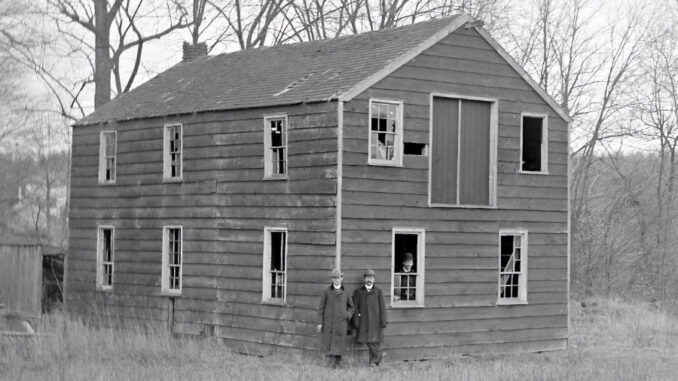
PARK RIDGE—When the old Campbell wampum mill was photographed 125 years ago, on Jan. 1, 1901, it was already a relic of days gone by in the Pascack Valley. The mill, which stood on the Pascack Brook in Park Ridge, was out of use. Today it’s gone completely; we know what it looked like only through photos like the ones in this page, which come from the collection of the Pascack Historical Society.
The story of wampum in the Pascack Valley began when John W. Campbell (1747–1826) of Closter moved with his wife Letitia Van Valen to a farm they purchased on Kinderkamack Road North in Montvale, close to the New York State border. He, like many farmers of his day, found a second job during the winter months. He made wampum—beads carved out of clam shells, which the Native Americans out west used for gifts and personal adornment.
Indigenous peoples had traded among themselves with wampum prior to the arrival of European settlers, but creating it—by manually hollowing out pieces of shell—was a slow and arduous task. Dutch settlers joined in the production of wampum as a means of trading with the Native Americans.
By the mid-19th century, the production of wampum was among the more important industries in Bergen County, and the Campbell family was at the forefront. John W. Campbell is credited with inventing the shell “hair pipe” wampum made from Caribbean queen conch shells that came as ballast on trade ships heading for New York City. These tubular beads can be seen in early photographs on the breastplates of Native American warriors.
The shell hair pipes put the Campbells on the map. Lewis and Clark bought and took Campbell hair pipes on their famous westward expedition in 1804.
In 1808, John W.’s son Abraham Campbell (1782–1847) moved to Main Street (Pascack Road) in Park Ridge, where he opened a blacksmith shop and wampum bead business. Abraham’s sons John, James, David, and Abraham Jr. eventually became partners and built a new mill on the Pascack Brook near the bottom of Wampum Road.
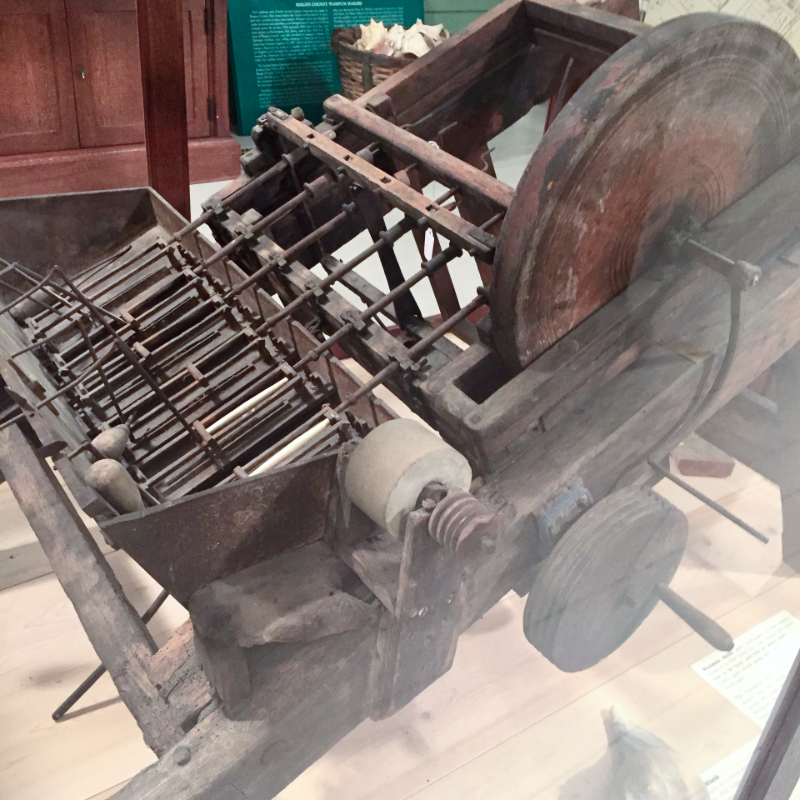
In the mid-1800s the Campbells revolutionized wampum production by inventing a drilling machine that streamlined the production process. The hand-made wooden machine enabled multiple hair pipes to be drilled at one time, uniformly, and with minimal breakage. More than one drilling machine existed, but today the only remaining example is in the Pascack Historical Society’s John C. Storms Museum, 19 Ridge Ave., Park Ridge. The Smithsonian Museum in Washington, D.C. has asked to acquire the machine for its collection, but for the time being it will stay where it was invented—in Park Ridge, N.J.
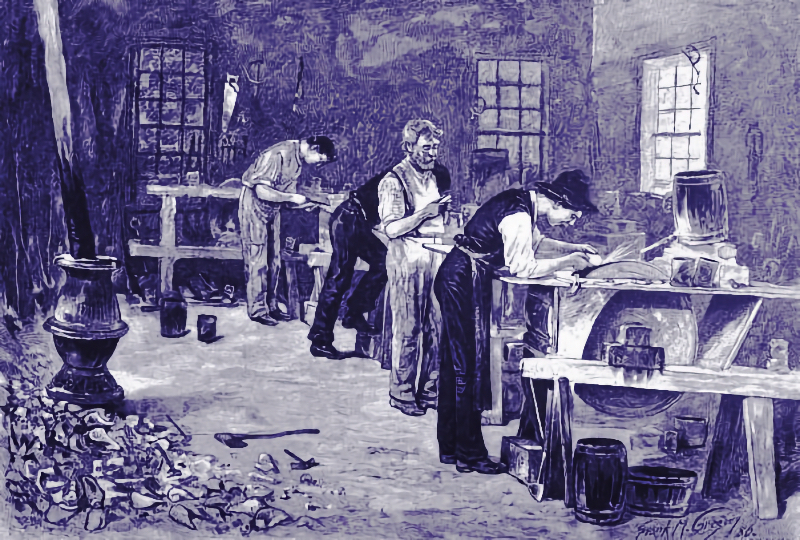
The Campbells did not sell their hair pipes directly to the Native Americans. Rather, they sold them wholesale to New York merchants, such as John Jacob Astor, who resold them to firms of traders in the United States and Canada and to the U.S. government. One of the trade goods that returned to the Pascack Valley was the so-called buffalo robe—bison hides that were used as lap blankets during wintertime carriage and sleigh riding.
By the end of the 19th century, the Campbells were out of the wampum business. The mill was vacant and deteriorating.
An 1891 article from the Passaic Daily Herald explains that while the Campbells had given up wampum production, “the old mill house is pointed out as one of the places of particular interest to travelers and summer residents of the historic Pascack Valley.”
In 1906, The New York Times reported that Alonzo Campbell (son of Abraham Jr.) had “offered a reward for the arrest of any person caught despoiling the old wampum mill…which he desires to preserve as a landmark.”
The Times added, “Curio collectors have pillaged it to such an extent recently that Mr. Campbell fears it will all be carried away.”
Today the wampum industry that existed locally is a cornerstone of the Pascack Historical Society’s museum, where one can find information about the Campbell family and their mill, early wampum-making tools, and even the Campbell family’s business ledgers.