
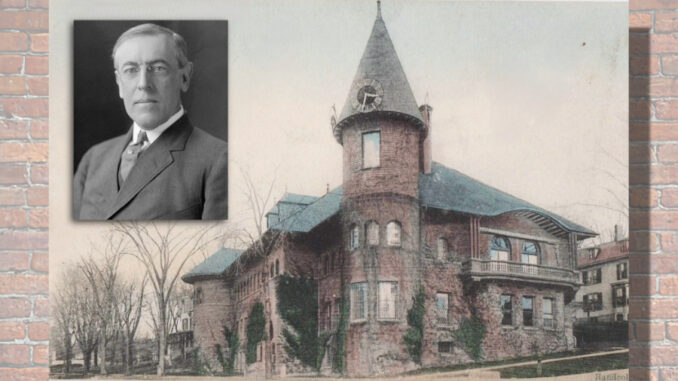
ENGLEWOOD, N.J.—Woodrow Wilson was the 28th President of the United States from 1913 until 1921, but before that he was New Jersey’s governor.
In fall 1910 he was on the campaign trail in an effort to clinch the state’s top seat—and one of his stops was in Englewood at a building that locals drive past every day.
The 1910 gubernatorial election in New Jersey pitted progressive Democrat Wilson, a political newcomer who had been serving as president of Princeton University, against Republican Vivian M. Lewis, a former assemblyman and the state commissioner of banking and insurance.
In Englewood, Wilson spoke at the Lyceum at Palisade Avenue and Engle Street. Democrats and Republicans alike attended the event, and newspapers reported that many women were in the audience.
“The Englewood Lyceum was entirely too small to accommodate the vast throng which clamored for admission. Long before 8 o’clock, the hour set for the meeting, every available inch of standing room was occupied,” the Bergen Democrat reported.
Wilson told the crowd during his speech, “It is very necessary, if this state is to be well-governed, that the people of sections like this should think where they vote, and vote as they think, not vote as they are in the habit of voting.”
He added, “There is nothing more disadvantageous to a free government than having men vote by habit.”
Wilson ended up carrying Englewood over by two to one.
Englewood’s Lyceum opened in 1890. The Citizens’ National Bank was housed in its iconic tower, but the building also had a ballroom, a concert hall, a gentlemen’s club on the second floor, and three library rooms, with separate ones for men and women.
The Lyceum hosted many important events throughout Englewood’s history, from political debates to fund-raising galas. During World War I, the Lyceum was used as a Red Cross headquarters.