
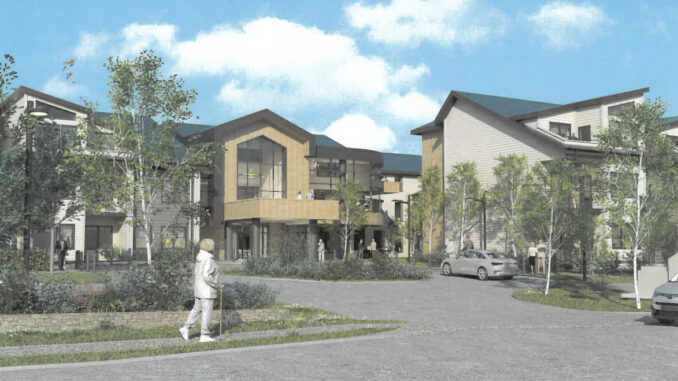
EMERSON—A disagreement over whether zoning exceptions granted to the former Armenian Nursing Home & Rehabilitation Center should apply to a proposed assisted living facility dominated a recent Land Use Board hearing.
During the Feb. 19 hearing, board planner Caroline Reiter questioned whether the conditional-use zoning that applied to the former nursing home could be used for the new proposal. If those allowances do not apply, the project could face stricter height limits and require additional variances.
Questions about building height, expanded floor area on the building’s partial third level, and which zoning standards govern the proposal took center stage during the 90-minute discussion.
An applicant traffic expert, planner and Aviva Senior Living’s chief operating officer are expected to testify at a fourth hearing Thursday, March 19, at 7:30 p.m.
The Feb. 19 hearing was originally scheduled to feature testimony from the applicant’s traffic expert. When the expert was unavailable, applicant attorney Brian Chewcaskie used the time to question project architect Michael Freedman about building height and how the building’s partial third floor relates to the 40-foot height limit allowed under conditional-use zoning in the R-7.5 zone.
Freedman presented a rendering highlighting in yellow portions of the roof that exceed the 40-foot maximum permitted under the former nursing home’s conditional-use approvals.
One board member asked whether a layperson looking at the proposal would see it as a three-story building. Freedman said the building’s setbacks were designed to help it appear consistent with surrounding residential homes, though he did not provide the square footage of roof area above the permitted height.
Planner questions applicability of conditional uses
Reiter said the applicant had not yet presented testimony establishing that the previous conditional-use zoning allowances should carry over to the proposed assisted living facility. She noted the project is larger than the prior building: the former nursing home contained 86 beds, while the proposed facility includes 122 assisted living units.
Reiter said the board’s attorney and engineer believe the conditional-use provisions likely do not apply to the current proposal.
If that is the case, she said, the standard R-7.5 single-family zoning rules would apply, limiting building height to 32 feet. Under that standard, the proposed building would exceed the height limit by more than eight feet.
Freedman estimated the building’s average height at 43.5 feet when measured from the average curb elevation along Main Street.
He said the third level occupies less than 60% of the floor area of the level below, allowing it to be classified under zoning rules as a half-story rather than a full third story. The third floor contains 38,500 square feet, with 22,655 square feet used for residential units, or about 58.8% of the level below.
Freedman said suggestions that the building use a flat roof to reduce its height would be “impractical” due to drainage requirements.
He also noted that portions of the building would be constructed below grade and said the design’s “generous setbacks” would help minimize the building’s overall scale.
Residents raise questions
Four residents asked questions about stormwater management, the amount of open space on the property, the height of neighboring homes, and whether rooftop HVAC equipment would be visible.
Freedman said the proposal would provide approximately 34% open space, compared with the 10% required under zoning rules. He said most HVAC equipment would be located inside the building and that rooftop mechanical equipment would not be visible.
He also said the applicant had not conducted an analysis comparing the height of the proposed building to surrounding homes.
The proposal for the 3.5-acre property at 70 Main St., the site of the closed Armenian nursing home, calls for 122 assisted living units: 36 memory care units, 36 assisted living studios, 47 one-bedroom units and three two-bedroom units.
The Armenian Nursing Home closed in April 2021 and has remained vacant since.
According to the application, a 120-bed skilled nursing facility was previously approved for the site under a Feb. 2, 2012 Land Use Board resolution.
The proposed building is described as three stories, though the applicant formally classifies it as a 2½-story structure. Plans show 44,635 square feet on the first floor with 49 units, 45,317 square feet on the second floor with 49 units, and 38,500 square feet on the third floor with 24 units.
Other variances requested include building height along Broad Street (40 feet permitted; 40.5 feet proposed), building height along Main Street (40 feet permitted; 43.5 feet proposed), maximum floor area ratio (50% permitted; 78.5% proposed), and minimum parking space size (10 feet by 20 feet permitted; 9 feet by 18 feet proposed), plus one ADA space measuring 8 by 18 feet.
Additional variances sought include maximum freestanding wall height (6 feet permitted; 10 feet proposed) and minimum driveway distance to an intersecting street right-of-way (50 feet required; 0 feet proposed).