
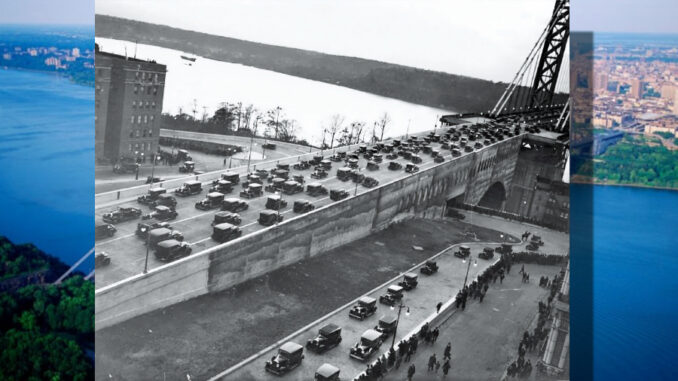
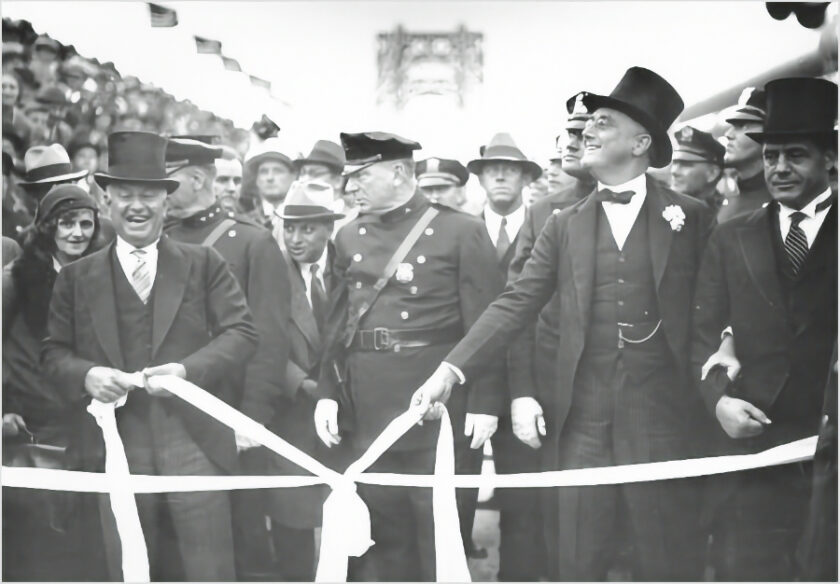
BERGEN COUNTY, N.J.—The George Washington Bridge was dedicated Oct. 24, 1931 amid great fanfare. Over 30,000 people—equivalent to the population of the Northern Valley from Old Tappan down to Englewood at the time—attended the ceremony, which featured an Army Air Corps airplane show and a military parade.
New Jersey Gov. Morgan Foster Larson and New York Gov. Franklin D. Roosevelt, dressed in their suits and tophats, gave speeches and cut the ribbon. That evening, between 6 and 11 p.m., pedestrians were allowed to stroll the length of the bridge.
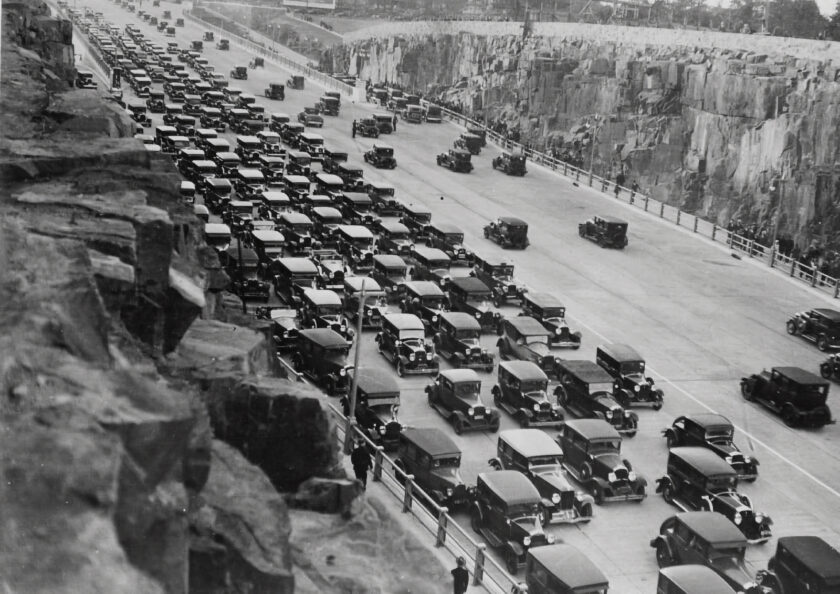
But it was the next day, when the dignitaries were back in their offices and the spectator stands had been taken down, that things really got moving. When the bridge was opened to traffic on Oct. 25, the volume it saw set a new world record when 7,098 autos crossed it in a single hour. In the first 24 hours of operation, 57,778 cars crossed the bridge, as well as 35,580 pedestrians (and one horse).
It was actually a young man from Tenafly who was the first to drive across the bridge when it opened to traffic—but it wasn’t supposed to be.
That honor had been reserved for Jacob W. Binder, secretary of the Bergen County Chamber of Commerce and the Hudson River Bridge Association. That morning, Binder and his party were in a car at the front of the line, but many eager drivers—including 20-year-old William Agnew Jr. of Tenafly—had been lined up for hours waiting for a chance to cross.
Agnew, who lived on Depeyster Avenue, had graduated from Tenafly High School in June and was working for a New York newspaper. For months he had been sneaking into the construction site, dressed as a workman and carrying a bucket that concealed a camera, so that he could photograph the bridge as it took shape over the Hudson.
When Binder’s auto took off from the New Jersey side, Agnew, who had reportedly been camped out in line since the previous morning, slammed on the gas of his brown roadster, overtook Binder’s car, and ended up reaching the New York side first—thereby claiming the honor of being “first to cross.”
He wasn’t the only young man who had his eyes on the prize. The New York Daily News wrote all about it on Oct. 29, 1931.
“A 65-mph race for the title of first man over the new George Washington Memorial Bridge was revealed for the first time yesterday when Jacob W. Binder of Hackensack, officially credited as first over, admitted yesterday he was really beaten to it by two 20-year-old daredevils,” the paper reported.
“Yes, two youths in geared-up flivvers eluded my police escort and dashed ahead of the official car containing myself and Mayor Hoebel of Fort Lee,” Binder told reporters.
“Flivver” was an old slang term for a cheap, small, often beat-up automobile, especially a Ford Model T.
Binder continued, “I was riding in the big coupe presented to me four years ago when ground was first broken for the bridge. I could easily have passed them, but felt it was foolhardy to race. Several times these young fellows nearly went over the rail. They were lucky they didn’t end up in the Hudson River!”
The other daredevil was Wesley T. Simpson of Astoria, a clerk for a Broadway machine company. He, like Agnew, had been camped out all night.
By all accounts published after the event, Agnew beat Simpson to the New York side.
“The cops were chasing us so hard,” Agnew told the newspaper. “I finally pulled over, but not till we were well past the New York line. The other fellow paid no attention to the cops and kept right on.”
Many people came forward to claim “firsts” after the opening of the bridge:
Misses Audrey Moran and Edith Staeger of Ridgefield were the first pedestrians to cross. Mr. and Mrs. W.D.C. Smith of Grantwood were the first married couple across. Babette, a mare owned by Mrs. Van Dyke See of Ridgewood, was the first on horse to make the crossing, and Mr. See himself was the first person to cross in a buggy