
It’s a fine morning and autumn is in the air. Let’s take an imaginary ride through the Pascack Valley and try to picture the countryside as it appeared in those last few years before modernity knocked on our door. We are transported back to the end of September, 1861.
The railroad will reach the Pascack Valley in 1870, opening up a link between our rural villages and the East Cost’s hub of commerce, New York City. However, this is still a few years away. For now, the handful of farmers and tradesmen who reside in this rural corner can travel east and board the train from Closter on those rare occasions that such travel is required.
The Northern Railroad of New Jersey opened just a few years ago, in May 1859. The line runs down from New York State, collects passengers in Closter and Englewood, and then continues to Jersey City, where one can take a ferry across the river to Chambers Street in Manhattan.
For a Pascack Valley farmer to make this trip, the first step is catching the stagecoach that will take us to the railroad station in the village of Closter. For this, our journey begins at the Old Trading Post on Pascack Road in Park Ridge.
Note: As we make this journey, for the sake of clarity we will use the modern names for these roads. Years ago, many routes through the Pascack Valley were not given a particular name as we know them today. The roads that existed then were generally referred to as the road going from one locality to another, or leading to a certain farm, mill, or other landmark.
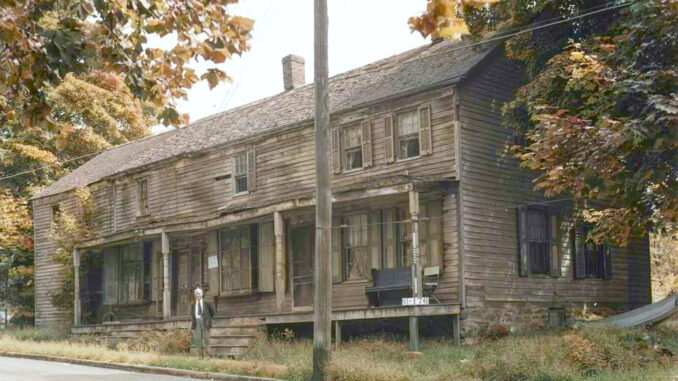
The trading post where we will board the stagecoach is a rambling wooden building on the old Lenape Indian trail later known as Pascack Road, at the corner of Mill Road. Built in the 1770s, it still does a thriving business, carrying a stock of everything that a farmer of the 1860s is likely to require. Here the people bring their surplus produce to be traded for tools, crockery, clothing, shoes, medicines, seed, harness, molasses, sugar, salt, and such necessities that are not raised on the farm. It is the commercial center of the valley, so it is no wonder that the stagecoach makes its start from here.
There stands the coach, its mode of power two sturdy horses, champing at their bits as though they are anxious to be off on their daily trip. Climbing up onto the box is William Jersey of Montvale, taking up the lines and about to snap the whip as a signal to go. He is proud of his team, being fond of horses. His use of the whip is showmanship, rather than speed. Jersey is a busy man. Besides making daily trips to Closter, he dabbles a little in local politics, is a constable, and is a pursuer for the Association for Detection of Horse Thieves and Other Felons, a type of police force that operates here.
The whip snaps, the horses start, and we are off. Let’s look around at the landmarks as we start south on Pascack Road.
The farmland in this section belongs to the Wortendyke and Campbell families. To our right, James Campbell is busy at work in his blacksmith shop. He inherited this trade, and the old sandstone homestead, from his father, Abraham, who came to Park Ridge before 1810.
Across the road, children are practicing their arithmetic in the district school, a small wooden building that consists of just one room. This is the seat of learning for a territory reaching out several miles on all sides. It has an attendance of about 60 boys and girls.
The mornings have been chilly, and hooks in the school entrance are covered in little hats, shawls, and overcoats. Fortified by a hearty breakfast, the children had done the chores of the house and barn early that morning before setting off to walk the mile or two to school. As they walked, more children joined the group and the journey became almost enjoyable.
At the end of the school’s narrow entrance hall, a pile of wood awaits the cast iron stove that warms the classroom. Also in the hall is a wooden pail containing the drinking water, and a tin cup beside it. On the teacher’s desk is a copy of “Webster’s Dictionary,” a 2-quart earthen bottle of black ink to refill the students’ desk inkwells, and a handbell. The walls contain maps of the ancient world, America, and New Jersey, plus a painted blackboard with sums drawn on it.
Our journey continues in next week’s Pascack Press…