
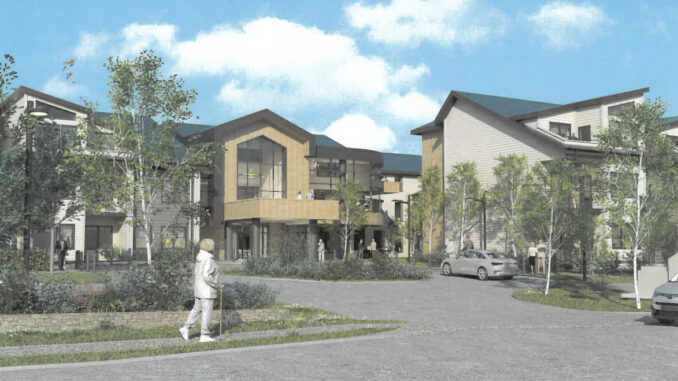
EMERSON, N.J.—By a vote of 6-1, the borough’s Land Use Board rejected an application Sept. 17 for a 122-unit assisted living proposal on a 3.5-acre site that was previously occupied by the Armenian Nursing Home & Rehabilitation Center for more than eight decades.
Following that vote, the board also approved, 6-1, a “motion to deny” the application, which attorney Chris Martin said was in case the applicant planned to contest the decision. Voting to deny the application were chair Rich Taub and members Anthony Khiami, Jeff Bischoff, Rich Worthington, Dominick Aramini, and John DiRado.
One board member, Michael Cimino, voted to approve the application. He did not publicly explain his vote. Most members did not publicly comment on their votes. However, Jeff Bischoff, who voted no, read a statement.
“While I fully support the inherently beneficial use of senior housing, this specific site cannot handle the sheer bulk of this design,” said Bischoff. He said the applicant chose a “profit-driven layout” and said the design would cause a loss of neighborhood privacy and an overshadowing of neighbors’ homes that “heavily outweighs the marginal public benefit” of adding one more floor (or half-story) of units. He said his no vote was due to the applicant’s decision to include the third-story units.
The proposed building plans showed 44,635 square feet on the first floor with 49 units, 45,317 square feet on the second floor with 49 units, and 38,500 square feet on the third floor with 24 units.
State law required Mayor Danielle DiPaola and Councilwoman Megan Ciolino, who are Land Use Board members, to recuse themselves from voting on “D” or use variances, as the applicant requested. As elected officials, both were advised not to publicly comment on the application.
We reached out Sept. 18 to Brian Chewcaskie, the applicant’s attorney, for comment but did not hear back by press time. Generally, after the board memorializes its denial, possibly at the next meeting Oct. 1, the applicant has 45 days to challenge the board’s decision.
Over nine months and six hearings that began in January 2026, the applicant — Armenian Home For the Aged, Inc. — presented experts in facility operations, engineering, architecture, planning, traffic, and stormwater to make the case for an expanded 2½-story assisted living facility.
Following two-plus hours of testimony from experts on Sept. 17, Land Use Board Chair Rich Taub opened the hearing to public comments. Of eight individuals who spoke, three appeared to support the facility, and five appeared to question or oppose the proposed 122-unit facility. However, some residents who opposed it said they might support a smaller facility or a facility in another location.
In addition, several residents said the proposed building’s height, increased size, and unsuitable location were key sticking points. Local school district officials also questioned the public and student safety impacts of a new long-term care facility on-site.
Public comments oppose, support facility
Emerson School Board president Behrooz Pasdar, joined by board members, the business administrator and the superintendent, said the district was not opposed to facilities that provide essential health care, such as nursing homes or assisted living facilities. However, he said, the board has “significant concerns” regarding the facility’s location and the “substantial impact” it might have on students, families, school operations, board-owned property and taxpayers.
He said the board hired an architect to review the proposal, and the architect found “serious concerns” with stormwater management and potentially significant water runoff onto school properties. He said the proposed development’s size and scope raised questions about whether the existing infrastructure can accommodate increased stormwater volume. He said any resulting flooding, drainage issues, erosion, or property damage to school facilities would need to be paid for by taxpayers.
He said the school board was concerned about the “number of individuals” who will be near local schools daily, noting that the assisted living facility “creates additional security, supervision and operational considerations that do not currently exist.”
He said the proposal should also be evaluated based on impacts to “school safety, security planning and the overall educational environment.” He said the need for additional EMS vehicles coming to the proposed facility could create “unsafe conditions” for students during arrival, dismissal, and school-related activities.
Resident Michelle Whitney-Rizzo said it was a “beautiful facility, wrong location,” noting that it should not be located between two schools (Villano Elementary and Emerson Junior-Senior High School) and a residential neighborhood. Whitney-Rizzo had started an online petition to oppose the proposed facility.
Resident Nicole Argenzia said she was not against a nursing home or assisted living, but “not that large in that area.” Resident Dana Mirabelli noted the proposed development required multiple variances (six were proposed), adding she was not against development or providing a place for aging seniors, but that “it just needs to be appropriate.”
Three individuals appeared to support an assisted living facility, one noting that it offers options for seniors as they age and potential community benefits. Another asked if an assisted living facility could be a “safe solution for this plot of land,” noting other less desirable land uses and adding that it might also provide jobs for local youth.
One resident, Alex Avedis, noted most residents have “concerns” about the project, including his own about stormwater management. “We all need to step back and think, how does this benefit the town?” he asked. He said the project allows seniors to stay close to family, noting another similar local facility on Kinderkamack Road is home to some residents.
He said such facilities can improve seniors’ quality of life and give peace of mind to local families and caregivers. He said such facilities may also host community events, offer educational programs, volunteer opportunities and health screenings, and often become “community hubs.” He said such facilities support aging in place and often bring “stronger neighborhoods, healthier seniors, and a more vibrant local economy.”
He said he respected what school board officials said but did not feel seniors living across from the junior-senior high school present any hazards, except for temporary traffic problems related to a responding emergency vehicle.
Avedis, a 30-year-plus resident, said “in my opinion” a lot of the school board’s concerns “were fictitious.” He said residents should view what such a facility will do for the town in the future.
The prior nursing home and rehabilitation center comprised 86 total beds. It closed in April 2021 following the passing of nearly 30 residents due to the COVID pandemic. Over the last five-plus years, officials said the vacant facility was used by the Armenian Home for the Aged for administrative and storage functions. The borough is contesting its tax status, alleging it was no longer providing nursing or rehabilitation care as its tax-exempt status requires.
Currently, the Foundation and borough are engaged in an ongoing New Jersey Tax Court dispute over unpaid taxes for 2022 through 2026. (See “Armenian Home tax exemption case heads to court” by Michael Olohan, Sept. 10, 2026, thepressgroup.net.)
Prior hearings cited facility height, size
Throughout the application’s prior five hearings, questions had repeatedly been raised by Borough Planner Caroline Reiter about the facility’s height (43.5 feet from Broad Street and 40.5 feet from Main Street) versus the 32 feet allowed under the property’s R7.5 single-family zoning.
Over several prior hearings, Reiter dinged the applicant for applying the “conditional use” height standard of 40 feet as previously allowed for the Armenian Nursing Home. She repeatedly said that standard did not apply because the assisted living use was different from a “conditional use” applied to the former nursing home on-site.
At a recent hearing, the applicant agreed it should abide by the 32-foot maximum height allowed in the R7.5 zone, a residential zone of 7,500 square feet or less. That meant the building’s proposed height ranged from about eight feet on Main Street to 11 feet on Broad Street over the permitted building height. The differences are due to different ground elevations.
At the Sept. 17 hearing, Chewcaskie addressed a recent state Supreme Court decision on “inherently beneficial” uses, noting the ruling asked local boards to address whether such a use caused a “substantial detriment” to the local Master Plan or ordinances. He said there was no substantial detriment from allowing the assisted living use, which he and the applicant’s professionals said was “similar” to a prior nursing home use.