PASCACK VALLEY—As we continue our stagecoach journey through the 1860s Pascack Valley, we follow the path that the stagecoach made through this area 165 years ago.
The route began at the old Trading Post at Pascack and Mill roads in Park Ridge, with the horse-drawn carriage collecting passengers as it meandered through villages that we now call Woodcliff Lake, Hillsdale, Westwood, and Emerson. Its destination was the Northern Railroad depot in Closter. This was how people traveled to New York City during that decade before the Pascack Valley got its own railroad line. If you missed the first three parts of the story, you can visit Pascack Press’ website and find them under the Back in Time tab.
We pick up our journey at what will one day be the nucleus of downtown Westwood, at the Broadway intersection where Washington Avenue becomes Westwood Avenue. In this time, there are no stores, no traffic lights, no train horns, no street signs, no cars. This section is still fully rural, with scattered farmhouses punctuating a pristine landscape of woodland and meadow. The land is owned by old families such as the Demarests, Brickells, Bogerts and Hoppers.
Our stagecoach turns right from Washington Avenue onto Broadway, but it looks much different than it will in the future. The dirt road ends after just a few hundred feet, branching out as First Avenue/Mill Street to the right and Jefferson Avenue to the left.
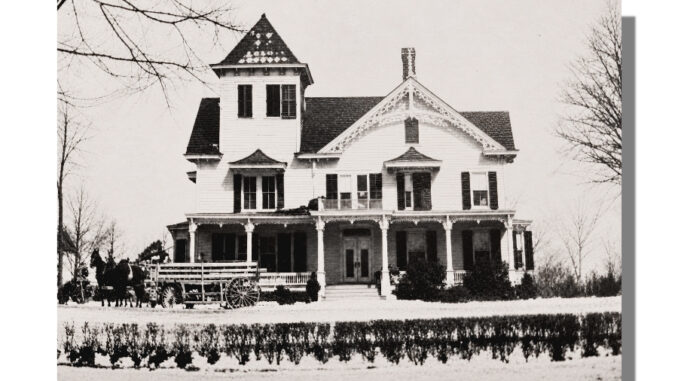
On this journey we take a left and follow Jefferson to its end at Kinderkamack Road. In front of us is the beautiful manor house of the Hopper family’s farm. The Hoppers are one of the founding families in this section, and their lands include hundreds of acres. Here we make a right, our last turn for a while. Kinderkamack, one of Bergen County’s oldest roads, will take us a very long way.
Kinderkamack Road has been in existence since before 1710. Its name is derived from an old Lenape word whose exact meaning has been lost to time (possibly “place of ceremonial dance”). The first European settlers adopted the word Kinderkamack to describe this section on the southeastern side of the Pascack Valley and the road that travels through it. In coming years this area will be renamed—first to Etna and then to Emerson—but the name of the road will stay.
The stagecoach wheels rumble across a small wooden bridge as we cross the Musquapsink Brook. One day this will be a busy commercial area at the border between Westwood and Emerson. For now, there is farmland as far as the eye can see.
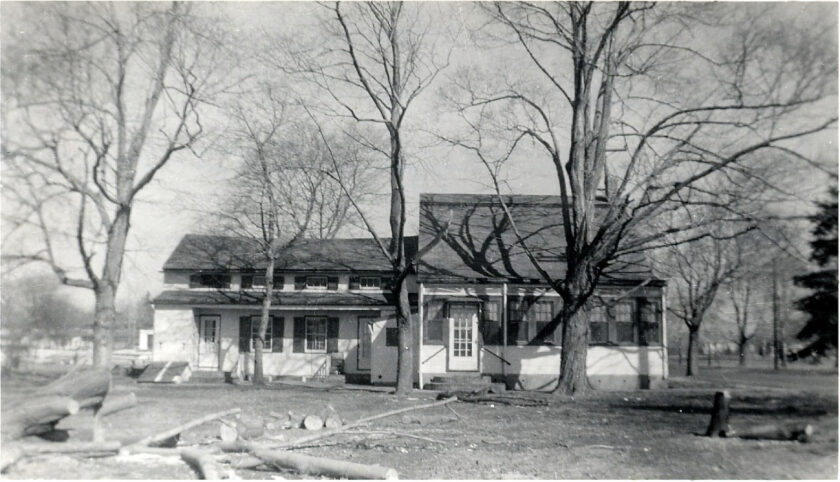
On the right we come to the massive Van Wagoner property, purchased by the family in 1802 and passed down through generations. John D. Van Wagoner owns the homestead now, and the farmer lives there with his wife, Jane, and teenage son, David. (A century in the future, in the late 1950s, this homestead will be demolished. The land will become a shopping center with a supermarket. This is where Stop & Shop and Marshall’s are located.)
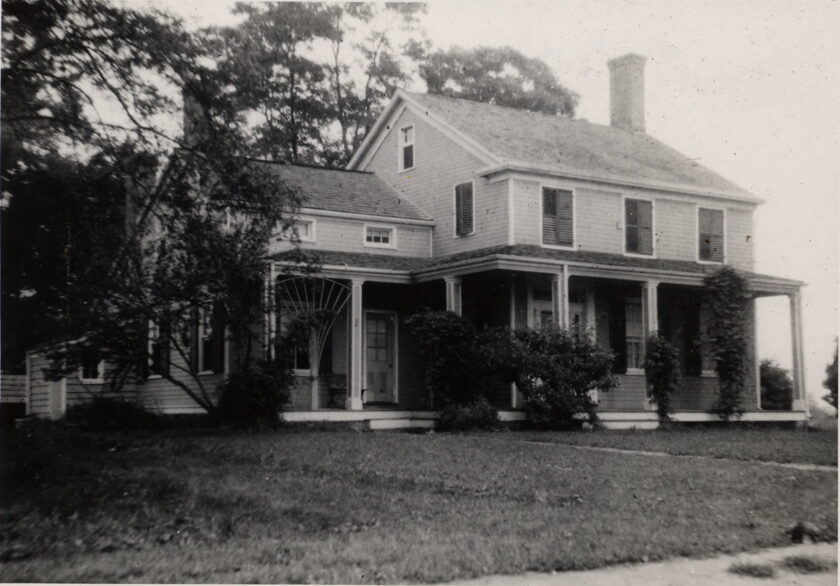
The Van Wagoners’ neighbor to the south is John D. Smith. He married Christiana Westervelt, and now they are raising their five children here. If only walls could talk! This land was owned by the Hopper family as far back as the Revolutionary War, and back then it included nearly 100 acres. Part of it was confiscated after the war because of Garret A. Hopper’s loyalist leanings. John Degraw bought the estate in 1840, and he passed it to farmer Smith, his grandson. (This one will stand the test of time—the Hopper homestead is still standing at 308 Kinderkamack Road.)
Below the Smith farm we enter Ackerman land, though the road that will one day bear their name does not yet appear on any map. Here are the farms of Henry Z. Ackerman, Albert Ackerman and Henry D. Ackerman, followed by those of David Demarest and John Lozier farther south. What would these modest farmers say if they knew their names would appear on street signs in the next millennium?
As we leave the Pascack Valley, we see the Hackensack River on our left, and at New Milford we cross it on a narrow wooden bridge. Heading east, the stagecoach follows the wagon lanes to Closter. The beautiful, breezy countryside is dotted with homesteads, some dating back to the American Revolution.
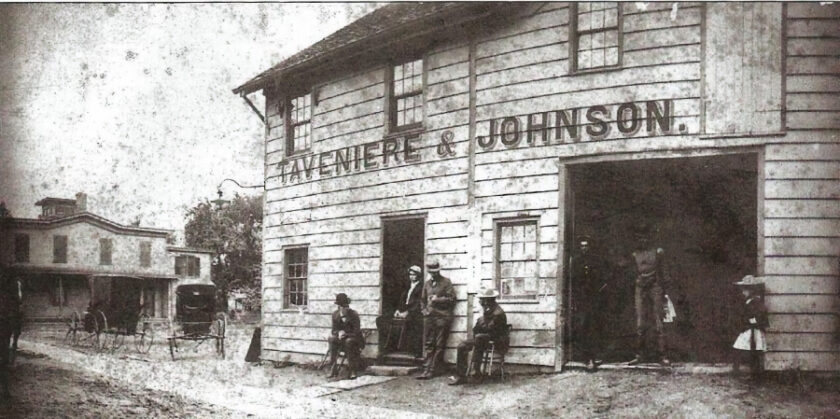
The passengers step off the stagecoach in Closter to wait for the train on the Northern Railroad of New Jersey. The stage rolls on through the village to Taveniere and Johnson’s livery stable, where the team will be put out and wait for the incoming train from New York.
Some of the stage passengers will go down to Englewood to attend a better school than the Pascack Valley provides. In fact, several local families send their boys to Englewood, and even New York City, where the educational opportunities greatly exceed those of our one-room schools. (It is customary for the scholars to go down on the Monday morning stagecoach, remain in town during the week, and return home Friday evening.)
At 5 o’clock in the afternoon, the stage will reach Park Ridge again. At this time in history, it is possible for a person to make a round trip to and from New York City in a single day. Still, Pascack Valley farmers seldom make the journey. They have no need to. For most, all that life requires can be found at home.