
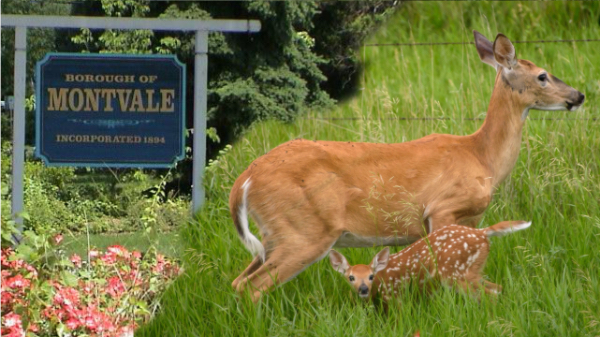
PASCACK VALLEY—Deer populations in Hillsdale and Montvale remain well above the roughly 10 deer per square mile considered healthy for local ecosystems, according to recent winter drone surveys.
The surveys were conducted by a research team from Raritan Valley Community College’s Center for Environmental Studies, led by deer researcher Jay Kelly.
At the March 17 meeting of the Hillsdale governing body, Administrator Mike Ghassali — who also is Montvale’s Mayor — said a mid-January drone survey found 122 deer within a 3.24-square-mile study area in Hillsdale, or about 38 deer per square mile.
A similar drone survey conducted Feb. 19 in Montvale counted 341 deer across a 4.4-square-mile area, or about 78 deer per square mile.
Although the two towns recorded different densities, both exceed what wildlife researchers describe as the biological carrying capacity needed to maintain healthy forest ecosystems.
In the Montvale report, Kelly wrote that environmental impacts on forests and vegetation typically begin to appear when deer populations exceed about eight to 10 deer per square mile.
“Additional indirect or ‘cascade’ effects on food webs and other ecosystem properties, including wildlife habitat, tree regeneration, soil conditions, and understory plant communities, tend to occur at densities above 15 to 20 per square mile,” Kelly wrote.
For biodiversity and ecosystem health, researchers generally consider fewer than 10 deer per square mile the optimal target.
Ghassali said the Hillsdale drone study results will be posted on the borough website. Montvale has already posted its survey report online.
He also reminded residents that feeding deer is illegal and can make wildlife dependent on human-provided food. Many municipalities prohibit feeding wildlife except for birds.
Officials in both towns said any meaningful effort to reduce deer populations would likely require cooperation among multiple Pascack Valley municipalities.
“Whatever we do here won’t help unless it’s a regional approach,” Ghassali said.
Hillsdale Mayor Michael Sheinfield, who attended a regional deer management discussion among Pascack Valley mayors in 2025, said options such as sterilization are extremely costly, often ranging from $300 to $1,000 or more per doe.
Hunting, he added, is largely impractical in many Bergen County communities because of housing density and the limited availability of open land for controlled hunts.
“There’s no easy solution to what you can do,” Sheinfield said, adding that in suburban areas the deer’s most common predator “has four wheels and an engine.”
He said municipal leaders will likely need to reach a regional consensus on possible deer management strategies.
Councilman Christopher Camp asked about deer movement ranges and was told suburban deer often remain within relatively small home ranges, sometimes only about one-tenth of a mile.
The Montvale report noted that the drone survey captured deer populations at the lowest point in the annual cycle and that numbers are likely higher during spring and summer months.
“This data suggests that intensification of deer management is needed at Hillsdale and Montvale to improve ecosystem integrity in the future,” the report states.