
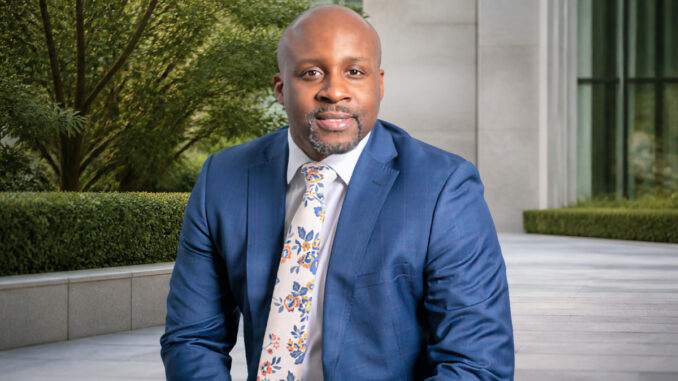
ENGLEWOOD, N.J.—Aaron Daly’s journey to becoming CEO of Bergen Family Center began far from the executive offices where he now leads an organization dedicated to strengthening families and communities.
Growing up on the Lower East Side of New York City in NYCHA housing, Daly experienced financial hardship and the loss of his father at a young age. Raised primarily by a single mother and later by his grandparents, he learned early lessons about resilience, humility, and the importance of helping others.
A life-changing opportunity came through the Fresh Air Fund’s Friendly Towns Program, which introduced Daly to a host family in Maine. That experience eventually led him to attend Lewiston High School and Bridgton Academy, where he was exposed to new expectations, new opportunities, and a different vision for what his future could become.
Today, Daly leads Bergen Family Center with a philosophy shaped by those experiences — the belief that one opportunity, one mentor, or one supportive environment can change the direction of a person’s life.
Hillary Viders: You grew up with financial, social, and emotional challenges. When did you realize that you could change your life around?
Aaron Daly: I did not truly realize that I could change the trajectory of my life until I went away to school in Maine. Growing up in the Lower East Side of New York City, very few people around me were talking about college, long-term goals, or the idea that there were different paths available to us. Survival was often the focus.
When I arrived in Maine, I was suddenly surrounded by people where college was not viewed as something extraordinary — it was simply the expectation. People talked openly about their future, opportunities, leadership, and what they wanted to become. That environment completely shifted my perspective. For the first time, I realized that a different life was possible.
More importantly, I began to understand that education was the great equalizer. It gave people access, confidence, opportunity, and choices. It was not just about academics — it was about exposure. Exposure to different people, different expectations, and different possibilities.
That experience changed me because it forced me to stop viewing my circumstances as permanent. I realized that where you start in life does not have to determine where you finish. Sometimes, all it takes is one opportunity, one mentor, or one environment that allows you to see beyond what you have known your entire life.
That realization continues to shape how I lead today. It is why I care so deeply about creating opportunities for children, teens, and families who may not yet see what is possible for themselves. Because I know firsthand how transformational exposure, support, and belief can be.
HV: What led to your acceptance in a school in Maine?
AD: My parents did not want me to spend my summers in New York City, so they enrolled me in the Fresh Air Fund’s Friendly Towns Program, which gave inner-city children the opportunity to spend summers with host families throughout New England.
I was paired with a host family in Lewiston, Maine, and that experience changed the trajectory of my life. What initially started as summer visits eventually turned into something much bigger. Over time, I built a close relationship with my host family, and ultimately, I moved to Maine and attended Lewiston High School before later attending Bridgton Academy for a postgraduate year.
Growing up in New York City, I had never really been exposed to a different way of life or a different set of expectations. Maine gave me that exposure. It introduced me to environments where education, college, leadership, and long-term opportunity were openly discussed and encouraged.
Looking back, the Fresh Air Fund program did far more than provide a summer experience — it gave me access to people, environments, and opportunities that fundamentally changed how I viewed my future and what I believed was possible for my life.
HV: Coming from the Lower East Side in NYC, was it particularly difficult to adapt to the environment in Maine?
AD: Absolutely. In many ways, it felt like I had landed in a completely different world. I went from growing up in the Lower East Side of New York City — surrounded by noise, struggle, public housing, and constant movement — to being in Maine, where life felt much slower, quieter, and very different culturally and socially.
At first, adapting was difficult. I looked different, talked differently, dressed differently, and came from a completely different life experience than many of the people around me. There were moments when I felt out of place and moments when I questioned whether I truly belonged there. But at the same time, those experiences forced me to grow.
What helped me adjust was realizing that while the environments were different, people still responded to authenticity, hard work, respect, and resilience. Sports also helped bridge many gaps for me. Basketball gave me confidence, structure, and a way to connect with people regardless of background.
More importantly, Maine exposed me to a level of stability and opportunity that I had not experienced growing up. I was suddenly around people who were planning for college, talking about careers, and thinking long-term about their future. That was transformational for me because it expanded what I believed was possible in my own life.
I often say that Maine did not change who I was — it expanded my perspective. I never lost the toughness, grit, or street smarts that came from growing up in New York City. If anything, those experiences became strengths. But Maine helped me understand that I could take what I came from and combine it with education, opportunity, and leadership to build a different future for myself and, eventually, help others do the same.
HV: Who were the mentors who helped you throughout your life?
AD: I have found mentorship in many different places throughout my life and career. Some mentors were people I knew personally, while others influenced me simply through their example, leadership, and commitment to serving others.
Professionally, I have always deeply admired Geoffrey Canada, the founder and former CEO of Harlem Children’s Zone. A great deal of my professional foundation and leadership philosophy was shaped by watching his commitment to children, families, and entire communities. What stood out to me was not just the programs themselves, but the belief that communities and young people deserved comprehensive support, high expectations, and real investment.
Later in my career, I found mentorship from a close friend of mine, Anne, who dedicated her life to supporting children and struggling families. What impacted me most about her was her consistency, compassion, and willingness to meet people where they were without judgment.
Throughout my life, there have been many men and women — teachers, coaches, supervisors, friends, and community leaders — who took a genuine interest in me, both personally and professionally. For someone growing up the way I did, having adults who believed in me, challenged me, guided me, and opened doors for me made an enormous difference.
And while I probably have not admitted this to her enough, my greatest mentor has been my wife. She has been responsible for some of the greatest growth in me as a person, a professional, a husband, and a father. She has challenged me to become more patient, more thoughtful, more self-aware, and more grounded.
HV: Why is mentorship so important?
AD: Mentorship is important because sometimes people need someone to help them see possibilities in themselves that they cannot yet see on their own.
Growing up, there were people who invested in me, challenged me, guided me, and exposed me to opportunities that changed the trajectory of my life.
A mentor can raise your expectations, provide direction, hold you accountable, and remind you that your circumstances do not define your future. For many young people, especially those facing adversity, having just one person who genuinely believes in them can make all the difference.
I believe mentorship is ultimately about responsibility. None of us get where we are alone, and we all have an obligation to help open doors for the next generation.
HV: What led you to Bergen Family Center?
AD: I began my career at Harlem Children’s Zone, where I served as a Program Manager and later as an Assistant Director of Programs. That experience provided the foundation for much of my leadership philosophy and commitment to supporting children, families, and underserved communities.
Throughout my career, I have also held leadership positions with organizations including Ascend Public Charter Schools, Brooklyn Laboratory Charter Schools, and NYC Early Learning Company. Across each of those organizations, my work has focused on education, youth development, family support, operational leadership, and community impact.
In addition to my professional roles, I have remained actively involved in nonprofit and community leadership through board service. I serve on the board of Go-Tutors, and I currently serve as President of the Board for Bridgton Academy.
HV: What are the most successful programs at Bergen Family Center?
AD: We have many impactful programs at Bergen Family Center, but I would say our early learning programs are among our most successful, both in terms of community impact and the number of children and families we serve.
Through the Leonard Johnson Early Learning Center and our HIPPY home instruction program, we support children and parents during some of the most important developmental years of a child’s life.
What makes these programs so special is the people. We have an incredibly committed team of teachers, home instructors, and early childhood professionals who genuinely care about the growth and success of the children and families they serve.
Early learning is critically important because those early years help shape the academic, social, and emotional foundation for a child’s future.
HV: What changes would you like to see at Bergen Family Center in the coming years?
AD: My role is not about changing Bergen Family Center. Bergen Family Center has been doing incredible work and serving this community for over a century. My role is to enhance that work, build upon that strong foundation, and ensure that everything we do is deeply focused on impact and measurable outcomes for the people we serve.
One of the things we are working on as an organization is creating greater clarity around the purpose, goals, and outcomes of each program. Every department is now focusing on specific goals and Key Performance Indicators tied to real community impact — not just the number of people we serve, but how lives are improved because of our work.
We want to ensure that Bergen Family Center remains a trusted and enduring fixture in the communities we serve for generations to come.
At the core of everything we do is our mission: Bergen Family Center strengthens communities by empowering individuals and families at every age and stage of life with compassionate care, education, and opportunities to build stable lives.
For me, leadership is about making sure those words are not just something written on paper, but something people genuinely feel and experience through the work we do every single day.