
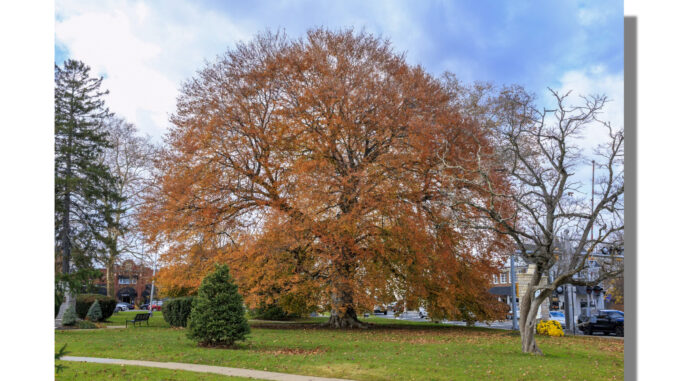
WESTWOOD — A copper beech that may have taken root before the nation itself was born — our storied “Kissing Tree” in Veterans Park, where young love has flowered for generations and residents recently packed in for Valentine’s Day photos under its canopy — has been diagnosed with an incurable fungal disease that experts say cannot be treated and will likely require removal for public safety, borough officials said this month.
Mayor Ray Arroyo, in a reflective essay that ran in our pages last week, breaking the news, wrote that the tree is “estimated to be somewhere between 168 years old … and 252 years old,” and that it is now “dying” from a fungus that hollows out the trunk and destabilizes its base.
In a separate, detailed factual summary provided by Shade Tree Advisory Committee chair Dan Zambrano, the borough’s advisers traced the diagnosis to a June inspection and documented the risk-assessment steps now underway.
How the diagnosis emerged
According to Zambrano, during a routine inspection in June 2025, an arborist with Bartlett Tree Experts noticed a small mushroom-like growth (a conk). A sample sent to the Bartlett Tree Research Lab identified brittle cinder fungus (Kretzschmaria deusta), a pathogen that affects the lower trunk and roots and has no remedial treatments.
The lab warned that while many mature trees contain some decay, this fungus is difficult to assess and trees “may fail unexpectedly.”
Bartlett later re-inspected the tree and observed a larger active area of the fungus, prompting the borough to consult Dr. Jason Grabosky at Rutgers (Ecology, Evolution and Natural Resources), Zambrano said.
Rutgers consult: “not a call to abandon all hope,” but prepare for risk
The borough contacted Dr. Jason Grabosky at Rutgers (Ecology, Evolution and Natural Resources), Zambrano said. Grabosky advised that older beech trees are under pressure from multiple stressors — including beech bark disease, beech leaf disease, and compacted soils — and that the Kissing Tree has dealt with some of these over the years.
Zambrano said Rutgers’ message was twofold: there is no cutting-edge cure to offer, but the situation is “not a call to abandon all hope,” and the next steps depend on risk assessment and the location/extent of impacted tissue.
What arborists found on site in November
Zambrano said the borough’s contracted arborist, Liz Stewart, had evaluated the tree on March 21, 2024 as part of Westwood’s successful application to the NJDEP Big and Heritage Tree program. After the fungus expanded, the borough asked Rutgers to consult with Stewart and Bartlett on best handling.
Stewart then met on site with Bartlett and borough representatives this Nov. 14.
Her findings, as relayed by Zambrano, included:
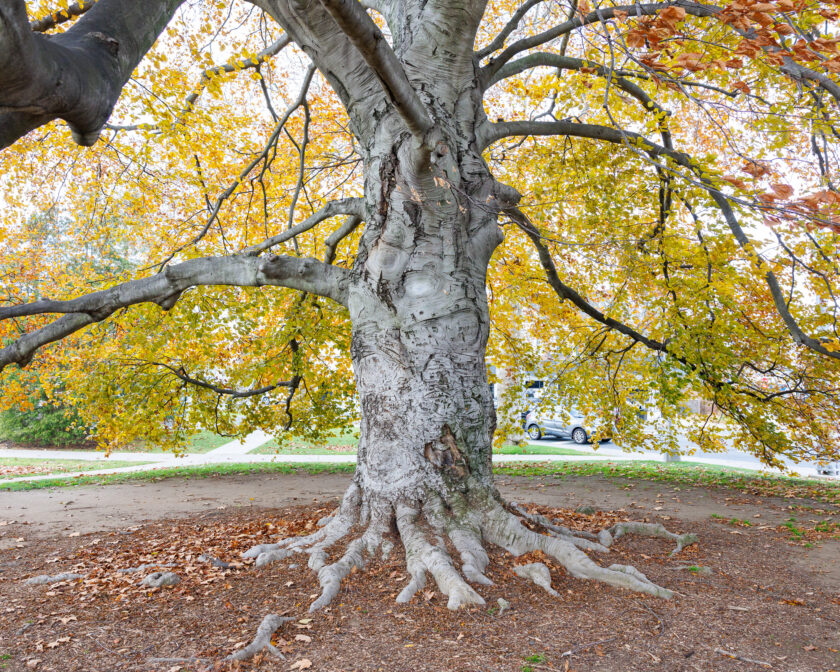
- A visible root flare with no visible concerning defects in the above-ground roots; probing around the perimeter root zone with a metal rod did not reveal notable concerns in that cursory test.
- An active decay area measuring about 10 inches wide by 14 inches tall.
- Hollow sounds when tapping a much larger section — approximately 38 inches wide by 60 inches tall from the base on the east side — symptoms not present in Stewart’s March 2024 evaluation.
- A canopy (crown) still in good overall health, with viable buds and beech nuts found at the base.
- A strong live crown–trunk ratio estimated at about 75%, credited to long-term care and proper pruning — yet with the structural integrity now in question.
Current risk rating: “moderate,” but consequences could be severe
The primary concern, Stewart concluded, is complete tree failure from the base due to weakened wood.
Using the ISA risk framework, the report rated the overall risk within a one-year time frame as MODERATE, with likelihood classified as SOMEWHAT LIKELY (Zambrano said that corresponds to a 2 on a 1–5 scale). While moderate is not the highest category, the borough is also weighing what officials describe as severe consequences if such a large tree falls in a public park setting.
Stewart noted that once brittle cinder fungus produces visible fruiting bodies, “significant decay has already occurred” in that area. She also indicated the decline may play out over several years and can be monitored — but the risk rating is expected to increase over time as decay progresses.
What the borough is considering: monitoring, possible interim supports, eventual removal
Zambrano said that after the report was received, the borough held a closed-session meeting on Dec. 2, 2025 with the mayor, council, Stewart and Bartlett’s arborist to review the findings and inform Zambrano.
Afterward, Zambrano recommended the tree be monitored monthly while the governing body decides next steps. Arroyo then attended the Shade Tree Advisory Committee meeting on Dec. 9 to brief the committee; Zambrano called it “one of our saddest meetings.”
In his essay, Arroyo wrote that experts advise the tree must eventually be removed to prevent harm should it fall in a storm — and that the borough arborist will continue monitoring structural stability.
In the meantime, Zambrano said the borough asked for a quote on interim structural supports — supports and propping with steel rods and braces — as a potential bridge measure depending on the tree’s condition as 2026 unfolds. Stewart recommended regular six-month monitoring if the tree is protected.
A big complication: what can be planted afterward
One issue shaping the long-range discussion is what happens after the tree comes down.
Zambrano said officials learned brittle cinder fungus may remain present in the soil unless infected stump and roots are removed, meaning a replacement tree may not be able to be planted in the same spot unless the borough explores other options.
The call for help: treatments, memorial ideas, and community participation
Even as the borough prepares a “safety forward” process, the Shade Tree Advisory Committee is actively asking for input.
Arroyo wrote in last week’s essay that the committee hopes someone reading may know of new or experimental treatments for brittle cinder fungus and will reach out.
At the same time, Zambrano said the committee is looking for ideas to educate, celebrate, and memorialize the Kissing Tree’s legacy — including how to commemorate the site if replanting there is not feasible.
Planned and ongoing efforts mentioned by Arroyo and Zambrano include collecting beech-nut seedlings for replanting elsewhere in town, exploring whether usable wood could become keepsakes if safe, and organizing community events to honor the tree while it still stands.
A painful contrast to January’s celebration
The moment lands hard in Westwood partly because the Kissing Tree was just celebrated on the public stage.
Jan. 19, Pascack Press reported the Kissing Tree’s addition to the NJDEP Big and Heritage Tree map — the first tree in the borough to receive that placement — and highlighted how the tree’s romance-and-history lore helped support the Heritage designation. We also detailed the tree’s standout measurements (including a 15-foot-2-inch circumference at 4.5 feet and an average crown spread of 94 feet) and credited volunteer research and advocacy that helped elevate the tree’s profile.
Now, the borough’s focus has shifted from celebration to stewardship in the face of loss: how to keep residents safe, how to tell the story honestly, and how to honor what the tree has meant to Westwood.