
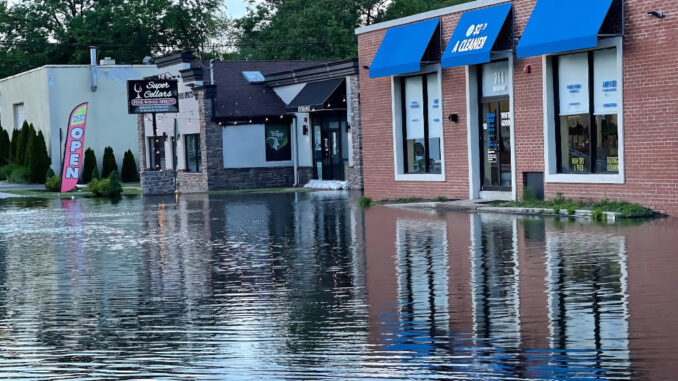
PASCACK VALLEY AREA, N.J.—Hillsdale Mayor Michael Sheinfield told residents Aug. 11 that a proposed $8.9 million flood mitigation and brook improvement project — aimed at reducing flooding and improving water quality in four Pascack Valley towns — will seek federal and state funding and has a strong advocate in one area congressman.
The four-town brook improvement and cleanup project stems from four separate drone studies conducted on brooks that traverse the towns. Most of the drone studies occurred in 2023 or 2024.
The studies, conducted by Boswell Engineering, identified hundreds of waterway obstructions, including downed trees, eroded streambanks, sediment shoals and potential contamination sources such as exposed sanitary manholes, in the Pascack and Musquapsink brooks and the Hackensack River.
According to the “Pascack and Musquapsink Brooks Flood Mitigation Project,” presented to New Jersey Fifth District Congressman Josh Gottheimer in early August, the four-town project outlines proposed work to improve waterways.
The 11-page proposal estimates a one-year timeline and breaks down costs as follows: about 15% for removing downed trees; 30% for removing brook obstructions; 30% for reconstructing eroded banks; 20% for engineering, permitting and design; and about 5% to 7% for shoreline restoration, including native plants.
Projected costs by town are: Westwood, $2,947,593; Washington Township, $2,195,625; Hillsdale, $1,954,100; and River Vale, $320,958. The proposal includes a 20% fuel adjustment totaling $1,483,655, bringing the estimated project cost to $8,901,943.
Sheinfield said Gottheimer told officials he would raise the project as a potential appropriations committee funding request for 2027 and advocate for funding.
Mayors from Westwood, Township of Washington, River Vale, and Hillsdale met with Gottheimer to press for possible funding.
Montvale mayor and Hillsdale administrator Michael Ghassali also attended the meeting.
Region requires ‘implementation funding’
In a letter to Gottheimer, Pascack Valley Mayors Association President Mark Bromberg, River Vale’s mayor, said recent storms highlighted the need for action.
“Recent storm events and resultant flooding, including those over the July Fourth weekend and subsequent July storms, underscored the system’s vulnerability when additional debris enters already constrained waterways,” Bromberg wrote. “At this stage, the need is clear and the need is now: the region requires implementation funding, not additional studies.”
Because the project involves four towns, Gottheimer said the effort had a “good opportunity” to receive funding because it is a regional project, Ghassali said.
Ghassali also noted that up to $100 million may be available through state grants for flood mitigation and brook improvements.
“We have a project that we’d like to get done,” Sheinfield said. “We came up with a plan to address the flooding situation, which was dredging and removing debris, and general cleanup.”
“No guarantees in any way, shape or form, but he’s [Gottheimer] supportive of it and understands the issue,” Sheinfield said.
See also “500-plus downed trees block waterways in four towns; state, federal funds sought for removal,” by Michael Olohan, Aug. 2, 2025, at thepressgroup.net.
The mayor credited previous work and study by Westwood Mayor Ray Arroyo, including the regional Forecast-Informed Reservoir Operations (FIRO) study being conducted by Stevens Institute of Technology. State Sen. Holly Schepisi (R-39) secured a $200,000 state grant in 2023 to fund the FIRO study.
Sheinfield said Veolia officials had not cooperated with FIRO researchers in releasing requested reservoir operations data.
“They’re not interested in sharing it [the data], and they’re under no obligation to,” Sheinfield said.
He told Pascack Press that FIRO researchers hoped to meet with Veolia officials soon to discuss the project.
Sheinfield noted that flooding has affected commerce in Hillsdale and Westwood, particularly in retail areas. He said the proposed project would include waterway dredging, removal of downed trees and leaves, culvert protection and restoration of eroded streambanks.
Most of the water flows through Pascack Brook, Musquapsink Brook and tributaries connecting the waterways as it travels between Woodcliff Lake Reservoir and Oradell Reservoir, which supply drinking water to hundreds of thousands of Bergen and Passaic county residents.
Resident questions Veolia role
Resident James Mallet of Lake Street questioned Veolia’s control over water levels in its reservoirs, particularly Woodcliff Lake Reservoir, which he said may contribute to flooding when water is released during heavy storms.
Sheinfield said that under state law, Veolia is required to prioritize water conservation and supplying customers, not downstream flooding impacts from releases.
He said water releases sometimes occur during periods of heavy rain, when flooding is already occurring. He added that a state of emergency or governor involvement is sometimes required before releases are permitted during storms.
Mallet questioned whether legislation could provide better control of reservoir levels and releases in cooperation with local towns.
He said Veolia was guilty of “old school thinking” by not using Doppler radar, FIRO modeling and reservoir levels to guide decisions and help mitigate downstream flooding.
We asked Veolia North America spokesperson Debra Vial about council and public comments criticizing Veolia.
Vial said several statements made during the Aug. 11 council meeting were inaccurate.
“On the FIRO Study, Veolia is participating in the Stevens University FIRO study and we are meeting with the study’s leader in September,” Vial said. “We’re currently finalizing disclosure agreements with the university.”
She said some information, particularly details involving infrastructure security, must remain confidential.
Regarding reservoir management, Vial said the New Jersey Department of Environmental Protection, not Veolia, establishes storm and reservoir policies.
“As the council is aware, the New Jersey Department of Environmental Protection — not Veolia — sets the policy about storms and reservoirs,” she said.
Vial said the state does not lower reservoirs preemptively because protecting the drinking water supply remains the priority.
Hillsdale Councilman John Ruocco, immediate past mayor of the borough, said he believed a possible solution to controlling reservoir levels was “more administrative” and something NJDEP might coordinate with the governor.
However, Sheinfield said he had doubts.
Ruocco said advances in weather forecasting, including Doppler radar projections, should provide Veolia more flexibility in managing reservoir levels.
“We have the ability to project and that should allow Veolia to have some comfort that they can release the water 24 hours in advance of a projected storm,” Ruocco said.
“As the storm gets closer and closer, they can either increase or decrease the flow of the water,” he said.
Ruocco concluded, “This is Veolia’s problem. It’s our problem because we get the water. But it’s Veolia’s — they’re in the catbird’s seat to fix the problem.”