
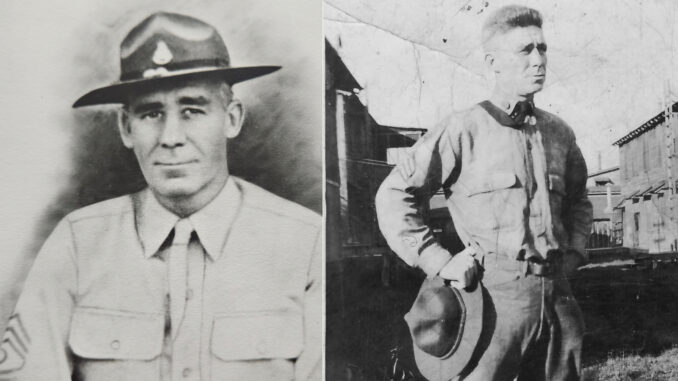
PARK RIDGE, N.J.—More than eight decades after First Sgt. Daniel Proctor died as a prisoner of war in the Philippines, his service and sacrifice came home to his family.
On Aug. 11, American Legion Post 153 presented Mayor Keith Misciagna with a plaque honoring his great-uncle for his “service, sacrifice and enduring legacy” in World War II — months after the U.S. military officially accounted for Proctor’s remains and ended a mystery the family had carried for generations.
“This would make my grandmother so happy,” Misciagna said. Visibly moved, he added, “We’re very proud of him, obviously.”
Proctor, a career soldier with the U.S. Army’s 31st Infantry Regiment, had risen by 1941 to the rank of first sergeant, the senior enlisted leader of an Army
company, and was reportedly only months from retirement when war overtook the Philippines.
He was captured after American forces on the Bataan Peninsula surrendered to Japanese forces in April 1942. He survived the infamous Bataan Death March and was later imprisoned at the Cabanatuan POW camp, where he died Nov. 4, 1942, at age 48.
The Defense POW/MIA Accounting Agency announced that Proctor was identified Nov. 26, 2025, through laboratory analysis and supporting evidence after decades among unidentified remains.
For Misciagna, the story begins with his grandmother, Maggie (Proctor) Misciagna, Proctor’s younger sister.
Misciagna said his grandmother lived to 92 and never stopped talking about her older brother Danny — with both pride and sadness — especially around Memorial Day and Veterans Day.
“She never forgot her brother,” he said.
Family stories kept Proctor’s memory alive. A sister who worked in the film industry once believed she spotted Proctor in newsreel footage of the Bataan Death March. According to family lore, the film was stopped so she could examine the images and determine whether the soldier was truly her missing brother.
Decades later, the Army was still searching.
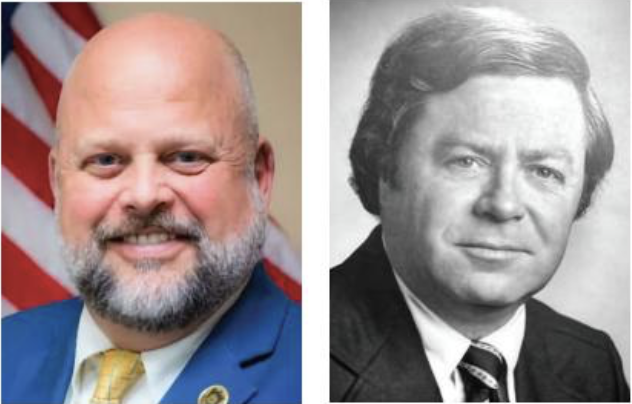
Misciagna said military officials contacted his father, Thomas “Thom” Misciagna, who served as Hillsdale mayor from 1976 to 1980, several years ago — close to the end of his life — seeking a DNA sample as part of the effort to identify Proctor.
The request surprised the family. After so many years, the search for Proctor was still active.
Misciagna said he had periodically searched his great-uncle’s name online over the years, always in vain. Then, last November, he found the announcement that Proctor had finally been accounted for.
“I never thought they would find him,” Misciagna said.
He called his aunt, now approaching 90, to share the news. She cried.
Thomas Misciagna died March 24, 2024, at age 88, not knowing his DNA sample would prove to be the corroborating evidence.
Even with the identification, Misciagna said the family is still piecing together the story of the man behind the military record.
They know Proctor was a longtime Army soldier — “a lifer,” Misciagna said — and believe his military tenure may have included service in the Great War.
Family photographs showing Proctor in a World War I-era uniform have raised questions about whether he also served in that terrible conflict, though that has not yet been confirmed.
Misciagna said the family is also learning more about Proctor’s personal life. He was married to Sarah, an Army nurse from Texas, and had a daughter, though many details about that branch of the family remain unknown. “Things were different then,” Misciagna said, noting that even some family connections had become complicated over the years.
According to the Defense POW/MIA Accounting Agency, Proctor’s remains had originally been buried with other prisoners in Common Grave 707 at the Cabanatuan Camp Cemetery. After the war, unidentified remains from that grave were relocated to the Manila American Cemetery and Memorial. Years later, as part of DPAA’s Cabanatuan Project, those remains were reexamined and one set was identified as Proctor’s through scientific analysis and supporting evidence.
American Legion Post 153 Commander Ryan O’Hara said Proctor’s story reflects the sacrifices made by thousands of American and Filipino troops who endured months of hardship following Japan’s attack on the Philippines after Pearl Harbor.
The 31st Infantry Regiment fought under increasingly desperate conditions before the fall of Bataan, facing shortages of ammunition, medicine and supplies. Its motto was Pro Patria — “for the homeland.”
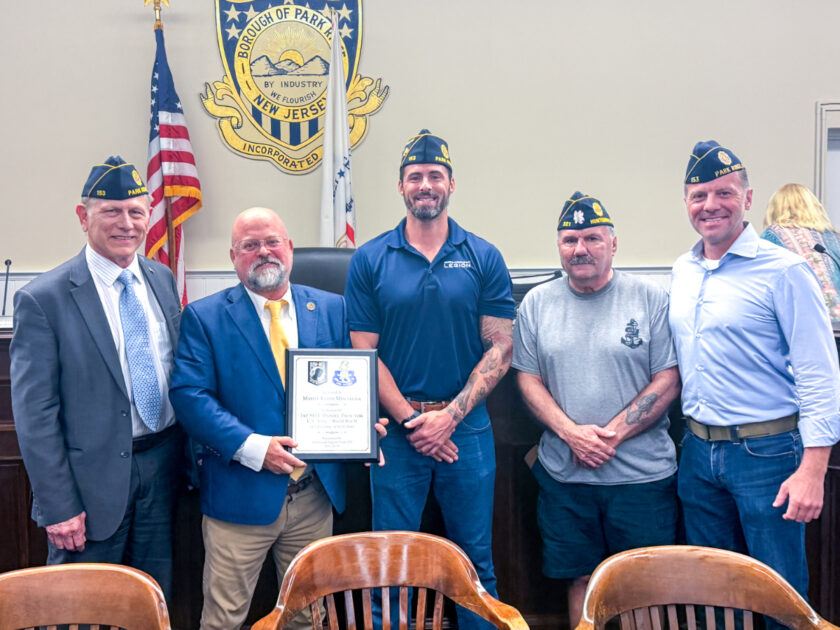
Councilman Robert Metzdorf said Proctor “served the country with honor and courage during World War II.”
“He died a POW, far from home, under circumstances of unimaginable hardship and suffering,” Metzdorf said. “For decades, his final resting place remained unknown.”
At the Aug. 11 presentation, Misciagna said he was moved by the Legion’s recognition and had not expected to be the focus of the ceremony. He said he did not serve in the military himself, but grew up understanding what Proctor’s loss meant to his family. He honors service and sacrifice in speeches on patriotic holidays.
Misciagna shared his story during this year’s Memorial Day ceremonies, speaking about not only the fallen servicemembers but also the families who carried their losses.
“The point is don’t forget these guys,” Misciagna told Pascack Press on Aug. 18. “Our family didn’t. The Army didn’t.” He thanked American Legion Post 153 for its touching and unexpected tribute.
He noted many other families would be grateful to have word on their MIA relatives’ remains, that these servicemembers may rest in peace, with closure and all due honors.
“Some 80 years later, they found him,” Misciagna said. “I never in a million years thought they would. It was really an amazing thing.”
— With staff writer John Snyder