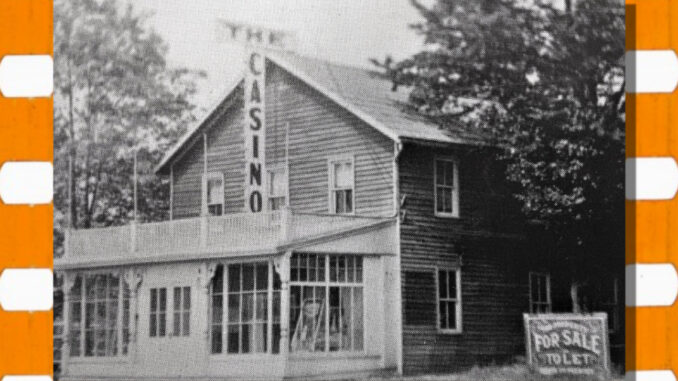
WESTWOOD—If you lived in the Pascack Valley 90 years ago, and you had 15 cents to spare, Westwood’s Casino theater was one option for a Saturday evening out. This early movie house operated in the 1910s at the corner of Broadway and Irvington Street.
For more than two decades a modern bank building has stood at this location, but at one time a large wooden structure was there. At the turn of the 20th century it was Van Buskirk’s carriage and harness shop, a place where local residents bought their modes of transport in the days of horse-drawn travel.
Around 1913, it became a theater that Van Buskirk named The Casino—although it had nothing to do with gambling. This was a social center where people came to see silent movies, theatrical performances, and political speeches.
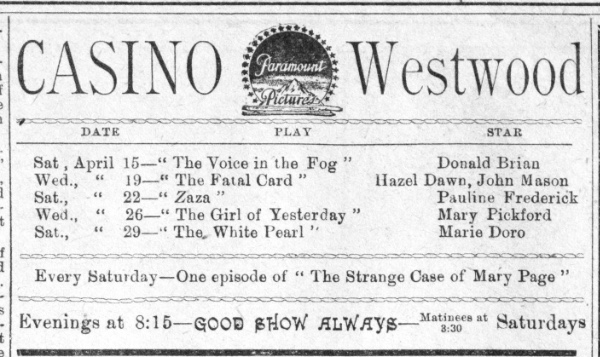
“At the Westwood Casino—a Big Special Show every Wednesday and Saturday evening,” reads a 1913 advertisement from the Westwood Chronicle. “High class Vaudeville, illustrated songs, and five reels of pictures every Saturday evening. Admission 10 cents and 15 cents.”
Imagine what an exciting prospect this was for the people in the small country town of Westwood. It would be difficult for a young person of the 21st century to imagine, as they have grown up in an era of on-demand entertainment, when streaming services allow them to watch just about anything at any time.
The Casino existed in an era before home radios, and certainly before television. Theatergoers viewed those silent films—which they sometimes called photo plays—with wonder. The silver screen was a groundbreaking, magical, and yet affordable form of entertainment.
Van Buskirk’s Casino proved to be incredibly popular. It showed silent films by the Famous Players Film Studio, distributed by Paramount Pictures. Founded in New York City in 1912, Famous Players sought to legitimize motion pictures as a respected form of entertainment by casting well-known stage actors in movie roles. Many early silent films were adaptations of theatrical productions.
The Casino’s stage also became the backdrop for political speeches and rallies. On days other than Wednesdays and Saturdays, the space was available to rent. On April 19, 1915, a group of Westwood women campaigning for voting rights held their first meeting there.
“A meeting for the promotion of woman suffrage, the first ever held in Westwood, was held at the Casino on Monday evening, with an attendance of about 60,” wrote the Westwood Chronicle. “The Westwood group of ladies most interested in the movement occupied front seats. This being one of the first meetings held in the campaign to secure votes for women next October, it will probably be followed by others.”
The Hillsdale-Westwood Equal Suffrage League formed that spring in response to a historic vote on the horizon. The question of women’s suffrage—the right for women to vote in elections—was put to New Jersey voters on Oct. 19, 1915 in the form of a referendum.
It was voted down: 133,282 ballots were cast in favor of votes for women and 184,390 were cast against. Of course, only men were allowed to vote. It wasn’t until the 19th Amendment was ratified in 1920 that women in the state would gain the right to select their representatives.
Between 1915 and 1920, the local suffragists held their smaller monthly meetings in members’ homes, and several larger rallies at The Casino.
The Casino stayed open for less than 10 years. The spot became a Ford dealership, followed by a Plymouth dealership, and then a furniture store. In the 1990s it was a medical supply store and auto body shop. The bank at this corner was constructed in 2006.