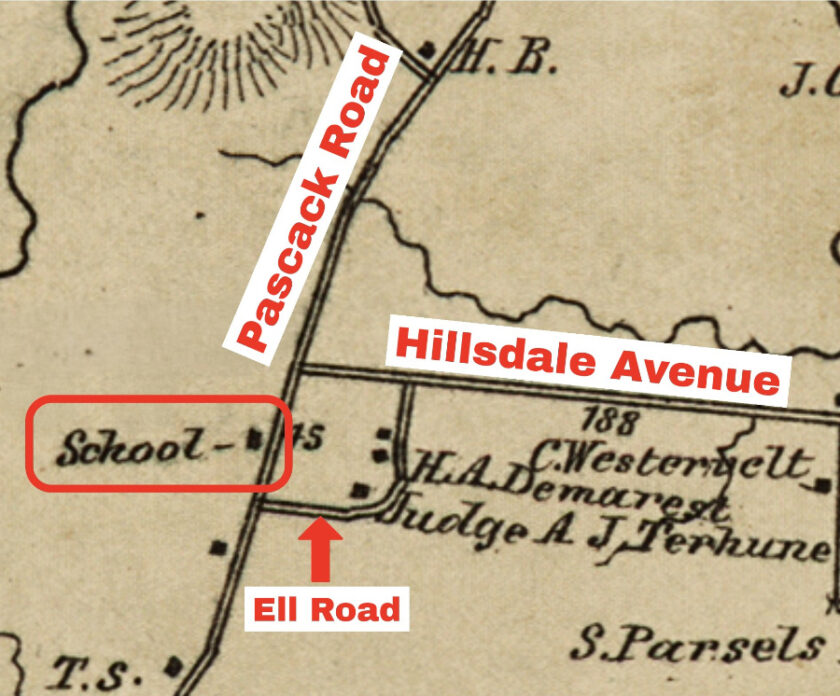
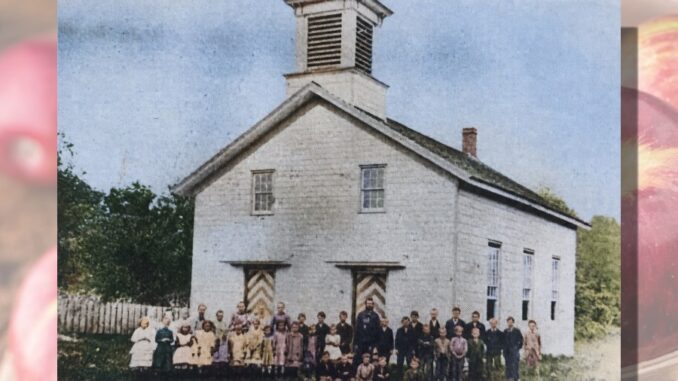
HILLSDALE, N.J.—The first school in Hillsdale, built in 1856, sat on Pascack Road near its intersection with Hillsdale Avenue.
During the first year, enrollment at the school was 36 students. In one large room, children from kindergarten through the eighth grade were educated under the guidance of a single teacher. In the photograph featured here, likely snapped during the early 1880s, teacher William W. Banta stands among his pupils.
This place was also known as the District 22 schoolhouse. Hillsdale, like the rest of the Pascack Valley, was still part of Washington Township back then. The large township was divided into school districts, each with its one-room schoolhouse that the farmers’ children could attend for a basic grammar school education. There was no high school in the area. Those who wanted a more advanced education—which was very few—might travel to a larger city and board with a family during the week, returning home for weekends.
In a little rural village like Hillsdale, townspeople wore many hats. In the late 1880s and into the 1890s, Banta ran a general store next to the Hillsdale railroad station (where the Wendy’s parking lot is now). He was also the postmaster and township clerk when Hillsdale incorporated in 1898. He must have also done some farming, because we have this from the Bergen County Democrat, July 27, 1883: “Teacher Banta is strengthening his muscle haying and harvesting.” A warning for any ne’er-do-wells who would make trouble in his classroom.
When this schoolhouse was built, Hillsdale looked much different. The railroad had not yet come, and so the section that we now think of as “downtown” did not exist. Pascack Road, as one of the oldest roads through the area, and a stagecoach route, was the main thoroughfare and a natural choice for a school location.
After the railroad line opened in 1870, things changed. The section around the Hillsdale station became the center of action and the nucleus for new suburban development. By the 1890s, Hillsdale’s growing population was complaining about the distance to the school on Pascack Road (these were days when the children walked in all weather), as well as the state of the building.
“The present school building, aside from being far from the center of population, has been notoriously inadequate to meet its purpose for years,” the Hackensack Republican reported on Jan. 21, 1892.
Statistics showed that fewer parents were sending their children to the school due to overcrowding. Out of a population of 154 school-age children in Hillsdale, average daily attendance was 74 students. The school had a seating capacity for 60.
By that time, Banta had left the school. The district had recruited Miss Sallie A. Buckman, age 22, a recent graduate of the Trenton Normal School (now The College of New Jersey). Like her predecessor, she was the only teacher for all the children at Hillsdale. The newspaper reported that she “had her hands more than full.” Sounds like it.
When Hillsdale broke away from Washington Township in 1898 to become a separate municipality, it took its name from this school as well as the train station. In that same year, Hillsdale built a new and bigger school on Magnolia Avenue, now the location of George G. White Middle School. Banta returned to the district to serve as its principal.
The old school on Pascack Road was no longer needed, and the building was moved 300 yards south and turned into a private residence. The home was demolished in 1998.